Philippines wins historic first award at Venice Architecture Biennale
Curators Khadka and Furunes take a Special Mention for “Structures of Mutual Support,” the Philippines’ first-ever Venice Biennale award.
The Russian Federation Pavilion answers the curatorial question of “How will we live together?” with “openness” — an almost empty architecture opening up a myriad of possibilities, with a gamer room as a testing ground for world building and a book of voices. It posits institutions as “living objects.”
The United Arab Emirates (UAE) Pavilion responds to the question by meditating on the tension between urbanization and nature in the UAE’s sabkha or salt flats via photographs posted side by side with vats filled with environment-friendly cement structure made from recycled industrial-waste brine. It narrates a wetland dream of tackling climate change by turning waste into something, well, wondrous.
For these architectural responses, the two countries were given awards recently at the 2021 Venice Architecture Biennale. The Russian Federation Pavilion curated by Ippolito Pestellini Laparelli with the exhibition “Open!” received a Special Mention citation, while the Golden Lion for best pavilion was awarded to the United Arab Emirates Pavilion curated by Wael Al Awar and Kenichi Teramoto.
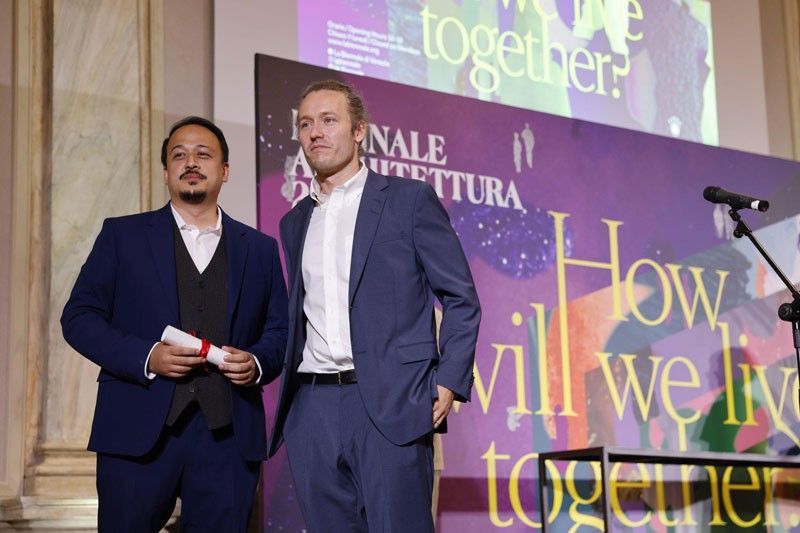
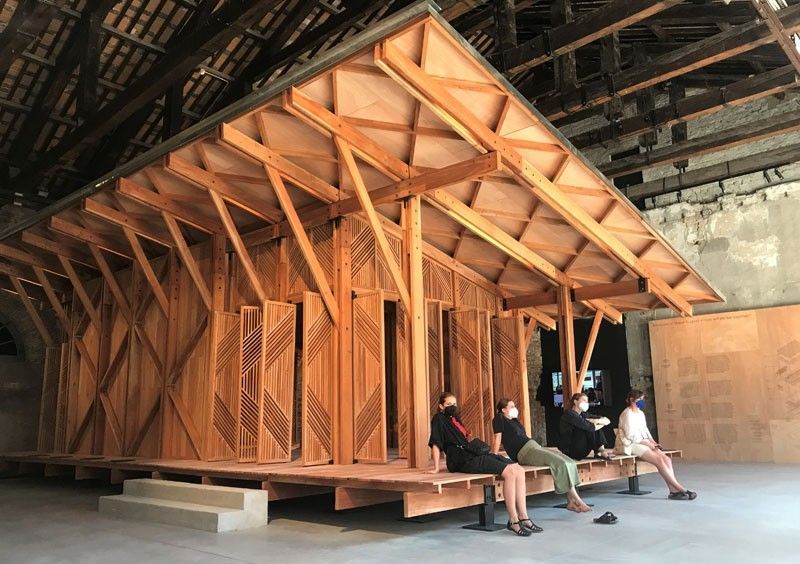
Now, here’s some good news for our country: the Philippines received its first-ever award from the prestigious global platform Venice Biennale for the exhibition “Structures of Mutual Support” curated by Framework Collaborative — a collab between GK Enchanted Farm community and architects Sudarshan V. Khadka Jr. and Alexander Eriksson Furunes. This is the first time a national pavilion from Southeast Asia has won an award at the Venice Architecture Biennale. The awards were presented on Aug. 30 at Ca’ Giustinian, the headquarters of La Biennale di Venezia.
The country’s national participation in the Venice Biennale is a collaborative undertaking of the National Commission for Culture and the Arts (NCCA), the Department of Foreign Affairs (DFA), and the Office of Deputy Speaker and Congresswoman Loren Legarda.
Out of 60 national participations, the Philippines was given the Special Mention for National Participation at the 17th International Architecture Exhibition conferred by La Biennale di Venezia for its “exemplary community project that creates a rich archive and experience of collaborative construction practices.”
Khadka and Furunes explain how the award recognizes the value of being able to rely on each other through mutual support. “Our focus was to do the project with the community well and also to share what we have learned with as many people as possible. We did not really enter the biennale with the aim of winning an award but we are so grateful and humbled that our collective effort has been recognized.”
For the two, architecture is not a static object but a process, a progression. The exhibition “Structures of Mutual Support” explores how the principles of mutual support would shape architecture by involving people directly in determining values embedded in it. To prepare for the biennale (before all pandemic and lockdown hell broke loose), Khadka and Furunes facilitated a series of workshops for volunteer residents from the Gawad Kalinga (GK) Enchanted Farm in Angat, Bulacan, to derive a common language in building something they all want: a library within the village. The library was built on-site in Bulacan, disassembled in a basketball court, shipped to Italy, and meticulously reconstructed in Venice. It was not just the object that travelled on the ship, but the idea of Pinoy bayanihan (as well as Norwegian dugnad and other similar traits around the world), the aspirations of a community made that trip as well.
Khadka and Furunes say, “The question of how we live together is also a question of how we build together. The particularities of different traditions of mutual support make each tradition a unique expression of cultural understandings of solidarity and mutual work. The commonalities, across cultures and nations, offer the opportunity to share these traditions with each other. These are ways of living together that already exist and we are trying to learn from them to integrate them back into the way we can build together.”
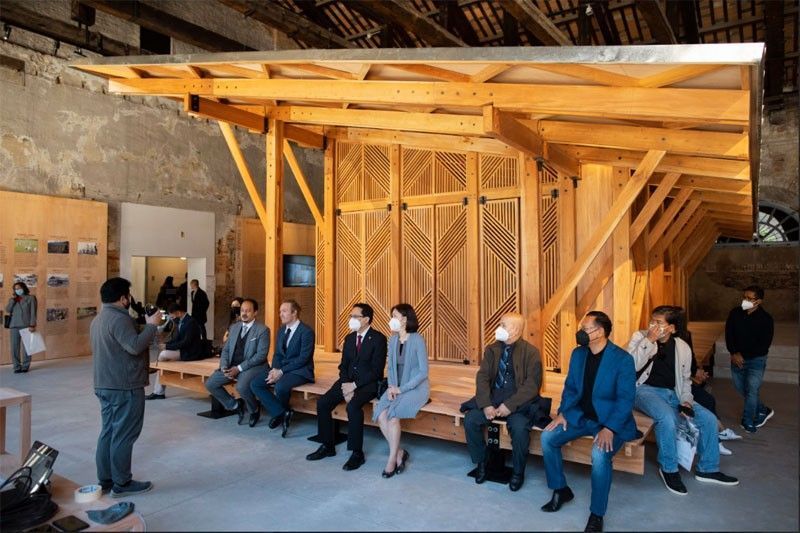
And this philosophy has earned the nod of an international jury chaired by Kazuyo Sejima and composed of Sandra Barclay (Peru), Lamia Joreige (Lebanon), Lesley Lokko (Ghana-Scotland) and Luca Molinari (Italy).
According to Khadka and Furunes, “The jury was quite diverse and they all saw it from different lenses. Their recognition is valuable because it means that our contribution is relevant to architectural discourse.”
This is the first time that the Philippines has won an award from the Venice Biennale, having first participated in 1964 at the Venice Art Biennale. After a 51-year hiatus, the country rejoined the Venice Art Biennale in 2015 and the Venice Architecture Biennale the following year. Through the NCCA and its partner agencies, the country has continuously organized the Philippines’ National Participation in the most prestigious of all art and architecture platforms.
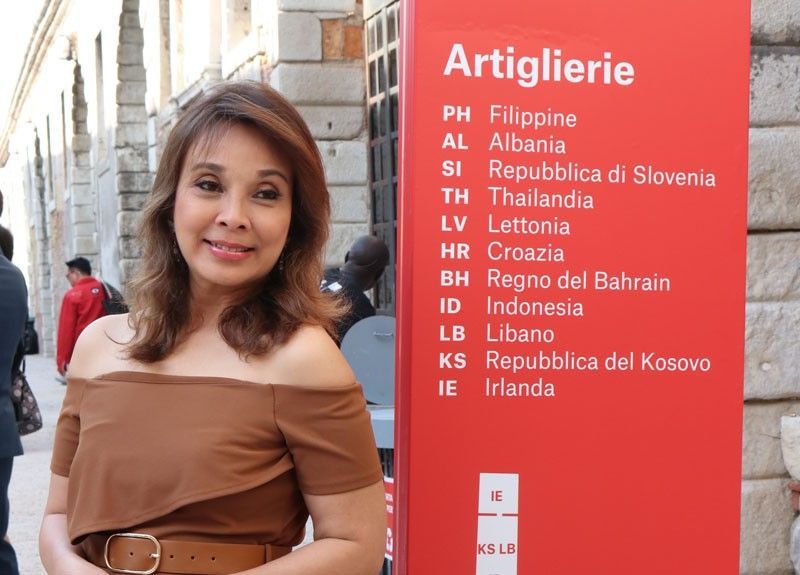
The main proponent of the Philippines’ participation, Congresswoman Loren Legarda, shares, “It is with utmost pride that we received the news, given the circumstance of the pandemic and the many hurdles we had to overcome.”
What is essential for Legarda is how our country can convey to the world that existing practices of our nation such as bayanihan, as well as our strong sense of community, can be solutions to the world’s most pressing issues.
“Structures of Mutual Support” is on view in Venice until Nov. 21 at the Venice Biennale Arsenale. The library, which was shipped to Italy before the lockdowns last year, will revert to the GK Enchanted Farm community in Angat, Bulacan, where it will be rebuilt and used by the community permanently.
Legarda concludes, “It is with anticipation we wait for the exhibition to return to the Philippines, back to the GK Enchanted Farm community, where it will no longer be a piece for the exhibition but a built object — if not an evolving organism — its value to be defined by community and enjoyed by its members.”
Imagine this: a library from Bulacan that voyaged to Venice and then back to Bulacan again, a structure that has accumulated miles and memories (and a prestigious award, to boot), a structure dreamed into existence by a community, a structure that is almost Borgesian with its tranquil magic. Its pages upon pages of possibilities are infinite.
A version of this story first appeared in The Philippine Star, 2021.


