Island of souls
Mark Justiniani and curator Tessa Maria Guazon on Island Weather, the glass-and-steel archipelago built for the 58th Venice Art Biennale.
Mark Justiniani remembers meeting an astrophysicist in one of Mark’s painting exhibits in the US. The artist had a hundred questions for the scientist. Something like how does one start when you want to understand more about physics.
The astrophysicist answered, “I always start… at lunchtime.” But what he told Justiniani set the latter on the path of reading up on ideas such as how space tells matter how to move and how matter tells space how to curve. From painting expressionist artworks, Mark recalibrated his practice into mounting conceptual works preoccupied with — according to curator Tessa Maria Guazon — “the configurations of space, the nature of vision and their ever-vacillating relationship with time.” Justiniani takes viewers on a journey through caverns, chambers, tunnels, vestibules, infinite rooms, as well as miles upon miles of aisles, mirrors, prisms and objects caught in that “middle ground between light and shadow.”
The curator shares a story with magic-realist leanings. She says her mother grew up in a seaside town. And the young Tessa heard a particularly García Márquez-like story about an approaching cyclone. “(There was) a threatening black funnel of water the wind had gathered. People went back to their houses and began taking pairs of scissors. They proceeded to make cutting motions in the air, hoping to unravel the cyclone, which must have looked like gnarled wisps of hair or a giant spool of thread from the shore that has taken over the skies.”
You could just imagine how mind-blowing Mark Justiniani’s installation would be at the Artiglierie of the Arsenale in Venice for the 58th Venice Art Biennale, with Tessa Maria Guazon as its curator. It would be like a master illusionist putting up makeshift magic, toying with physics and optics — plus color commentary provided by someone bearing fantastic prose about young women with angel wings. What a dream team.
The exhibition is billed as “Island Weather,” which is not just about the atmosphere per se, but the state of things. When things drastically change, Pinoys tend to say “weather-weather lang ’yan.”
This is the fifth time the Philippines is participating in the most prestigious art event in the world since its re-entry in 2015, including participations in both the Venice Art and Architecture platforms. The country’s national participation is a collaborative undertaking of the National Commission for Culture and the Arts (NCCA), the Department of Foreign Affairs (DFA), and the Office of Senator Loren Legarda.
NCCA chairman Virgilio S. Almario, National Artist and commissioner of the Philippine Pavilion, says, “The effort and dedication of our country to return to Venice year after year, despite challenges, is a testament to our belief in the power of art to bring people together, draw them closer and create a community. It is our confidence in art to transform individuals and atmosphere to a place of wonder, and contemplation.”
Senator Loren Legarda, the visionary and principal advocate for the country’s participation, explains, “Through our participation in the Venice Biennale, we hope to highlight the richness and vitality of art traditions that have ancient roots in Philippine society. But more importantly, we hope to make our pavilion a venue to foster patriotism and nationalism.”
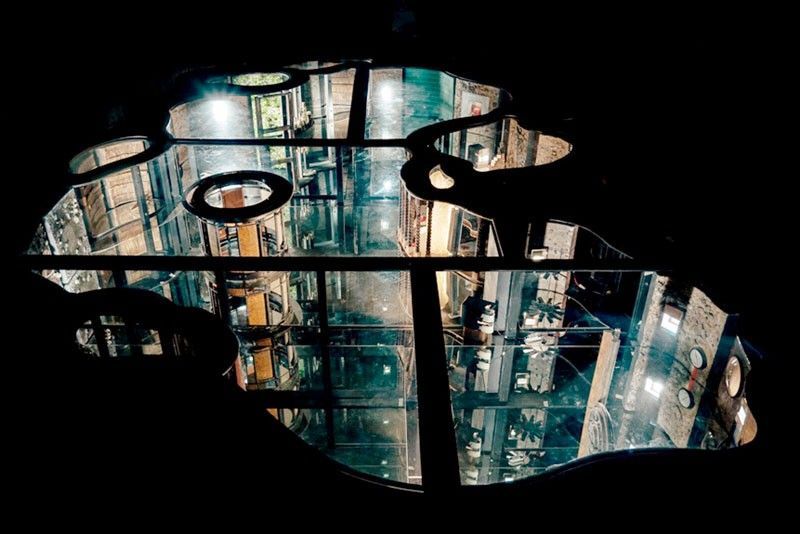
Justiniani’s installation piece for “Island Weather” is titled “Arkipelago” (from his “Infinity” series) and comprises three geomorphic forms of glass and steel, with turret-like constructions and complementary elements hanging from the ceiling and bound to walls. These constructed tableaux reference the archipelago inside the fully darkened pavilion space. Ramps and bridges connect the islands.
Visitors are encouraged to step on the glass surfaces to view the assemblage of objects inside. Images and forms will be multiplied manifold with the viewing experience encompassing latitude and depth: a dive beneath and a sweeping reach. As visitors experience the work, they also encounter the regions of the Philippine archipelago in a fleeting, fantastic, even ghostly manner. They would see lighthouses, sugar mills, seats of power, and even Siquijor, which is cloaked in mystery.
“It’s about a nation dealing with its past and its present,” he says.
The installation’s metal frame and glass took two months to construct in the Philippines. The frame was measured and customized to fill the country’s space at the Arsenale where the country has exhibited since 2017.
Justiniani explains, “This is the biggest installation I’ve done, and perhaps one of the most difficult yet.” He said, “The challenge is that we’re dealing with heavy load but at the same time its components, especially the mirror and glass, are fragile.”
Guazon says that Justiniani’s pieces impart joy of illusion as viewers enter another world. The immersive experience of the work is a major aspect of the installation and brings into high contrast the experience of the real world and the world that art offers.
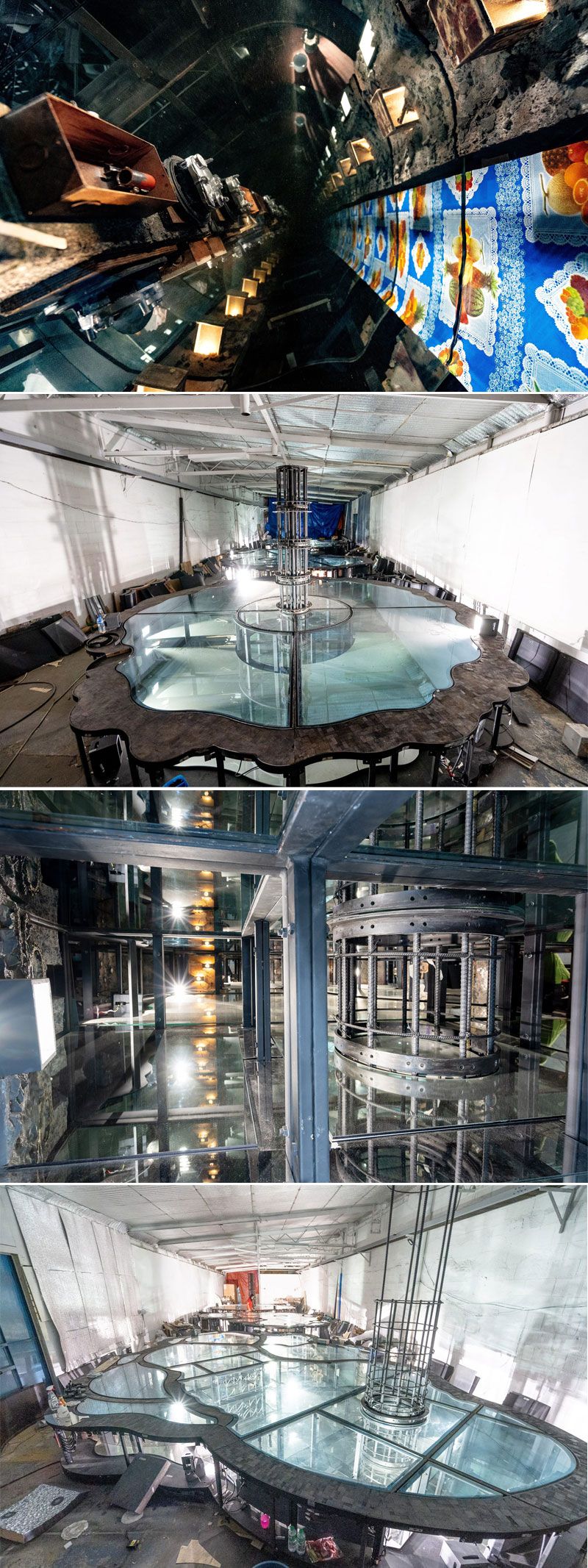
The Philippine Pavilion curator explains that there is the momentary immersion in another world, which offers a sense of dislocation or fascination. “These are immersive environments. In the ‘Infinity’ series, the works are often in darkened rooms. You enter a different space. While the objects may appear familiar — grass, toys or anything from everyday life — they will appear multiplied. It’s a trick on the eye, a play on spatial experience.” When visitors walk upon the glass platforms in Justiniani’s installation at the Venice Biennale, they will get the feeling they are walking over the very depths of something mysterious. Guazon says, “In truth, it is just a shallow space. That’s where the magic of the artistic practice lies — we are brought to a different place. (‘Arkipelago’) invites viewers to burrow in.” Something archeological and psychological.
She concludes, “I think the work is also about the sense of wonder, which is part of the power of art. ‘Arkipelago’ will transport us to a wonderful place. Linking this idea of the fantastic, the mythical with everyday life. How does art transport us from this wondrous place to the challenges of contemporary living? How do we now activate the wonder that underlies the spectacular? Stories and images have the power to do that.”
Mark Justiniani has been using mirrors as a medium as early as decades ago. We wonder what that day was like when he placed mirrors beside words and entire archipelagos of infinities popped out.
The Philippine Pavilion in Venice will open to the public on May 11 until Nov. 24.
A version of this story first appeared in The Philippine Star, 2019.


