A flood of words, water & wonder at the closing ceremony of the Venice Art Biennale
As the Biennale closes, Mark Justiniani’s mirrored “Island Weather” seems to ripple out of the Philippine Pavilion into the flooding lagoon city.
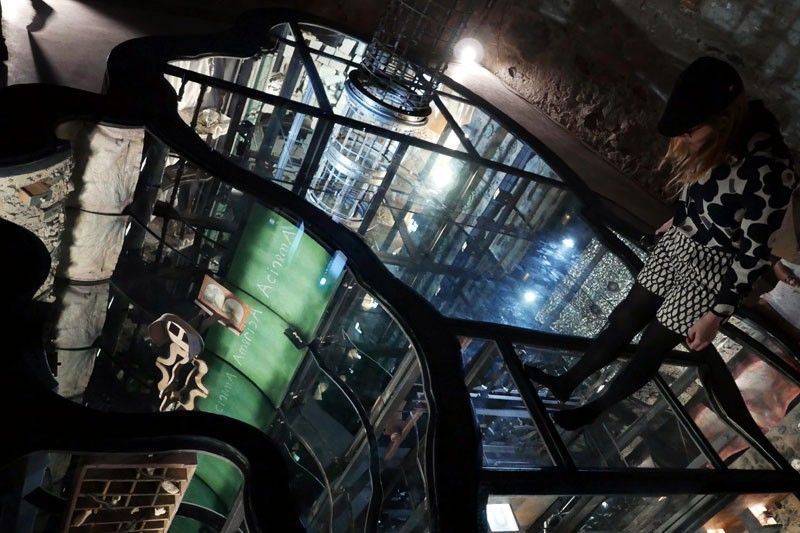
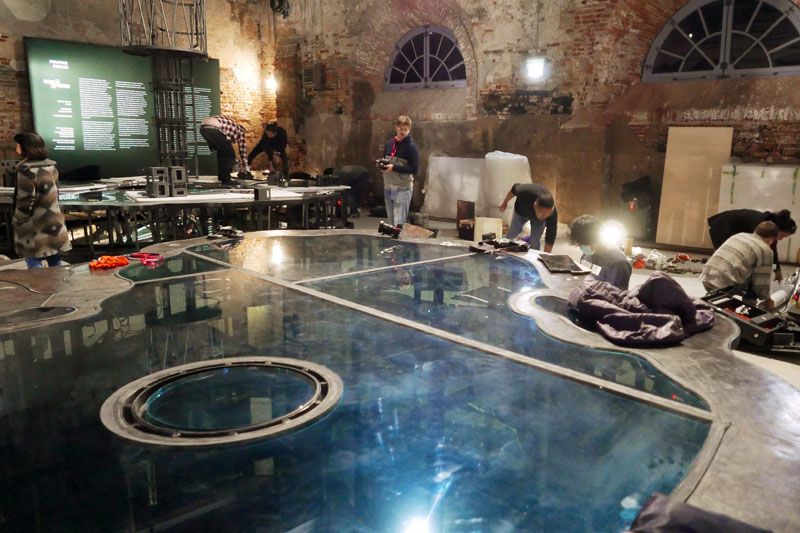
It was fortuitous, for sure. Was it prophetic? Well, that’s going a bit too biblical. Unexpected, hell yeah. But the thing is, we really can’t dismiss how the exhibition at the Philippine Pavilion in the 58th Venice International Art Biennale (curated by Tessa Maria Guazon) “resonated” outward onto the piazzas, chiese and stradas of the lagoon city itself. “Island Weather” is composed of three immersive installations by Mark Justiniani consisting of metal, glass, mirrors and an assortment of objects that depict the Philippines’ past and present conditions. It represents an archeological burrowing into our metaphysical makeup. It touches on the political, sociological and cultural climates, as well as how fortunes can change overnight. The term “weather” is not dealt with in the atmospheric sense, but as a metaphor for how a nation is built upon the ebbing and flowing of events, the tempestuous tides of history. But the exhibition about the stormy psyche of Filipinos, the shifting winds, and the temper of the times would somehow take on a whole other dimension.
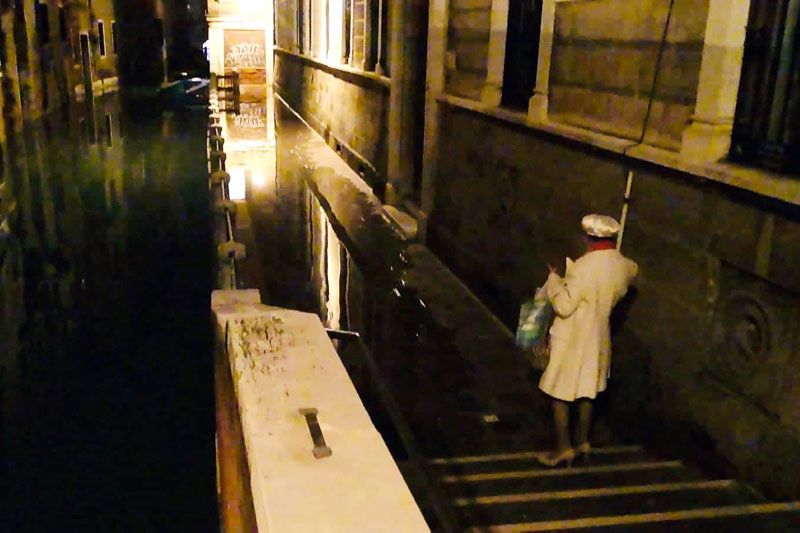
A week before the finissage or closing ceremony of the biennale, Venice (a city perched on thousands of wooden piles driven into mud) was submerged in acqua alta (exceptionally high tide), hitting the 1.87-meter (74-inch) mark — its worst in 50 years. Dark waters turned St. Mark’s Square with its catacombs, crypts and cathedrals into a setting for a disaster movie. Priceless artworks and mosaics were soaked in sewage. “Venice is on its knees,” tweeted the Venetian mayor. In a news conference, Mayor Luigi Brugnaro said, “I saw people in tears because they lost everything.” A man was reportedly struck by lightning while operating an electric water pump. Another man was found dead in his home. Gondolas and ferryboats were overturned on the Grand Canal. People in galoshes negotiated bridges of sighing planks. Seagulls swarmed. Even rats drowned in alleyways.
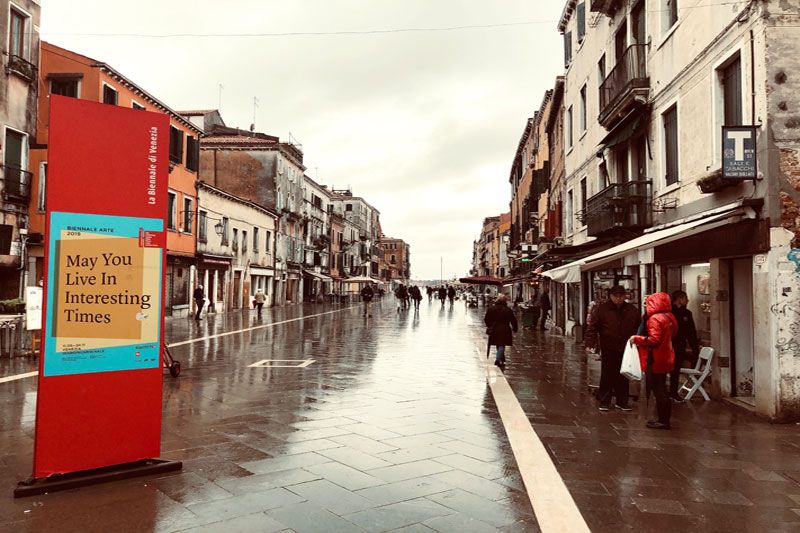
When photographer Avee Navarro Tan and I got there, the combination of heavy rains and high tide had us trapped in our rented apartment for hours: all the restaurants, shops and convenience stores within our area in Corte Nova were closed, with the city seemingly abandoned except for a few brave souls in knee-high fisherman’s boots or lost tourists staring at a disappearing city. We couldn’t go anywhere until the flood subsided. Our visit to the Artiglierie of the Arsenale (where the Philippine contingent holds court) and Giardini (with a few more pavilions left unvisited) would have to wait. Art had taken a backseat to something scary and calamitous. A portent of what’s to come, perhaps? We hope not.
In an age where climate change is reconfiguring the lives of everyone (even the lives of climate change deniers), does art still matter? Will our passion to create and express ourselves still — pardon the pun — hold water?
Curator Tessa Maria Guazon answers: “Art matters in situations of crisis because of its numerous potentials — the manner it fuels the imagination and the depth of hope it offers. The creative responses to crises through art strengthen our resolve that we can turn dire situations around.”
Guazon did not imagine how “Island Weather” would coincide with the rise in water levels in Venice, but she says artworks are constantly transformed in the process of their making and presentation. “I think this makes our encounters with art exciting: no singular meaning adheres to a work or to an element of the work, meanings are constructed in context. Works need not always be explained to viewers. I find that tiresome! Part of the challenge and excitement of our encounters with contemporary art is discovery and knowing that viewers construct meanings of artworks around their own experience.”
In our own country, where art is treated either as the runt of the litter (politics and economics have always occupied the main gallery) or as a cash cow (auction houses, art fairs and the lords of commerce run the show), and where each of us has to contend with the same problems (calamities, dead-end jobs, inflation, criminality, traffic woes, water shortage, lack of dependable public transport system — lack of everything, basically), why does art still matter and why must we participate at all in a biennale in faraway Europe?
Virgilio “Rio Alma” Almario, chairman of the National Commission for Culture and the Arts (NCCA), explains, “Naipaglaban na ito ni (then Senator) Loren Legarda. She said, ‘We need to expose our artists to global events and happenings, so that — through their exposure — they will gain a wider perspective in creating something. Kailangan natin ang ganitong gawain. The biennale is a great opportunity for Filipino artists.” And we not only excel in the visual arts, he asserts. Almario talks lengthily about our intangible culture. “Napakayaman natin dito. We have 131 indigenous communities, each of them has its own language. The Philippines has the most folk epics in the world — we have recorded around 50.”
The chairman’s dream is the creation of an extensive library-database dealing with our intangible cultural heritage (ICH) for the preservation of our oral traditions and expressions (language is of supreme importance), as well as social practices, rituals and performing arts. It all begins with a five-year research plan — highlighting tribes that go largely unnoticed, focusing on the gaps.
Deputy Speaker of the House of Representatives Loren Legarda says she hopes we Filipinos experience a cultural renaissance.
“I want Filipinos to appreciate our history, heritage and culture through the arts. We want the country to use this as a platform to engage the international community on the cultural level. Filipinos are talented and we have a rich history that has produced a very layered storyline for our country. Our successful return to the Venice Biennale in 2015 after half a century of absence is proof that we always had our place in the world, we never lost it; we only have to be brave enough to seize it, but modest enough to continue to improve and grow with the global art community.”
How does the country’s participation in the biennale benefit the Filipino community in Venice?
Darwin Gutierrez, former head of the La Communita Filippina di Venezia and who has worked for 14 years at Palazzo Abadessa (one of the most charming hotels in Venice), says, “Ang ganda ng effect sa aming mga Pinoys dito. ‘Yung mga Italians nagsasabi sa amin, ‘You are not only good in the service industry, but you are very good in terms of art. They congratulate us. Sabi nila, ‘How come you’ve only joined the biennale just a few years back (in 2015)?’” Gutierrez, together with the sons and daughters of overseas Filipino workers in Venice, assist the hardworking peeps of the NCCA such as Riya Brigino Lopez (head of the Philippine Arts in the Venice Biennale [PAVB] coordinating committee) and PAVB manager Mapee Singson for both the art and architecture biennales — so, this is an all-year round labor of love for Gutierrez and the Pinoy youth in Venice.
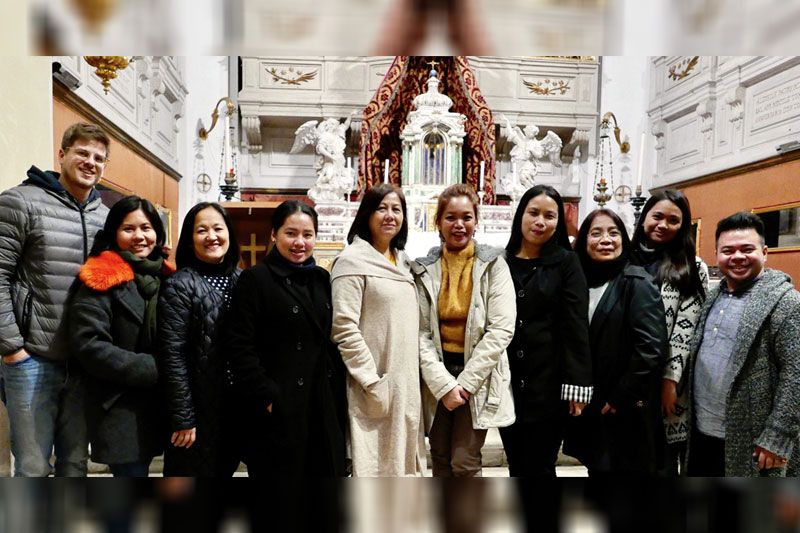
Another guy who gives his full support to the Philippine contingent in Venice is Philippine Ambassador to Italy Domingo Nolasco.
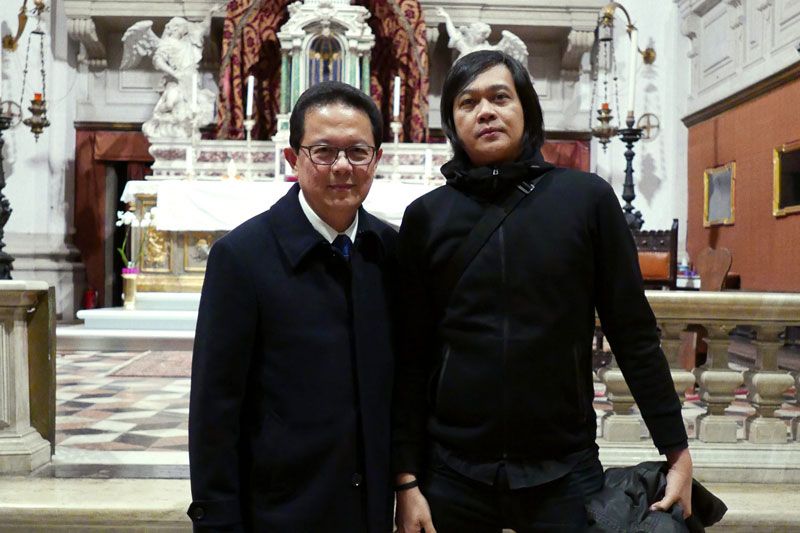
He says, “The Venice Biennale generates interest in the Philippines and creates goodwill internationally. Our participation in the biennale also supports the Department of Foreign Affairs’ cultural diplomacy program. It also encourages tourism to the Philippines.”
The ambassador also points out how Sentro Rizal (the official cultural institute mandated to promote Philippine culture abroad, and which has branches around the world) helps overseas Filipinos link with language and the arts of the Philippines. This gives them a sense of identity, essential for their well-being as they live abroad.
Nolasco explains: “Many of our countrymen here get their notion of Filipino culture from informal sources (family members), social media (Facebook), or even commercial media (television). What we try to do at the Philippine Embassy in Rome and Sentro Rizal Rome is to provide overseas Filipinos in Italy opportunities to engage and learn Filipino culture while abroad. This is done through our cultural activities that also uplift the Filipino image in Italy.”
The Filipino community is one of the most well-integrated foreign communities in Italy, the ambassador points out. “We believe this is because Filipinos are very sociable and hardworking as well as the fact that there is a lot of cultural similarities between Filipinos and Italians, including family centrism and the roots in Christianity. This allows Filipinos to adapt well to the Italian society.”
The NCCA — as part of PAVB’s outreach program — held a series of language seminars right after the biennale finissage in Milan and Rome under a project called Filipino Language Teaching Program (FLTP). It was conducted by University of the Philippines (UP) professor Eilene Antoinette Narvaez.
“Many of the second and third generation of young Filipinos whose family is living abroad are gradually forgetting their own language as they are more exposed to the language of the country where they reside,” Narvaez explains. “When they need to go back to the Philippines, they find it difficult to adjust.”
Participants in the seminar were OFWs and migrant Filipinos. Twenty-four Philippine Embassy staff-members also attended and actively participated in the discussions — including Ambassador Domingo Nolasco and his wife Cecile.
Narvaez says, “Most of them shared their experiences about their children on how gradually they forget about speaking Filipino even though they used it back home. They do not see it as useful. But not all Filipinos in Italy are like this. One of the participants approached me after the seminar, the daughter of OFWs. She grew up in Italy and understands Filipino, but has difficulty speaking in Filipino. She knows that she needs to learn the language because she has hopes of returning to the Philippines someday.”
According to reports, there are an estimated 150,000 registered or documented Filipinos working and living in Italy. The UP professor recalls, “An OFW said to me at the (closing ceremony) of the Venice Biennale how, way back then, when you refer to the term ‘Filipino,’ foreigners would automatically associate it with being a domestic helper. But because of the Philippine representation at the Venice Biennale, Italians have become increasingly aware of us Filipinos, that we are culturally rich and talented in a variety of arts. Our countrymen need to see that we are a race that is also proud of our culture, language and the arts. And that we have heroes like José Rizal who elevated our reputation as Filipinos.”
Art is, indeed, a mimicry of life. Or the other way around, as Oscar Wilde opined.
Guazon concludes how the country’s participation in the Venice Biennale underscores how we place ourselves as Filipinos in the many disparate sites we occupy. “The Philippine Pavilion is not only about the work, the artist, or even the curator. It is about presenting an idea to the world, knowing that the idea somehow encapsulates how we imagine the Philippines at a specific moment in history.”
Today, we Filipinos are being inundated with calamities, disasters, and adverse weather conditions (both literal and metaphorical). Suffering traces the helix of our DNA. But we always find a way to keep our heads above water, to build dikes of courage to hold back the flood of fear (a quote from MLK), and to let art and culture chronicle the terrors and triumphs of our events.
A version of this story first appeared in The Philippine Star, 2020.


