Mountain song: PHL Pavilion brings the aura of Banahaw to the Biennale
In the Philippine Pavilion, visitors walk among fabric, fake stones and sound, following the light. Mark Salvatus brings Banahaw to Venice.
VENICE, Italy — Well, I stand up next to a mountain…
Contemporary art often does not reveal itself on first meeting, much like an enigmatic lover. Usually, a conceptual piece or space is felt first before it is even understood.
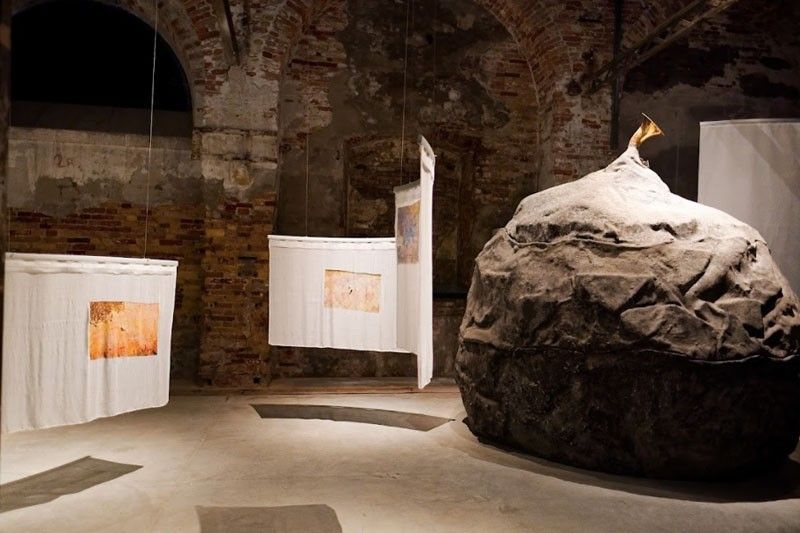
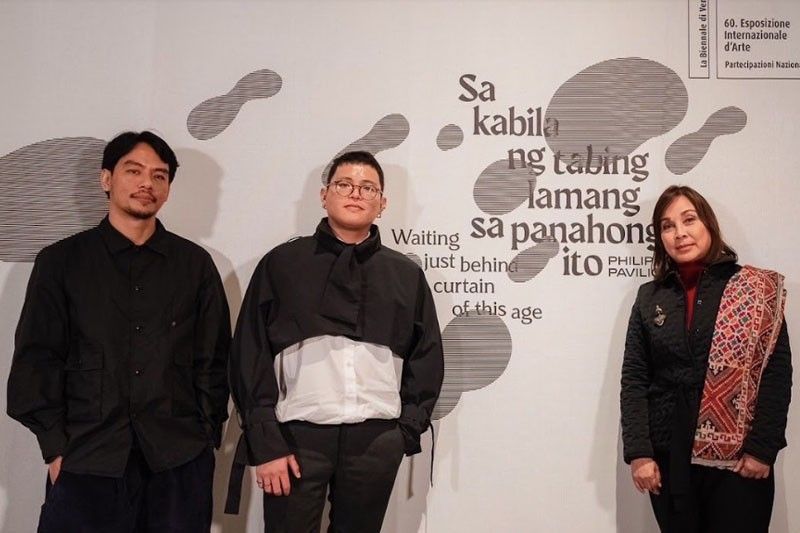
If you go around the Philippine Pavilion’s current exhibition titled “Sa kabila ng tabing lamang sa panahong ito/Waiting just behind the curtain of this age” (curated by Carlos Quijon Jr., featuring artworks by Mark Salvatus), which is our country’s official entry to the 60th International Art Exhibition – La Biennale di Venezia, you’d be perplexed at first. Birdsong, Eric Dolphy/Don Cherry-like bursts of horns, fits of coughing, the rumblings of a low-flying plane, landscape breathing, and ambient sounds recorded in Mt. Banahaw emanating from a 12-channel speaker system herald the sights ahead. Inside, you’d encounter see-through white curtains hanging from the rafters of the space in the Arsenale; fiberglass boulders impaled with brass instruments (a trumpet, a tuba jutting out like Excalibur out of stone) poised in various spots; a video of musicians on a misty mountain hop up the mystical mountain, their instruments transforming into twigs and tangled tips of trees; and the spirit of a revolutionary holding dominion over the place.
A lot to take in, for sure.
Yet, what distinguishes this space is how it makes visitors assimilate to a propped-up environment. It is the opposite of “stand out,” since the PHL Pavilion provides a sense of calm, a few minutes of rest, reprieve and respite from the visual and auditory bombardment of other art rooms in the old Venetian shipyard and armory. (It gets loud, believe me, especially in nearby Romantic Ireland.) The “Curtains of this Age” installation makes you forget that you need to check seven or eight pavilions first before meeting friends over cicchetti at Andrea’s bacaro. It’s like how I imagine what it would be like to hike up a mountain — guided by birds, rocks, curtains of sunlight or rain — in this era of fake news, senseless wars, social media inundation, global boiling, and life after a plague. In a moment of clarity, you’d realize how nature, in all its mystery and inscrutability, is the only thing that truly makes sense or even matters. And from the summit or thereabouts, you go back down to the sound and fury of reality.
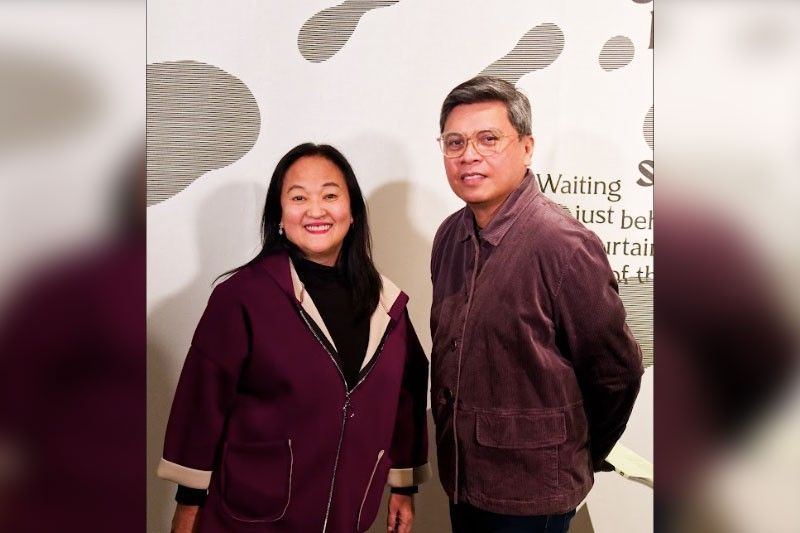
For curator Carlos Quijon Jr., the idea for the pavilion germinated from an iteration of Mark Salvatus’ archival project, “Museo ng Banahaw,” where the Lucban, Quezon-born artist collected pop cultural paraphernalia, family memorabilia, bits of historical narratives, as well as accounts of the myths and legends surrounding the mountain and adjacent areas. Mark’s grandfather, Ramon Sr., was a writer and historian, so there were a lot of pertinent materials in the Salvatus household.
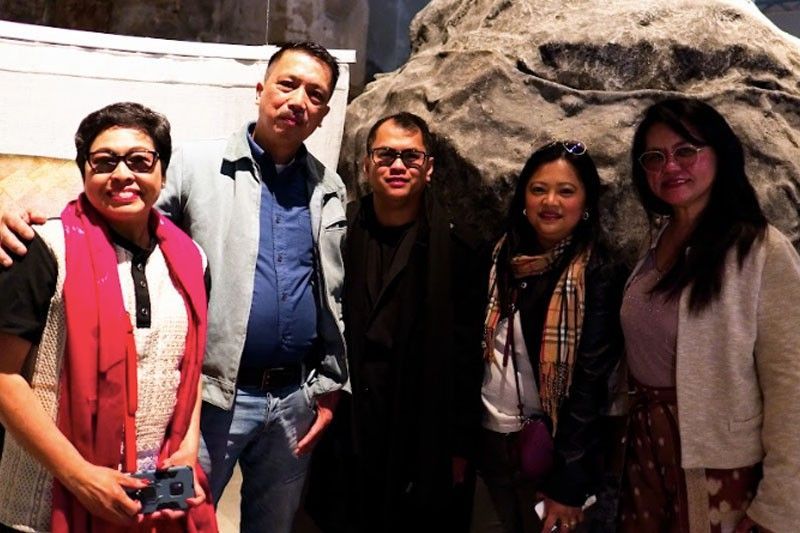
“If this is for a country pavilion,” explains Quijon, “it needs to have a spectacle, an idea of scale, how do we create an entire experience out of it. So, that was our first conversation.” The ideas piled up like a mountain. The pair — along with their collaborators — decided on making a “theater of mysticism” of sorts. A stage for the esoteric, if you will.
The curator explains, “How do we transpose the ideas of mysticism surrounding Mt. Banahaw into an experience?” The artist, whose practice revolves around the acts of assembly and salvaging, adds, “And how it connects to culture and everyday life of the locals.”
By the means of layering is the answer: a 25-year collection of photographs from the artist’s seaman-uncle; footage from Lucban filmmaker Abbo Q. Dela Cruz’s Misteryo Sa Tuwa; textile prints reworked from Salvatus’ “Human Conditioned” 2017-2018 work composed of Google Map images; boulder props inspired by the batong-buhay, living rocks inhabited by elementals that figure heavily in folklore; old instruments from a Lucban marching band (given up in exchange for new ones); and looming over is the philosophy of lay preacher and Lucban folk hero Hermano Pule, who played a pivotal role in 19th century struggle against Spanish colonialism and religious injustice (the title of the exhibition having been lifted from Pule’s speech as he and his group made their last stand on the hills of Tayabas) — each of these elements bolsters the concept of a collective memory.
Quijon amplifies, “Some historians have argued that Pule’s revolution planted the seeds for Rizal. If you frame it more thoughtfully, it’s part of this national, natural progression of fighting for freedom and emancipation, et cetera. Pule’s practice, the way he recruited people or the way he got them to donate to the cause, was by walking miles and miles. This was the kind of navigation that we wanted to achieve in the space.” The rite of Pamumuwesto is also involved, going from station to station. “You have this panata to go up the mountain and visit particular streams, rocks or caves to cleanse your kalooban.”
Thus, in the PHL Pavilion, visitors walk around — surrounded by fabric, fake stones and sound effects — and follow the light. The curtains function as a metaphor. Just behind them could be victory, success, progress, or whatever the objective is.
The thrust is to draw a connection to a rebel leader’s spirit. Salvatus, who was baptized in the same church as Pule, explains, “We were inspired by his imagination of the future. He lived outside Manila, but he already had a vision of the national. For us, it’s aspirational.”
With all these multiple layers — Puli the preacher, marching bands, a historian grandfather, a seaman uncle, anting-anting as an emblem of resistance, Banahaw as a protector from oppressors — the curator’s role is to function like a director of a stage play written by the artist.
“It’s interesting for me to think about mysticism and faith during these times,” points out Quijon. “(Our exhibition was the result of a) post-pandemic imagination. We wanted to have that as an inflection of the exhibition. So, our pavilion (exudes) lightness, airiness and ease.”
Over limoncello, the pair will continue to talk about art, the biennale, mystical Banahaw, how Salvatus as a high school student and his friend spotted strange lights hovering near the mountain. UAPs (Unidentified Aerial Phenomena), perhaps, or something else as outrageous and otherworldly?
Getting a chance to have a chat with the curator and artist about their concept is not the same as ambushing magicians into revealing their magic tricks. Not at all comparable. Listening to Carlos Quijon Jr. and Mark Salvatus discuss their most ambitious contemporary art project to date is like hearing two travelers talk about the path that led them up the mountain — the twists, the turns, the companions they met along the way.
Quijon concludes, “The usual reaction of visitors is, ‘This is beautiful. Can you tell me more about it?’ For me, that’s the best reaction for an exhibition. Because there’s a connection even if you don’t understand it. It’s the most potent weapon of art — catching one’s interest.”
Somewhere in the old Venetian armory, men and women are hearing the breath of a faraway mountain.
A version of this story first appeared in The Philippine Star, 2024. Print edition.


