Galleria Pandemia: Art in the Time of COVID
Ruiz, Ocampo, Miel, Borlongan and Justiniani on what the lockdown did to their practice, and why art is the last thing out of Pandora’s jar.
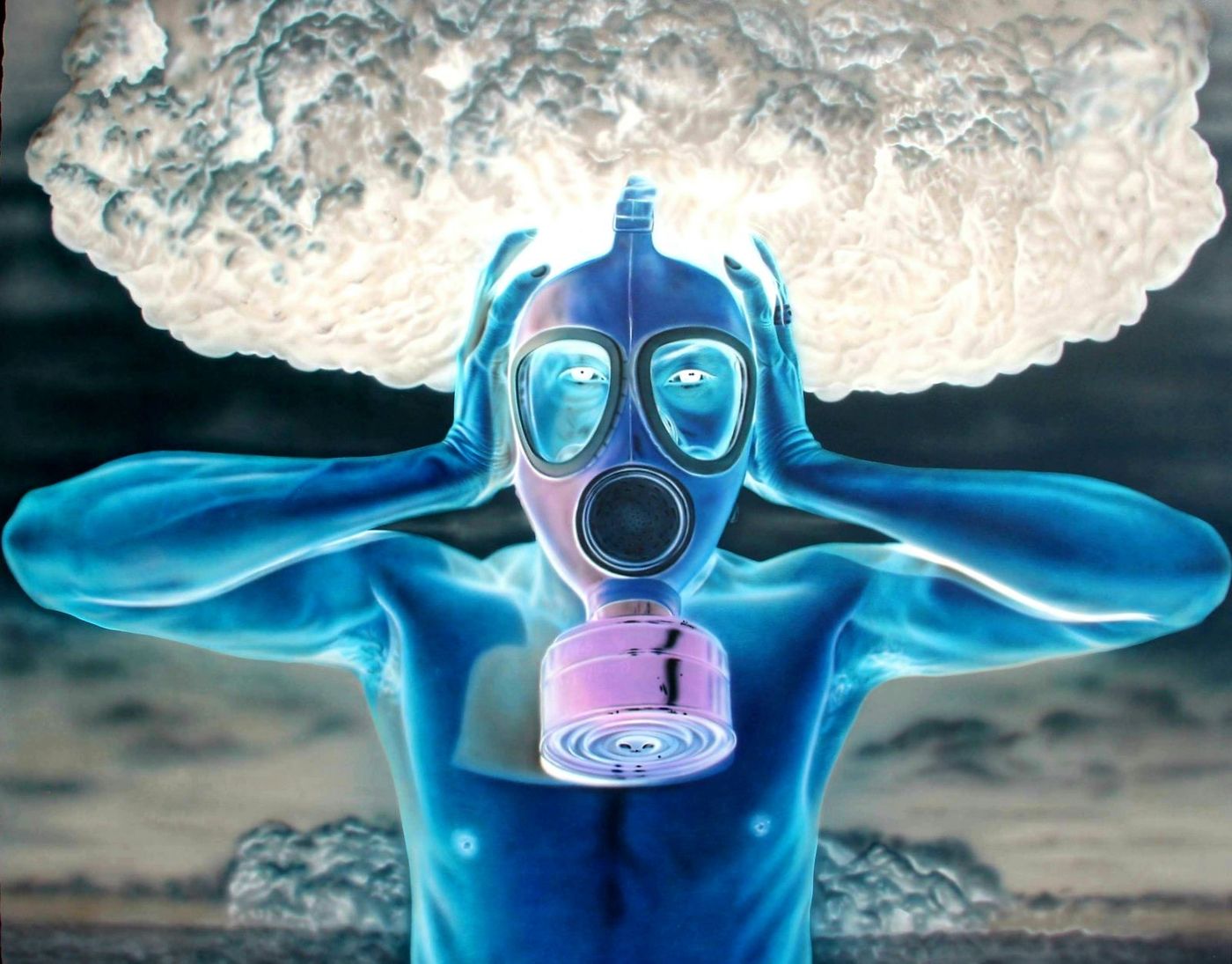
You don’t need a weatherman to know which way the wind blows. Bob Dylan said that. He’s right. Because we have artists (painters, pipers, poets, the seer of visions) who keep on chronicling for us the temper of the times, the zeitgeist, what really is going down — even before sh*t really happens. They have a sort of radar, an antenna, a secret sense for such things. They are Tiresias with spray cans and paintbrushes. Some of them are art-fair and auction-house darlings (you know who you are), but most of them are struggling and yet slaving away out of sheer love of expressing the inexpressible (we know who we are). You could listen all you want to politicians with their midnight ramblings or lizard-men ministers of the Department of Hermeneutics and Interpretation with their warblings about the COVID-19 virus — and get nada. You could listen to celebrities as they cluck about how the pandemic is “the Universe’s way of healing itself” — and shake your head as you listen to accounts of people dying in hospital hallways while waiting for beds, ventilators or even test results. You could listen to influencers telling you to stay home (“you mother-plonkers!”) and to Netflix or to TikTok away the dread and uncertainty in your hearts because of schools and businesses being shut down, with your career in peril and much of your life put on hold — and get the urge to bash someone’s head in. What? Stay home and watch Money Heist? Tell that to day laborers who don’t give a rat’s ass about red jumpsuits, or the Tiger King, or Gal Gadot and her Hollywood cohorts in their multimillion-dollar mansions singing “Imagine no possessions.” Hmm, imagine that. We’d much rather watch videos of locked-down Italians singing Black Sabbath from their balconies.
They say the virus is the Great Equalizer, but, as we learned in this country, some VIPs are more equal than others. Let me casually throw in an unrelated African proverb: “If you break a coconut on a man’s head, he will not enjoy eating it.”
But hear me out: art (in whatever form) is still essential. Without it, life — especially during the long dark days of quarantine — would be unbearable. (As they say, the earth without “art” is just “eh.”) Galleries have been temporarily closed, exhibitions have been cancelled, everything is in limbo, but artists thankfully are still doing art and responding to the situation. It is the only way to pass the time of being holed up at home: to become what you really are.
We wait fervently for any news about a vaccine or a cure. We applaud the health-care workers and other frontliners of the world. We say a silent prayer for those we know who’ve drawn their last breath. We read about feelgood stories that restore our faith in humanity — and they are legion. (Not all stories are about policemen power-tripping or barangay captains going medieval on curfew violators.) But we also welcome moments of levity by spending more time with loved ones and even exchanging “Miss Rona” memes and GIFs to keep ourselves from going batshit crazy; a little dose of gallows humor never hurt anyone. Most importantly, we must continue with our life’s work. We simply have to keep on keepin’ on.
The artist Laurie Lipton has an Instagram post comparing the “Artist on a Normal Day” and the “Artist in Quarantine.” And both entries show the same picture. Has nothing changed for the most reclusive, most solitary of all the practitioners of the seven arts? We asked several of our visual artist friends how the pandemic has affected their respective practices. (They also contributed images of works-in-progress that deal directly or indirectly with the Corona crisis.) And what they say may shock you. Ha-ha. No, not really. It just shows how resilient many of us are in the most challenging of seasons in our limited series here on earth.
Art, like life, finds a way.
Jose Tence Ruiz says, “Art lives through all human experience. Orgasm, bliss, war, contagion, hallucinations, ecstasy, depression, love, politics. My art thrives on all these events, so I feel I am part of humanity in a special but uniquely desperate time of crisis.” Ruiz, or “Bogie” as his friends call him, is preparing for three shows (fingers crossed that they don’t eventually get cancelled) while in isolation. “The Internet, TV, all still there, so I am not cut off. I need the world, or a running view of the world, to do my work, and these umbilici are still attached.”
He emphasizes how Francisco Goya, Francis Bacon, Otto Dix, George Grosz, Käthe Kollwitz, the Surrealists, Mang Nanding Ocampo, Rico Lebrun, Edward Kienholz, Hans Haacke, Mona Hatoum, Jaime de Guzman have all confronted the dark side of existence and came out with illuminated insights.
“I hope I can do the same thing,” Bogie explains. “It’s what artists must really do, not just dole out pleasant platitudes with brilliant color and butterflies, but with some deeper, more useful understanding of where we are in the cosmos, who we are, what our worth is, how we might remain happy despite all this.”
While Jose Tence Ruiz jokes that he is so “bagoong na sa bahay sa kakagawa,” Manuel Ocampo admits that the COVID crisis has made him realize that social distancing has always been part of his practice.
“For me being asocial is ideal,” Ocampo amplifies. “I do not want to react to the situation in a direct and obvious way, but the viewer will generate the meaning in the context of the time he is living in, so artists cannot control the viewer’s interpretations. Anyway, viewers are always guilty of committing this treacherous act of projecting himself as the center of the thing he is looking at — I think we are obsessed with meaning that we are too much distracted by it. As for painting, I’d like it to just be itself: a verb and an object.”
Dengcoy Miel, on the other hand, shares, “No one needs art in a pandemic — nothing to muse about in a gallery during an emergency. All leisurely pursuits are scaled down and muted. But despite this, there is an immense desire within the art community to help raise funds for the frontliners, too. And we have done so. The isolation has probably given artists an opportunity to reevaluate their art. It has dispensed clarity that goes beyond mere economies of it. It has also highlighted how vulnerable we are when priorities change.”
Nothing much has changed for Elmer Borlongan. Since the lockdown, Emong has started doing soft pastel monotypes of people in self-isolation, aside from churning out drawings and paintings. He says, “I believe art is for healing. It breaks the monotony of everyday life. Art serves as a therapy and outlet in expressing the joys and sorrows of mankind.”
Mark Justiniani’s studio for sculptural installations has been closed for a month now. The isolation has given him more time to reacquaint himself with the basics while focusing on acquiring healthier habits. He shares, “It’s a time to review the fundamentals of art, but more importantly of life itself.”
Justiniani says some leaders have characterized this crisis as “a war against an invisible enemy.” He states, “And I guess they have chosen those words to emphasize urgency. Viruses have always been with us. Studying and knowing their nature will allow us to accept living with them. The more we eliminate the unknowns, the less fearful we will become.”
He thinks that, in the coming years, we will see a lot of art pieces that talk about this very significant period in our lives. “Art will try to fulfill its function: find correlations, process, and, hopefully, arrive at insights which could be of value to all of us.”
All this has made Bogie realize: “Art and life cannot be disentangled and this will give us more insight, if we survive. Art allows us to think through it, gives us perspective, allows us to understand that we are not alone in suffering.”
Dengcoy talks about the state of art in a pandemic-stricken world. “The effect on art can only be seen after this pandemic has passed,” he says. “The clarity is in the resplendent rediscovery of the need to produce something beautiful for oneself. Not for a gallery, not for a show, not for anything else, but for the simple reason that producing art is to remind us that we are alive and can henceforth offer these works to the memory of the fallen. That’s humanity. I think that’s one of the best roles art could ever fill.”
We are all aware of Pandora’s unboxing video, er, story: how Zeus gives Pandora a mysterious box (or a large storage jar, according to the original uploader). The box is locked and it comes with a note: “Do Not Open.” Of course, Pandora opens it out of curiosity and unleashes upon the world Disease, Hate, Sickness, Envy, Poverty, Pain, Hunger, Vice and all the buzzing, stinging moths of mayhem, misery, everything malignant. As Pandora tries to close the box, she finds something stirring inside it. It turns out to be Hope. Hope to get all of us through the swarming evil around humanity.
The story does not end there, though.
After Hope, out comes another; the other gods had slipped it in. Pandora is awestruck as the creature flits and flutters, creating these wondrous shapes and sounds in mid-air.
It is Art.
A version of this story first appeared in The Philippine Star, 2020. Print edition.


