The sad, extraordinary tale of a general in the Revolución exiled as a ‘leper,’ as told by a Spanish artist
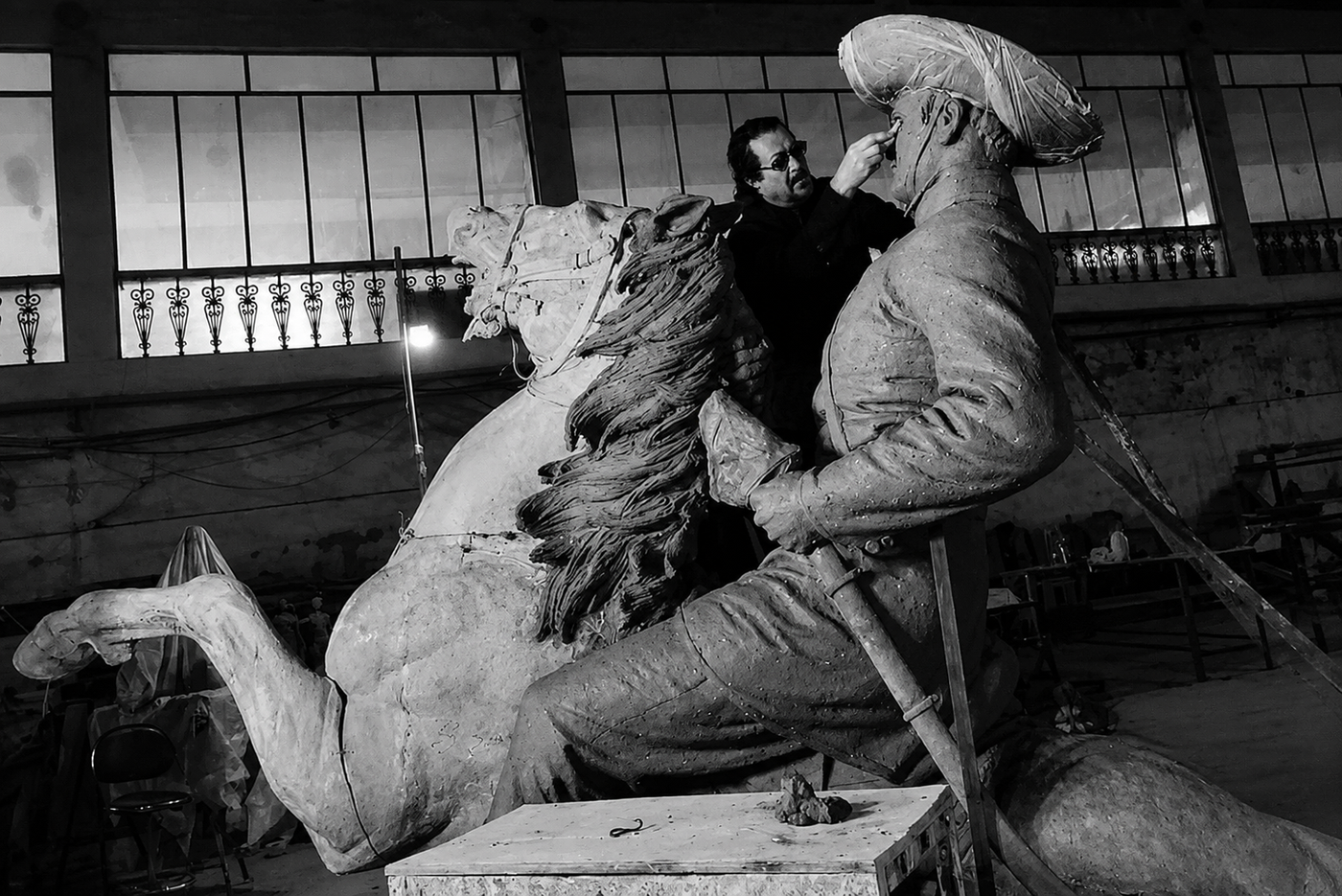
Spanish artist Ginés Serrán on sculpting a bronze monument in Iloilo for General Martín Delgado, the revolutionary hero exiled to Culion.
It has been a leaf storm of a life. The artist whose background is anthropology once hitchhiked across Europe, lived in a kibbutz in Israel, explored the Hudson River in New York by canoe, made Nigeria his home in 1977, hung out with American Indians at Yellow Thunder in South Dakota, traveled to Tepoztlán in Mexico with artist Fernando Botero to meet master Rufino Tamayo, lived for several years in small villages in Japan (the fishing people of Uchikawa [Shinminato] as well as the rice peasant community of Kuromaki), returned to Spain and built a studio upon the hills of Grazalema. He did all that and was named by the National Geographic Society as one of the “outstanding contemporary Spanish explorers” in 2003. And last year he marked his 225th exhibition in 22 countries.
In some of these shows, Ginés Serrán has paid tribute to the likes of Walt Whitman, Pablo Picasso, Omar Khayyam, Rabindranath Tagore, and created portraits of ancient poets Basho and Yakamochi, as well as — this might come as a welcome surprise — Philippine presidents José P. Laurel and Sergio Osmeña. The connection between Spain and the Philippines has always fascinated Serrán, its shared histories, and its umbilical cords of affinities.
It’s the reason why the Spanish artist has exhibited at Galleria Duemila; made friends with the likes of Gus Albor, Sansó, National Artists Arturo Luz and BenCab; has done work in Manila, Calatagan, Cebu, Boracay and Bohol, etc.; and currently jets in and out of the country for his project for Andrew L. Tan and Megaworld — to create the statue of a Philippine Revolutionary hero at Megaworld’s Iloilo Business Park.
Meet Serrán’s subject: General Martín Delgado, celebrated hero and first governor of the Iloilo province.
“Dr. José Rizal in Luzon and General Martín Delgado in Visayas are perhaps the two most important heroes and martyrs of the Independence,” explains Serrán. “They sacrificed their lives for the freedom your country enjoys today. However, until today, General Martín Delgado remains an unknown and forgotten figure in the historical annals of the Philippines.”
Delgado was instrumental in the Panay resistance during the 1898 Philippine Revolution, leading simultaneous uprisings against the Spaniards in towns across Iloilo during the Spanish Colonial Rule and, afterwards, during the American Occupation, he challenged American forces employing guerrilla tactical warfare, removing his troops to the mountains from where they fought the enemy. The general was ultimately forced into surrendering. He spent his last years in the leper colony in Palawan.
His death is as dramatic as Rizal’s, opines Serrán. Delgado was exiled to Culion — despite the fact that he wasn’t suffering from leprosy. He died in Culion in 1918.
“Martín Delgado is a very sad figure in Philippine history,” he adds. “There was a grave injustice done to him.”
The sculpture of the general will be placed at the intersection of Megaworld Boulevard next to Casa Emperador. The Megaworld complex will house not only offices and other urban developments, but also structures designed for history, art and education.
Serrán says, “It will educate and bring back to the younger generations the memory of General Delgado’s life and historic contribution. It will honor him for centuries to come, bestowing upon him the national recognition he deserves.”
Serrán has undertaken extensive research for this project, getting photographs and documentation from the archives, even visiting and talking to historians as well as the last of the general’s surviving relatives in Santa Barbara, Iloilo. The artist got to examine Delgado’s personal effects (his cane, his horse’s bit guard) and furniture that are kept there, even studying the lone statue of the general with his horse in the town square. It has deteriorated over time, informs Serrán.
“Ours will stand almost four meters tall with a six-meter pedestal. And it will be in bronze, and it will last for thousands of years.” The general will be depicted by Serrán as a figure astride a horse — but brandishing neither gun nor sword.
“To do so wouldn’t do him justice. Instead, I am putting a dove on his left arm as a symbol of Freedom and Independence. And consistent with Mr. Andrew Tan’s vision for the monument: it’s a depiction of a true hero, a salute to success, a feeling of victory. And I can tell you, as a Spaniard, that General Delgado’s place in history has to be reexamined. His story has to be retold.”
And the monument will act as a prologue in that regard.
“An artwork is not just a sculpture or painting hanging on the wall,” he concludes. “It has a soul, tells a story. Behind it is a world of feeling.”
Ginés Serrán’s monument to General Martín Delgado commissioned by Megaworld will be unveiled early next year at the entrance of the Festive Walk strip of the Iloilo Business Park in Mandurriao, Iloilo City.
A version of this story first appeared in The Philippine Star, 2016.


