A shot of Basi with Bob Feleo
‘I don’t believe in inspiration,’ says master sculptor Bob Feleo, on the Basi Revolt of 1807 and why art should provoke thought.
“I don’t believe in inspiration,” dismisses Bob Feleo.
We are in his home in La Loma where the artist and UP professor maintains a working area on the driveway of his humble apartment. Feleo is one of the most low-profile, genuinely anti-glam artists you will ever meet in the Philippine contemporary art scene. A key influence — according to art enthusiast Trickie Lopa — in the oeuvres of Rodel Tapaya, Kawayan de Guia, Leeroy New, and Leslie de Chavez.
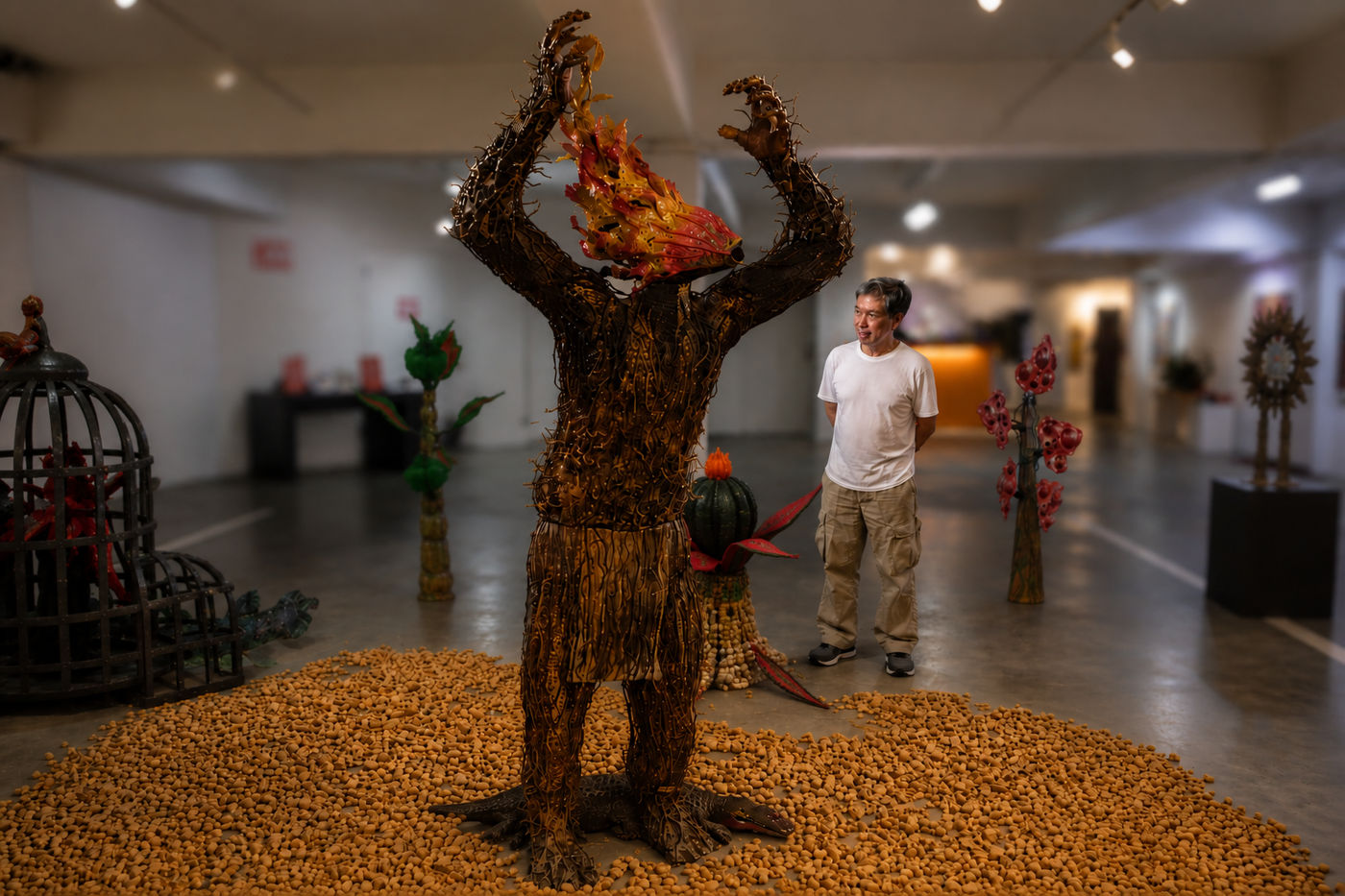
The life-size sculptures that are part of Feleo’s “Tao-Taong Aklasang Basi-Ang Hanay ng Ñ” are lined up like cosmic soldiers near the gate, within the ranks are sculptures of crocs and plants with fangs. It took Bob seven months to finish each figure. The installation will take over the central exhibit space in the 2015 Art Fair Philippines from Feb. 5 to 8 at The Link, the car park of Ayala Center in Makati City.
In a moment, Feleo will take out his bottle of basi (sugarcane wine made in Ilocos Norte) and offer shots to me and photographer Fernan Nebres.
Well, the germ of an idea for the suite of sculptures came from Feleo’s encounter with Jak Pilar’s article in Archipelago magazine in the ’70s. He liked Esteban Villanueva’s depiction of the Basi Revolt. “Nagtuloy-tuloy na doon,” he explains. Visits to the Ilocos region ensued as well as conversations with locals. “Hanggang kagabi iniisip ko kung bakit ’yung Basi Revolt ay mas importante dun kina Diego Silang — mas organized, mas mayroong direksyon.”
The answer, Feleo concludes, is because the Spaniards were prohibiting the “source of communication between Ilokanos in the present and their ancestors.” Basi figures prominently in the lives of Ilokanos, a part of their rituals of birth, death, victory, defeat, you name it.
“Sa kanila kasi ’yung inuman nila sagrado,” he explains. “So, nung binawal na ’yung medium of trance, medium of spirituality — both physical and alcoholic — eh away na, hindi na puwede ’yun! Lifestyle na eh; staple. ’Yung Ilokano farmer ang minumumog ay basi.”
Feleo says the most passionate about the subject matter are people from Piddig, where the revolt started in September 1807. “Makikita mo ’yung intensity, para kang may nasaling na sugat. OK ’tong mga ’to kasi hindi nakakalimot. Dapat yata lahat tayo ganun — hindi nakakalimot.”
We talk shop with Bob. He used aluminum expanders as armatures for the Basi Revolt sculptures as well as materials such as Japanese rice paper, sawdust and eggshells mixed with white glue. He then painted the figures with acrylic. (He says sawdust and white glue are used by carpenters in doing ceiling work — “pang-masilya.”) Feleo cringes when his works are categorized as “sculptures.”
“(Tayong mga Filipino) may tradition ng pag-gawa ng mga imahen ng mga ninuno. Tapos, seryoso ’yun kasi kino-consult pa ’yun after-death. Tuwang-tuwa ako nung may nakita ako na mga figura na maliliit na galing ng Palawan na ang tawag ay ‘tao-tao.’ Eh bakit ko tatawaging sculpture ’yan (pointing to his ‘Ñ’ figures). Eh ano namang pakialam ko sa sculpture?” says Bob with a laugh.
Feleo goes on to say that there should be subtleties in art. He is, after all, purely about work, work and more work. “Tama na ’yung mga ek (laughs).”
The man is all about creating awe-inspiring work with a dose of self-effacement. He claims he got into teaching after he graduated from the Philippine Women’s University as a painting major because he wasn’t even sure he would land a job. Teaching eventually became his bread and butter: first at the Philippine High School for the Arts in Makiling (in 1980) and then at the University of the Philippines (in 1990). “Kasi ayoko ring sumayaw,” he adds with a smile.
“The basics are always the foundation,” Feleo answers when asked what is the main thing he always tells students. “You can be a non-formalist, puwede naman talaga. Pero mas gusto ko may choice ka.” And then he smiles.
Feleo reveals that playing with toys as a kid, particularly G.I. Joe action figures, was key in shaping him to be an artist who deals with polymetric work. “Kakahawak, kakatingin, na-imbibe mo ’yung surface anatomy.” To this very day, his nephews and nieces give the great Bob Feleo action figures as gifts.
“Mayroon nga ako diyan Hitler (laughs).”
The man pours us another shot of basi and then goes back to work.
A version of this story first appeared in The Philippine Star, 2015.


