Rodel Tapaya and Marina Cruz: Two for the road of art
Contemporary Filipino artists Rodel Tapaya and Marina Cruz on folklore, memory, and building an artistic life together in Bulacan.
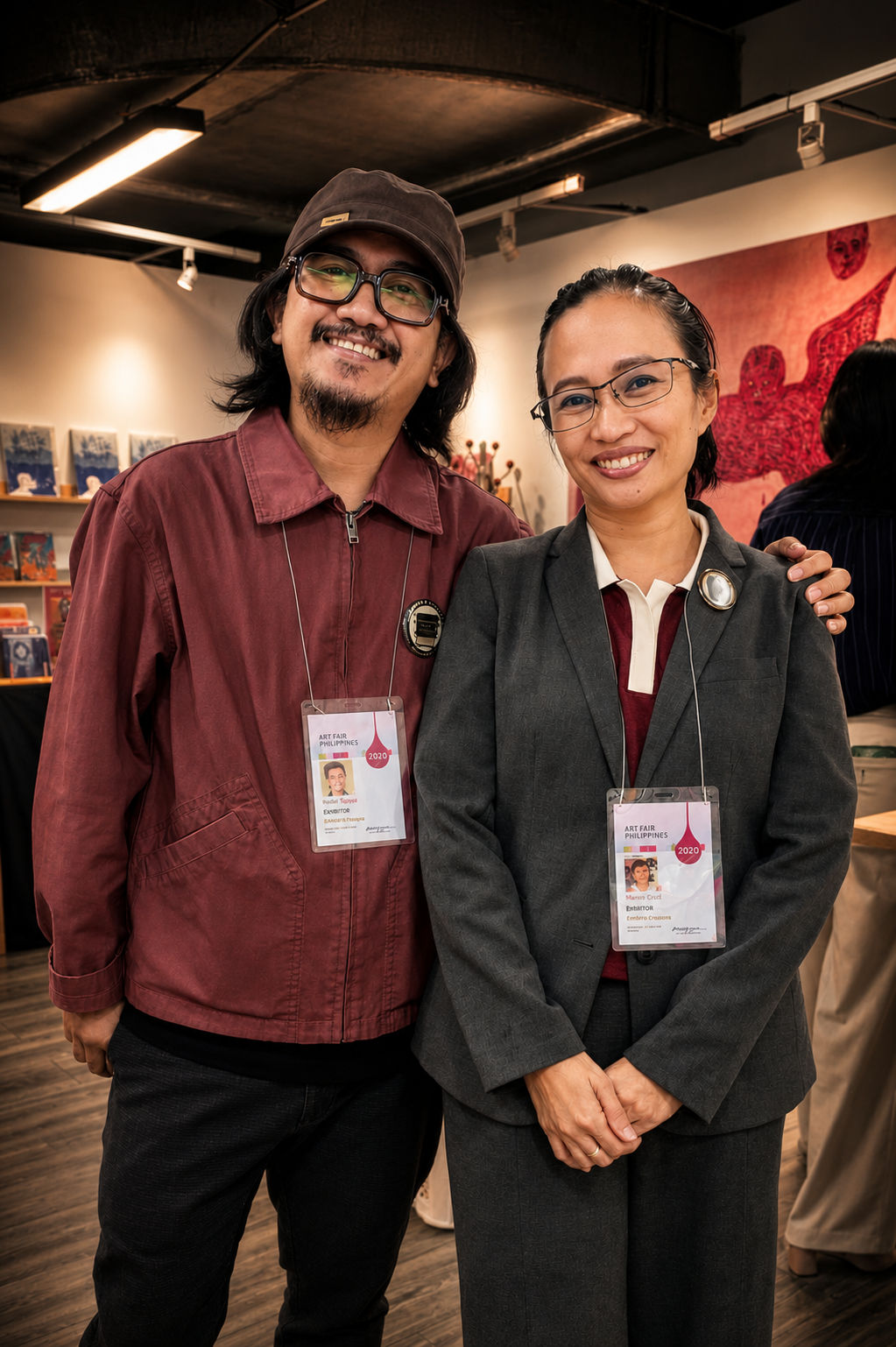
When he was nine years old, he helped out in the family’s tinapa business by buying old newspapers from recycling shops to be used in wrapping fish. The boy would browse the lifestyle section and then cut out the artworks in the art and culture pages. He also drew cars when he was five.
When she was seven years old, she was tasked by her mom — a public schoolteacher and wife of a duck farmer — to make visual aids for class. The girl hated sleeping in the afternoons, did little “projects” for herself, and she remembers mailing a still life drawing to a kiddie TV show called Batibot.
The boy recalls a plant in their old backyard called “mata ng pusa” which he and his playmates used as bullets for their sumpit. Outside their small house is a farm with lots of mysterious flora.
The girl remembers how her grandfather promised her a birthday gift the following day, only to wake up baffled as to how come they had so many “guests” in the house; it turned out her grandpa died that morning. She never found out what the gift was.
The boy grew up to be Rodel Tapaya. The girl grew up to be Marina Cruz. They met each other at the College of Fine Arts in UP in 2000, got married in 2007, have two kids and currently live quietly in Bulacan. And, oh, they are two of the most skillful and cerebral, highly successful yet down-to-earth figures you will ever get to meet in the Philippine art scene.
“Magaling si Marina in different media or presentations — she can do painting, sculptures, installation, embroidery, etc. She chooses the medium that is effective in what she wants to express or show in her work,” says Rodel, who counts his participation in the 2014 Gwangju Biennale curated by Jessica Morgan and winning the 2011 APB Signature Art Prize as among the highlights of his career.
“Rodel is very passionate about his work and always continues to develop. I am not saying this kasi he’s my ex-boyfriend (laughs) — I mean husband — I think Rodel’s work is strong in terms of both content and form. He is very true to his expression, and I find his works original and unique,” says Marina. Cruz won in the Philippine Art Awards in 2008 for her work “Embroidered Landscapes of my Mother’s Life: A Biography,” and won also in the Ateneo Art Awards in the same year.
They live in a two-story house. The house proper (living room, kitchen, etc.) is separated by a small door leading up to the studio with one large open space and two small spaces with separate study areas. “I work from 1 to 5 p.m., intense. And then 8 p.m. onwards doing lighter tasks, meaning thinking, reading, making studies,” Rodel explains. Marina works intensely from 9 a.m. to 12 noon, takes a break, and then continues from 2 to 5 p.m.
“We just have a simple privacy rule,” she explains. “If one is wearing earphones then it means off-limits — no talking, disturbing, etc.”
Rodel Tapaya loves making mural-size paintings throbbing with narratives, folktales, myths, legends and other stories that make people think, wonder and express their values. He also injects commentaries in his works.
Marina Cruz gravitates toward family, memory, home, belonging and belongings. Her work is ruled by home, objects, clothes and dolls. She even taught at Miriam College as a high school art teacher to fulfill her mom and grandma’s request for her to pursue a teaching career. But art beckoned…
She explains, “I think of my art practice as a problem-solving exercise with givens and strategies to arrive at a desired outcome. I also try to experiment in different forms, painting, photography, embroidery, sculptures, prints and video.”
Rodel is also restless. He points out, “I try to do something different every show, presentation, concept and form.”
The Rimowa project was a bit unusual for the two artists. Rimowa Philippines donated four pieces of luggage to The Art of Travel auction at the FilipinaZ Art and Fashion Fair to be transformed into masterpieces by Rodel and Marina — along with fellow artists Alfredo Esquillo and MM Yu. Those pieces were auctioned off to the public and the proceeds were turned over to a charitable organization.
“The surface of the suitcase,” recalls Rodel, “was challenging to paint because it has textures. But I had an idea right away, since I had a work called ‘Modern Manananggals,’ an installation about OFWs.” So he thought of painting that scene on a piece of Rimowa luggage.
In Marina’s case, she shares, “Since I am working with themes on objects, particularly clothes, I thought I could show what we usually put inside the suitcase — which is clothing — and put that outside of a suitcase.” She also did research on what paint material is compatible with an aluminum surface.
“Have brilliance, will travel” should be the motto for these two Filipino artists.
The goal, according to Rodel, is always “to create memorable works.” And the man is still mystified by stories, hunting down creatures that are strange and beautiful.
As for Marina, she concludes, “I am the mother of two awesome boys, the life-partner of an amazing artist, and I am an artist who hopes to inspire people through meaningful works.”
Maybe that was her grandfather’s gift all along.
What she is now.
A version of this story first appeared in The Philippine Star, 2014.


