Aze Ong weaves a tale of pain & transcendence
Chronic pain in the hands of a fiber artist who crochets for a living: Aze Ong on making her largest work yet for Art Fair Philippines.
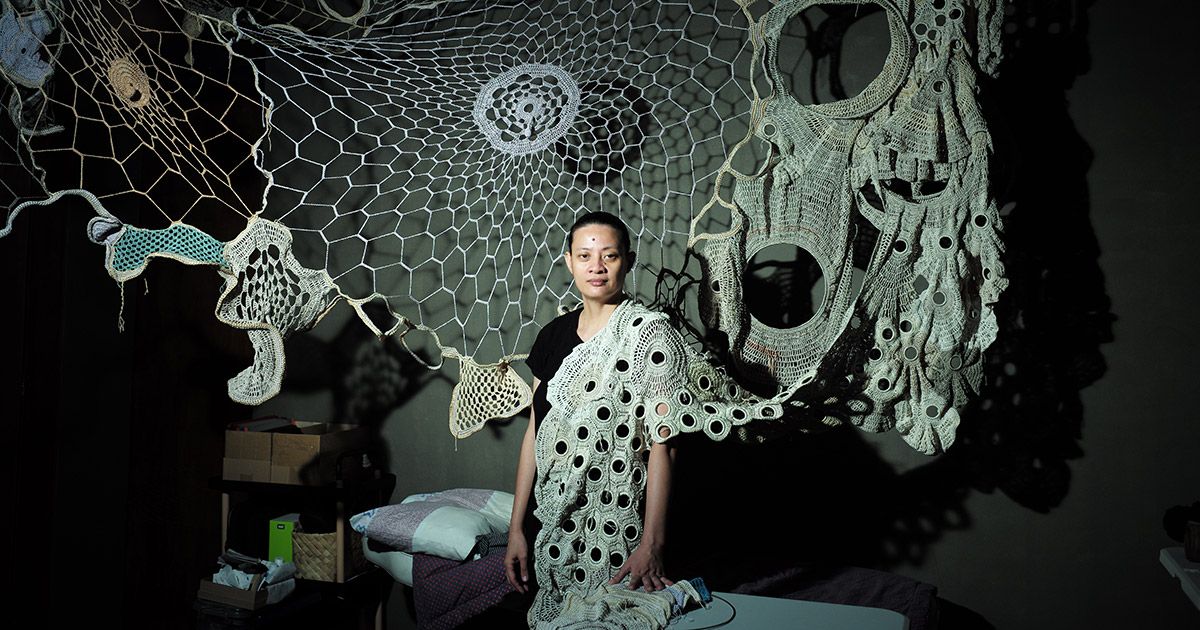
Art sometimes is not a lovely stroll into sunlit meadows with a canvas and a set of paints to render nature’s own profile pic. Art can be painful, bone-twisting, leaving a trail of gnarled fingers and frayed feelings.
Aze Ong—throughout the course of her practice focused on fiber as a medium (crocheting, sewing, knitting, knotting, weaving art pieces)—developed chronic pain in her hands, wrist, and arm due to repetitive motion and pushing her body to the limit. Numbing at first, then a web of excruciating pain ensues. Birthing those monumental, organic-looking, tentacled weaves was becoming quite an ordeal for the artist: the spirit remains willing, but the fingers are signifying surrender.
For her Transcendence piece for this year’s Art Fair Philippines Projects at Ayala Triangle Garden, Aze was undaunted: she wanted to create something bigger than her 2014 work titled My Soul’s Light.
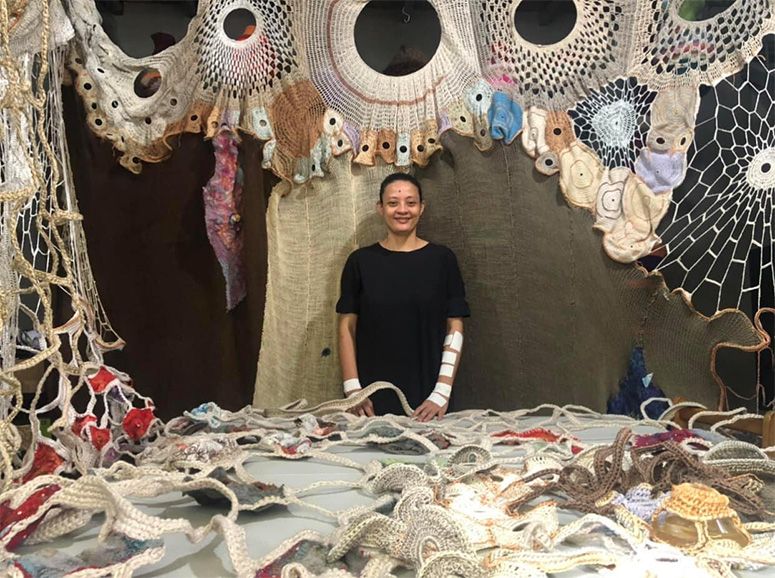
“(My intention was) to create an epic piece of art despite the physical and psychological challenges,” she explains. “This was easy when I was younger but the repetitive motion, pacing and accumulated injuries in my hands made things difficult. The concept is to challenge my own limitations and to transcend into a higher state that goes beyond patience. To trust the journey that anything is possible.”
Last year, she joined the spiritual group called Love, Peace and Harmony Philippines. It combines Chinese teachings, meditation, chanting, trance states and modalities to promote calmness and soul healing. It promotes forgiveness and mindfulness: a quiet state of mind.
“Ang unang inspirasyon (for the Art Fair piece) was when I started to see golden light balls during meditation practices where I can be in a trance state by just closing my eyes and keeping quiet—or chanting. Ang sarap ng tahimik.”
To get to this point in Aze’s artistic travels, let us crochet back into her childhood.
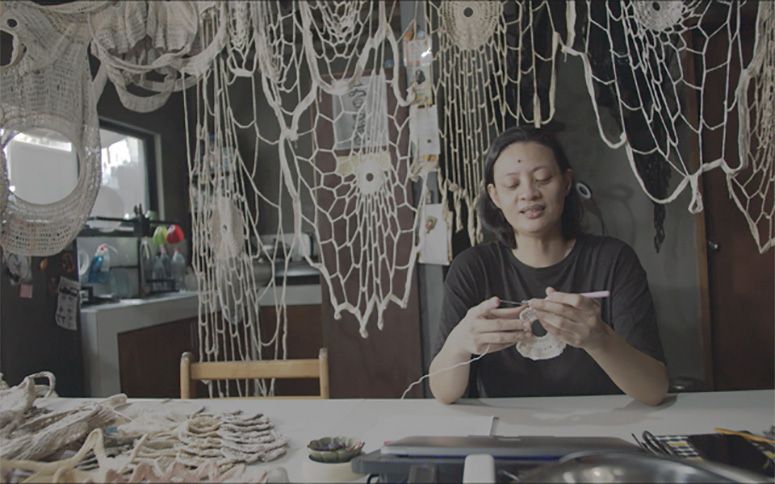
Aze Ong grew up in idyllic Antipolo. Her mother, Evangeline, started a garment business in the garage of their home. The young Aze was surrounded by dressmakers and an arsenal of sewing machines, threads, needles and fabrics. She would play with pieces of discarded fabric or “retaso.” As she got older, she was tasked with sewing buttons on ready-to-wear pieces designed by her mom. Aze accompanied Evangeline to the market to buy fabrics and eventually to sell clothing. Curiously, Aze’s first time to operate a sewing machine was when she turned 40—and it felt natural. Maybe it even seemed like a mechanical extension of her own hands and fingers.
Back in 2010, she reconnected with artist Lirio Salvador during an exhibition at Likhang Diwa where Aze’s crocheted bags were on view. “What you’re making is art,” Lirio told her. Aze was skeptical at first, since she considered herself simply a “creative person”; an artist, not quite yet. But Salvador saw something extraordinary in what Ong was creating. The art establishment at that time was unconvinced.
Her first few years in the art scene bore that out. Being accepted by galleries for exhibitions was tough enough, but the acceptance of fiber as a medium was even tougher. “How can you legitimize your work as art?” was the usual question. Defiantly and persistently, Aze wove on and on. The acceptance came eventually—she was invited for projects, exhibitions in galleries and museums, and residencies abroad, squeezing in art shows in local malls.
“Nagkaka-momentum na ’yung public art project ko titled Queen wherein I would walk with my sculpture and activate it in public spaces. I started this in New York at Bliss on Bliss Art Projects—then all of a sudden, at a snap of a finger, nawala lahat ’yun. Devastating ’yung pandemic. The public spaces did not have a ‘public’ (audience) anymore, and everything shifted virtually. Immersive pa naman mga installations ko, tactile and interactive. Okay lang kung three months, I will consider it (a period of) rest, pero umabot na ng two years.”
But this is where we pick up the threads. Adapt, this woman did. And even via Zoom, people were moved by her performance. “It spoke to them on a different level. If I were to examine my works, I would say it is too simple; the stitches are ordinary; the materials are available in the market, mostly donated. But to be able to touch people’s hearts and lives through my art is something extraordinary.”
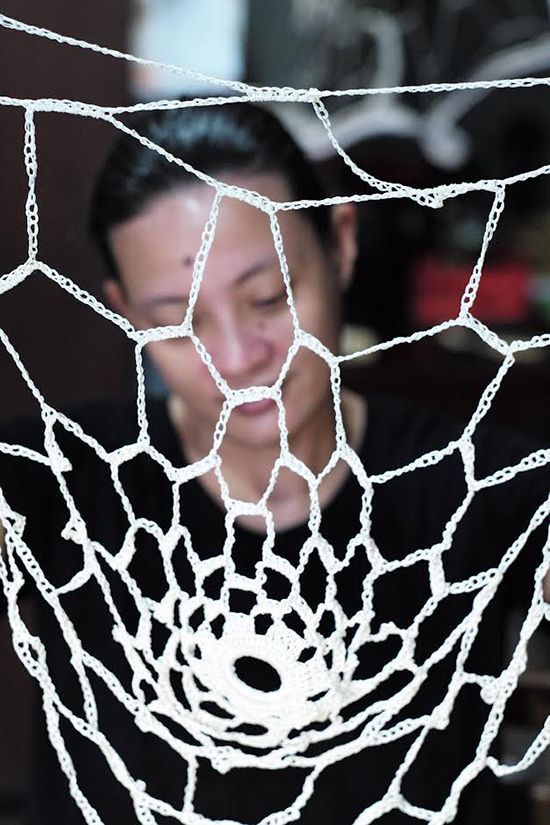
What gives her art its strong Filipino trait? Aze answers, “I think it’s the creative process. Nung nasa Bukidnon ako for a year as a volunteer teacher in Kibangay, na-expose ako sa Talaandig indigenous people. Usually ang pinagagawa kong projects sa mga bata sa school ay tungkol sa way of life nila at ng mga ninuno nila. I got to immerse in their culture. Ginagamit ang resources available in their environment; colors are loud; forms are fluid; may mga ritwal bago mag-embroider o gumawa ng damit para sa isang tao. Parallel siya sa creative process ko. I feel that somewhere in this universe, spirits help me create these works.”
The artist is set to unveil her largest creation to date—Transcendence—at the fair, open to the public on Mar. 23, during this timeline currently stricken by tangled webs of conflicts, twisted stitches of facts and their alternatives. We ask her if there is a political dimension in her work.
For Aze Ong, the personal is political.
“I must admit na male-dominated pa din naman talaga ang art world. But I hope that people get to feel and see the power of fiber and that is the power of women: flexible, patient, can mend holes, can stitch together imperfections, can be molded—yet it has its own form, flows like water, simple and complex at the same time.”
A version of this story first appeared in The Philippine Star, 2022.


