Tales of the Weird on the way to Santiago
A reanimated chicken, a gothic coop, a hostel room for snorers, and hammering on a hotel wall at 3 a.m. with nobody in the next room.
Part two: In which the author revisits the route to Santiago de Compostela in Galicia, Spain (the third most important Catholic site in the world next to the Holy Land itself and the Vatican), upon the invitation of the National Tourist Office of Spain in partnership with Thai Airways. This sequel took almost a year to be writ. Why? Because life, as it always does, got in the way. Expressing the invisible, painting the inexpressible, playing lackluster bajo for the band Los Vómitos, getting repairs done on a persistently problematic sink. Now in the crisp quietness of a Sunday morning, this un-saintly scribe looks back at the Camino de Santiago or Way of Saint James, the sidelights, back stories, Gothic and Romanesque architecture, and the little weird things that make the trip. “Life’s a journey, not a destination,” so said by… not Miguel de Cervantes nor Octavio Paz but… Steven Tyler, channeling Ralph Waldo Aerosmith, er, Emerson. Imagine it’s the first day of summer in Northern Spain, so step out of the hotel and revisit the route taken by thousands upon thousands of pilgrims before you, board the tour bus with its motor softly braying like the steed Rosinante, sit down, buckle up, cue your inner Quixote, and take the next exit (with dramatic pause a la Rod Serling) into the Twilight-lite Zone.
Let me make this quick and painless. If you’re in Old Europe and staying in monasteries or hospitals turned into plush hotels, it could get mightily creepy. Some of the Paradores we stayed in have already been turned into places with contemporary cool — such as the ones in Alcalá de Henares and Villafranca. (Although in the latter, if you walked downwards for a couple of yards, you’d get to a village straight out of Hammer House of Horror, complete with a goth graveyard and castle with an eerie light inside, and I sh*t you not.) But the other hotels — well, what with un-altered interiors straight out of Medieval times, rocking horses, mysterious chests in the lobby, antique mirrors facing the bed, chain accents (yeah, chains!) a restaurant that was formerly a morgue, and shadowy portraits — were a different story. The girls in our tour agreed to shack up by pairs. One night, I was roused by someone banging on the walls. Ah, I thought it strange that my colleague in the next room decided to have some hammering done. A picture frame needed to be mounted, perhaps? Was she moving furniture around? At three in the bleeping morning? Turned out that she bunked up with another person in another part of the Parador. No one was in that room. Oh, hell.
From hereon it gets relatively lighter.
Avoid walking under a nest of storks at Alcalá de Henares. Our first stop on this Santiago de Compostela pilgrimage was this university town populated by students and those cutesy, gangly white flyers always in search of good weather. I saw a man get “projectiled.” I will not say by what, but it wasn’t cute. (It’s actually bird shit.) He angrily said a few unprintable things — in Spanish. Walked off into the grayish Spanish sunset.
On the rooftop of our hotel is jardin tallado (or carved garden). It’s breathtaking. Our guide said that across it was formerly a woman’s prison.
At the University de Alcalá, there used to be Donkey’s Door used by students whose mental bulbs are a bit pundido. If I studied in Alcalá, I’d probably get a lifetime pass through it, knocking on Donkey’s Door every day.
Jorge Luis Borges was awarded the Cervantes Prize at the university in 1979, Octavio Paz in 1981. Borges is the king of the poetically peculiar. “Every writer creates his own precursors,” the Argentine once wrote. Borges is the precursor of Rod Serling. In the future someone will write like me, think like me, and annoy the bejesus out of the lot of you who want to read something serious on a Sunday.
This is not it.
In Logroño, there is a sculpture of a man creating himself, called “The Evolution of the Work.” (Maybe his ghost does the hammering on hotel walls at 3 a.m.) Across the square, there is the Game of the Goose, the Snakes & Ladders game for pilgrims, featuring two monolithic dice. It would be more fun if trapdoors were involved. Roll the dice and you have to step into the Pits of Hell square, and then just like in Drag Me To Hell, the portal opens.
“(The region of) La Rioja is not just a tourism stop (on the way to Santiago),” tourism official Monica Figuerola told us, “it’s a real life experience.” She’s right.
Monica took us to a chocolate shop called Viena. The place sells chocolate with wine and truffles with gin. I left the place smacking of sweetness and a bit sauced up. Now, that was saintly.
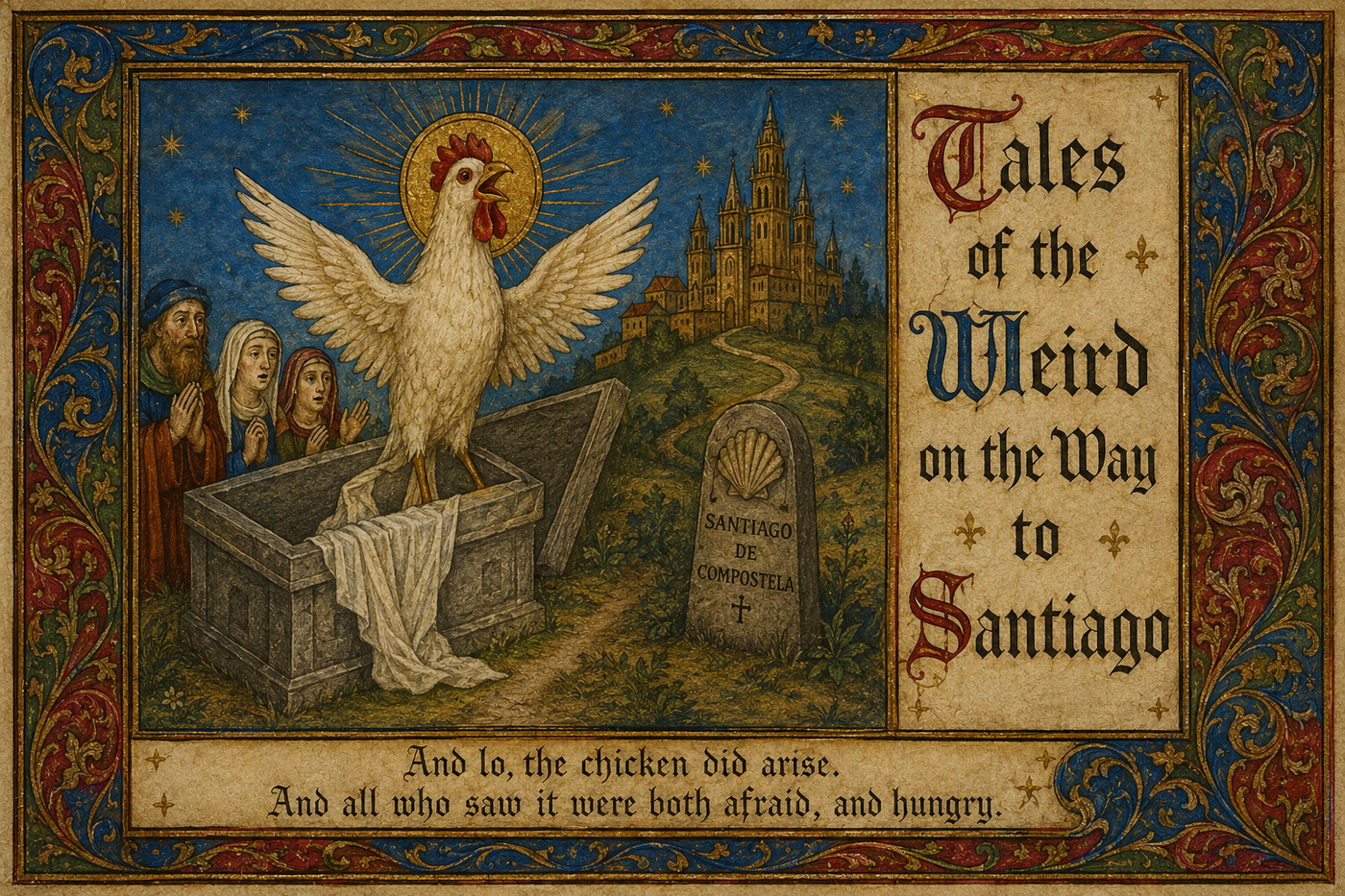
At Santo Domingo de la Calzada, the plaza mayor turns into a medieval market in December brimming with oil, soaps, wine and small theaters. Our guide Marina told us the story of a magistrate’s reanimated chicken meal. Imagine digging into a piece of hot-and-crispy wing and then it starts flapping away.
In the town’s pilgrim hostel, there is a room for snorers. How about those with supernaturally stinky feet? “Welcome to the Royal Eczema Suite.”
Inside the cathedral dangles a cross with words such as “Pollution,” “War,” “Traffic,” “Drugs,” “Slavery,” among other modern-day burdens. On my cross would be written “Primetime Teleseryes” and “Christian Bautista Songs” (they kill you with banality).
There is a gothic chicken coop inside the Santo Domingo Cathedral, a tradition that stemmed from the story of the saint bringing back to life an innocent man sentenced to the gallows. Lore has it that the magistrate thundered sarcastically, “The boy is as alive as the rooster and the hen I was feasting on before me.” Then — flap, flap — the lunch is alive!
Inside the cathedral sits a skull inside a mini silver cathedral. A saint’s, reportedly.
In Burgos, our guide Gloria shared the etymology of the word “burg” as “hill and on top of it is a castle — like Hamburg and Luxembourg.”
Inside the cathedral a “flycatcher” clock strikes the hours. We witnessed the mouth-opening moment, as another fly perished every hour on the hour.
A Da Vinci painting is in there, so is the fifth tomb of El Cid. The hero literally rests in pieces. Napoleon took some of the bones during his destructive tour of Europe. (Like LeBron James and his band of Heat laying waste the lands in the East and the West… we’ll see if they could sustain that in the playoffs.) The Cid is depicted in a kitschy painting at the back entrance. Or maybe it’s a portrait of Charlton Heston.
At San Martín in Frómista, we met tour guide Mara, a very informative storyteller.
The church’s façade is punctuated by sculptures of weird creatures. “In hell, you will meet these kinds of animals,” said the guide. There’s Dog Face, Man with Upside-Down Head, Deaf-Dumb-Blind Monkey, and the Kid with the Eternal Stomachache. I haven’t been to hell and already I’m not liking it.
We had a pilgrim’s meal at Mesón de Villasirga. The huge serving of lamb alone could last me an entire month.
More journeying. We saw Gothic cathedrals, we saw Romanesque cathedrals. The Romanesque philosophy is an extension of the Platonic principle: the inner is the most important. According to our guide Christina, “It is simple, stark and promotes meditation.” The Gothic on the other hand is Aristotelian: the external is the ultimate. “If the inner is good, the outer can be good as well,” she added. “There is dialogue, movement.”
Stained glass. Tiered towers. Flying buttresses. Pantheons and mausoleums. Ancient shapes were all around us. Certain places looked eerily Medieval, left me thinking I could get summoned by the Inquisition at any moment. To be tried for heresy. One of our companions could be charged with bitch-craft.
We saw a Gaudí-designed edifice that is now a Caja España. Not really representative of the signature un-straight line approach (curved construction stones, an assortment of twisting organic-like forms), but obviously Gaudíesque just the same. One of the few designed by the Spanish maestro in Northern Spain.
It was freaking cold in O Cebreiro, as if Summer were still en route by bus, or still finishing the mammoth lamb meal at the Mesón. Maybe it was chugging Estrella Galicia beer with Autumn.
When we finally arrived at Santiago de Compostela — after all the journeying, after absorbing the Camino’s history, secret histories and many-splendored myths, and putting up with mysterious presences — it was nearly sundown. But for the pilgrims arriving on foot or bicycles who have accumulated all those miles and as many memories (and maybe, on a slightly lesser degree, even for us on this Turespaña tour), it was the prelude to something entirely new. A sunrise of sorts for the soul. A foreshadowing, a precursor. I got off the bus, stretched a bit. My feet were in Santiago’s soil.
The weird turned to wonder.
For particulars about the Camino, e-mail areaturismo@santiagoturismo.com or visit www.santiagoturismo.com.
Special thanks to Turespaña, NTOS Singapore, Paradores, World Heritage Cities, and the La Rioja, Castille & Leon tourism offices.
Our trip to Camino de Santiago was hosted by The National Tourist Office of Spain and Thai Airways. All words and opinions are our own.
A version of this story first appeared in The Philippine Star, 2012.


