La Luz in my religion
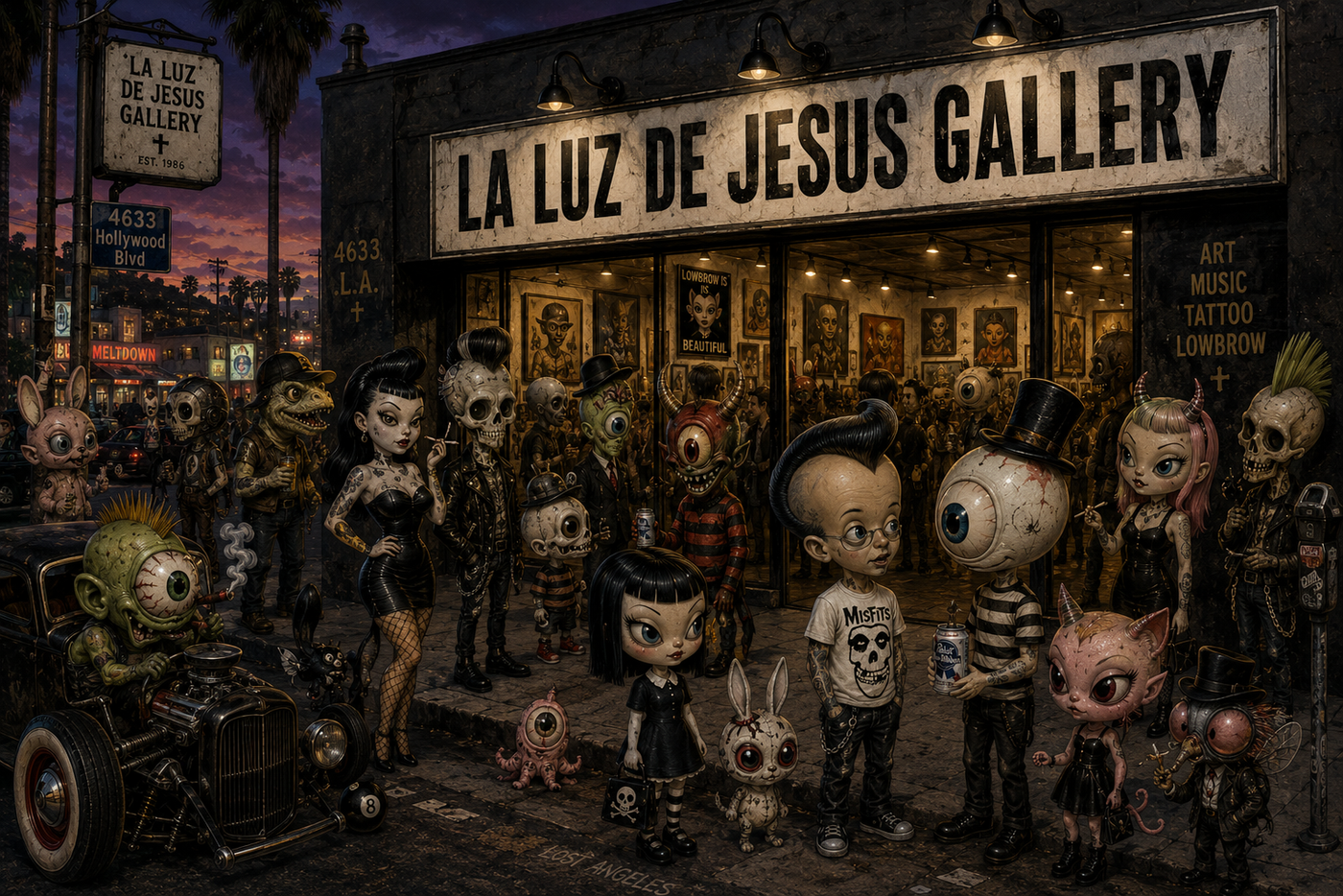
Inside La Luz De Jesus on Hollywood Boulevard, the gallery that turned lowbrow art into a congregation, with a gift shop of relics and toys.
It is the first time I’ve put myself in danger of being crushed by a cute Tim Biskup character.
I am at the La Luz De Jesus Gallery in Los Angeles, California. In Hollywood. No, not the Hollywood teeming with silicone sisters and manager misters. Not the side with the Walk of Fame. It’s the seedier one with liquor stores, back alleys, coffee shops, Thai restaurants (true, true), a smattering of strip clubs, and menacing types with thousands of ways of mulcting money out of you. (One guy needed a few bucks for a Greyhound trip to Wyoming, another for an investment in a revolutionary invention… whatever that is set me back by a buck.) Grayness all over the area. But the building that houses La Luz and The Soap Plant/Wacko boutique gives the area a cluster of colors and much-needed character.
La Luz De Jesus Gallery is the main post of outsider art (as well as folk art and counter-cultural philosophies). It is appropriately situated inside a converted post-office building. A far cry from its original location at swanky Melrose Avenue, which is a good thing considering the area automatically conjures the Aaron Spelling soap opera featuring buxom blondes and rubbish Heart tracks rather than counter-cultural paintings.
The gallery was established in 1986 by entrepreneur and art collector Billy Shire, who was instrumental in jumpstarting a school of art in LA (a very influential one even in our own neck of the woods). Shire was dubbed the “Peggy Guggenheim of Lowbrow” by lowbrow bible Juxtapoz magazine founded by artist Robert Williams (who also put up the highly influential Zap Comix, along with Robert Crumb and S. Clay Wilson).
La Luz showcases mainly figurative, narrative paintings, and unusual sculptures. Its website says Luz exhibitions are “considered post-pop, and the art content ranges from folk to outsider to religious to sexually deviant.” The gallery’s main objective is to bring underground artists and counterculture to the masses. By doing so, La Luz has brought the underground above ground — like the art of Gary Baseman, whose characters can even be seen in an animated series for ABC/Disney called Teacher’s Pet, and even the art of Tim Biskup.
I am not sure, though, about the name of the red, monolithic Biskup character (in either hard plastic or vinyl) that I accidentally bumped into. (I would find out later on that it is called “Helper.”) Its one good eye staring at me menacingly, as if it needed bus money to Wyoming.
La Luz has introduced groundbreaking artists to an even wider audience like Robert Williams himself (one of his most famous works is the robot-rapes-girl painting on the cover of GNR’s “Appetite for Destruction”), Joe Coleman, S. Clay Wilson, the late R.K. Sloane, tattoo artist Don Ed Hardy, Gary Panter, Glenn Barr, Joe Sorren, Camille Rose Garcia, Liz McGrath, Todd Schorr, Mark Ryden, and our very own Manuel Ocampo (the title of his show was “Lies, False Hopes and Megalomania” — which kicked major ass). Even Simpsons creator Matt Groening exhibited at La Luz, as well as master of horror Clive Barker. Two equally influential artists.
The La Luz employees (wrapped in goth and LA punk apparel) were very helpful in showing me around the gallery featuring works by Bob Dob, even inside the backroom with dozens of lowbrow wonders. They even helped me find specific items at The Soap Plant/Wacko store.
Shire calls it a “whimsical, visual grab-bag, department store of wildness.” He’s right on the money.
The store has folk art pieces, relics and ritual objects (Santeria? Macumba?), not to mention books, toys, inflatables, shirts, décor, ceramics and glassware, masks, Edgar Allan Poe bobble-heads, KISS action figures, Last Gasp books (Ryden’s Fushigi Circus, McGrath’s Everything That Creeps, Beat Generation coffee-table books), Rat Fink toys (from the master Ed “Big Daddy” Roth), jewelry, gaily-painted “Tree of Life” candleholders and (gasp!) a rack of skull collectibles. Shire has an even more impressive collection of skulls in his home — everything from an Indonesian crown made of bronze skulls, to animal and human skulls (an alligator, a monkey, wolf, beaver, cow, dog, deer, even a skeleton of an eight-month-old human fetus), to sugar skulls from Mexico (pesky ants stumbled upon those sweet treats one day to Shire’s horror).
Strange how The Soap Plant literally started as a store that sells soaps (and baskets). These days, it is not surprising for Debbie Harry of Blondie to turn up and buy Haitian voodoo dolls, for Billy Idol to send his chauffeur for some Rambo gum, or for someone to order 500 rubber chickens used in the wedding reception of a Hollywood couple that didn’t last.
But this place, the hippest gallery cum gift shop in LA, is here to stay. It’s as solid as a rock because it knows how to rock ’n’ roll.
La Luz mounted a show last year featuring Dean guitars painted over by artist-rockers such as Rob Zombie, Marilyn Manson, Mark Mothersbaugh of Devo, as well as rock stars such as Dave Navarro, Ace Frehley of KISS, Ozzy Osbourne, Slash, Les Claypool and Dave Grohl, among others. The show was a tribute to the late great Dimebag Darrell Abbott of Pantera.
Elvis impersonators show up in gallery openings, along with a band of artistic gypsies and a motley crew of art lovers, including celebrities such as Johnny Depp, Nicolas Cage, Marilyn Manson and Flea. It’s as rock ’n’ roll as the Roxy or Rainbow Bar & Grill, with shows featuring lowbrow masters like “Robt.” Williams and such, or exhibitions of Haitian voodoo flags and Mexican postcards. Jarring sights for jaded eyes.
The great Robert Williams once said, “If it matches your couch it’s art, if it commands your attention it’s culture.”
Even Tim Biskup’s character, with that one good eye, can spot the difference.
Special thanks to Amoreena of La Luz De Jesus Gallery.
A version of this story first appeared in The Philippine Star, 2008.


