Ronald Ventura’s hyper-realist Olympics
Two Tokyo shows timed to the Olympics: Ronald Ventura on anime eyes, emoji as language, and a reality we can no longer tell from the cartoon.
It was carefully, skillfully designed like one of Simone Biles’ floor routines.
It was supposed to unfold like this: around the time that Hidilyn Diaz, Neshty Petecio, Eumir Marcial, Carlo Paalam and other Filipino athletes are raking in medals at the Tokyo Olympics, artist Ronald Ventura is exhibiting his latest opus in a couple of shows in Japan. It was just fitting that Ventura, who has set and broken auction records at Christie’s and Sotheby’s, presented his latest works in a city where Olympic records were being established and shattered — faster, higher, stronger and dramatically more transcendent.
But, alas, the pandemic handed the world innumerable losses. Lives lost, travel halted, plans derailed, an existential reset in order. (It is still far from over in our own neck of the woods as we lock ourselves down once again: the agony of defeat for long-suffering Filipinos, the thrill of victory for face-shield importers, baton-happy barangay bullies, and tarpaulin suppliers of electioneering politicians. Watch us compete for the vaccines in short supply and oh-so-slow rollout… go for gold… change is scramming… run, zombies, run.)
The ability to overcome anything, though, is the story of humanity. Just before the best athletes in the world soldiered on and hit the field, Ventura’s exhibition at Whitestone Ginza New Gallery was on view from June 4 to 26. And as the Olympics was about to finish its Tokyo run, a Ventura “introspective” show opened on Aug. 7 at the Karuizawa New Art Museum.
The world is in dire need of a balance check. Sports, art, solidarity can help us regain our footing.
‘Comic Stripes’
Ronald Ventura sees reality as a swift slideshow of visuals. There is no smoothening of transitory images, the country of the “in-between.” The artist said it is like perusing a magazine or watching fast-cut edited videos. There is bound to be some overlapping, with raw images bleeding into one another.
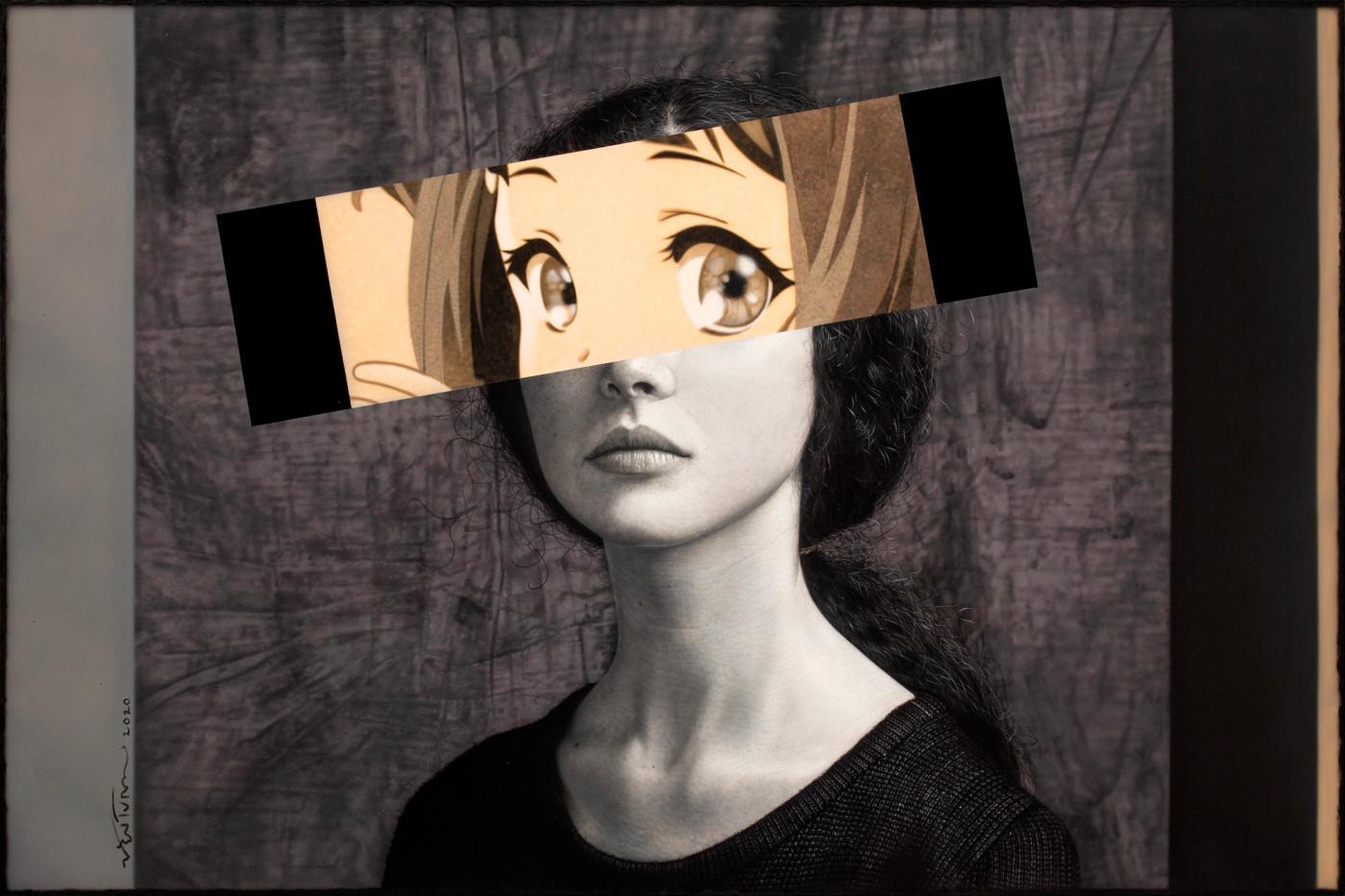
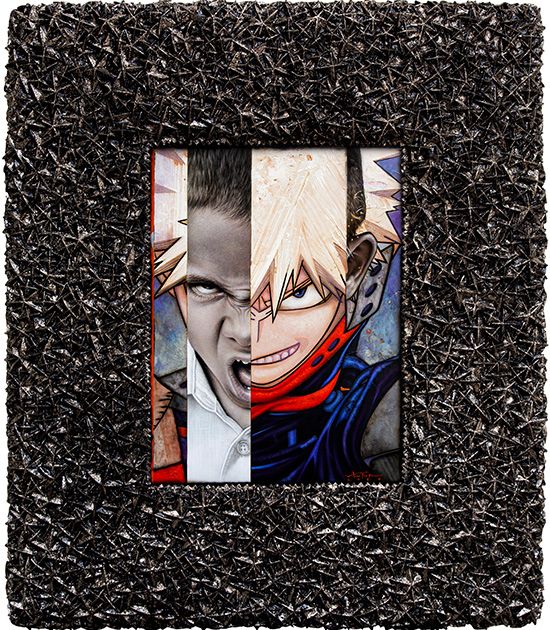
In his previous show at Whitestone Ginza New Gallery titled “Comic Lives,” he presented paintings with gulfs of stacked realities. In some of the paintings, anime eyes and hair are — “superimposed” is not the word we are looking for here, but rather — collaged or overlaid on hyperrealistically drawn images of women, statues or even (as meta as it sounds) “paintings.”
“This is how real life is,” according to Ventura. “Fast, instant, and disconcerting.”
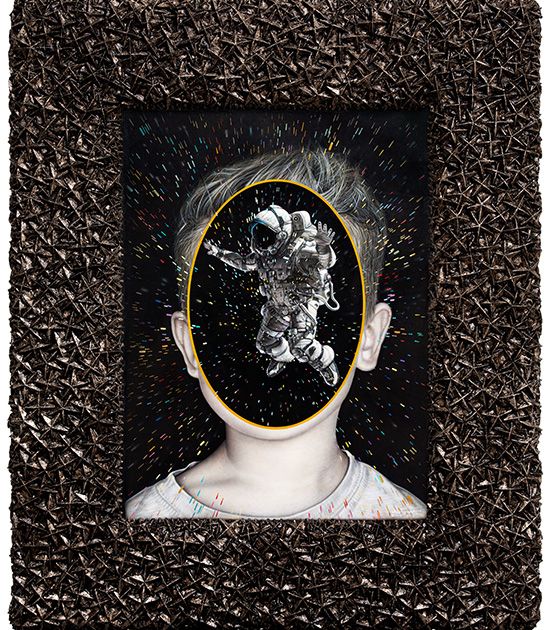
He shared his observations. Every day we are bombarded with a diarrhea of imagery: the dizzying number of channels on cable TV, the world wide web, distressful signals from our omniscient mobile phones, etc. Take the case of online shopping sites, he said. At your fingertips are an endless array of items you can buy — access is instant, choices are infinite, and decision-making is within seconds.
This is the tragic-comic aspect in today’s life: we live inside the screen, and the screen lives inside us. How digital methods have taken root in our analog madness.
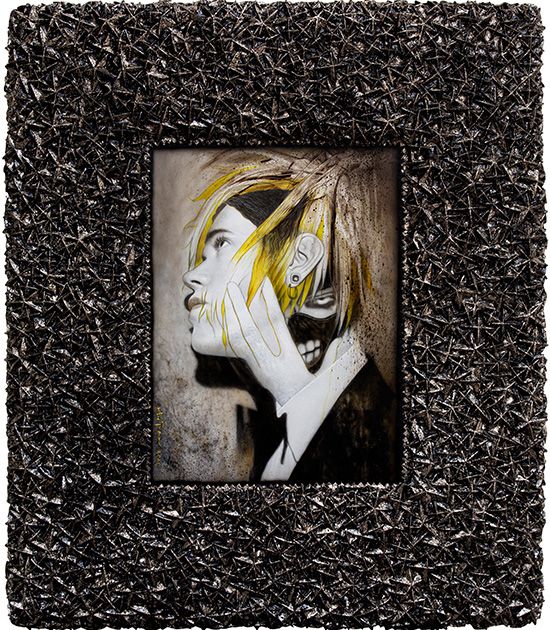
Human expression has been standardized in a handy set of “face characters” — or fingers, fruits, clouds, mug of beer, a unicorn with hearts for eyes, whatever emotions one feels “ATM” (At The Moment).
In England, teachers are reportedly making use of emojis to help their students understand Shakespeare’s plays — imagine how Hamlet could be interpreted using icons such as knife, crown, dizzy face, ghost with tongue sticking out. “To honeybee or not to honeybee, that is the question.”
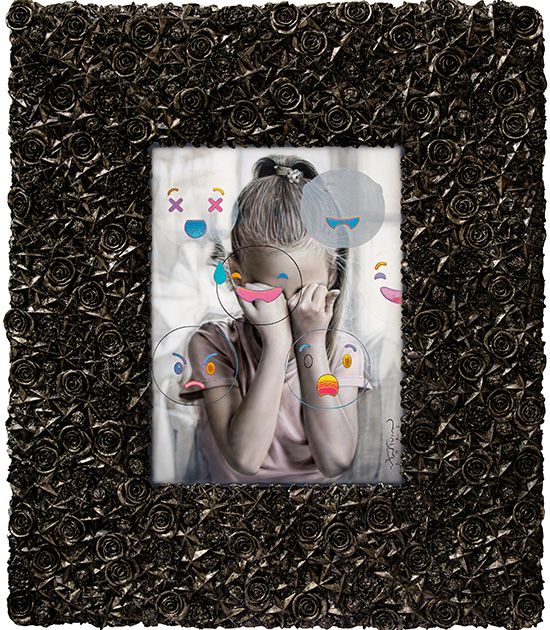
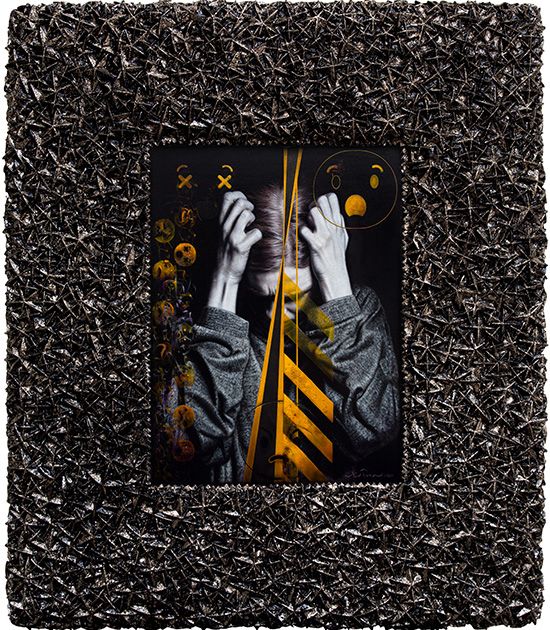
For this exhibition titled “Comic Stripes,” the artist is making the case that emoticons or emojis are usurping the role of words as signifiers. No longer treated as code or ciphers, these symbols are currently ensconced in modern human discourse: popular, ubiquitous, universal. “Even if they come in basic shapes and simple symbols… they are easily understood,” the artist pointed out. We get it right away. Our cave drawings have turned into plump yellow heads.
These observations have prompted Ventura to create works with sharpened — not blurred — boundaries.
Ventura’s three different hyper-realistic portraits of girls are intervened upon by anime eyes and a procession of emojis.
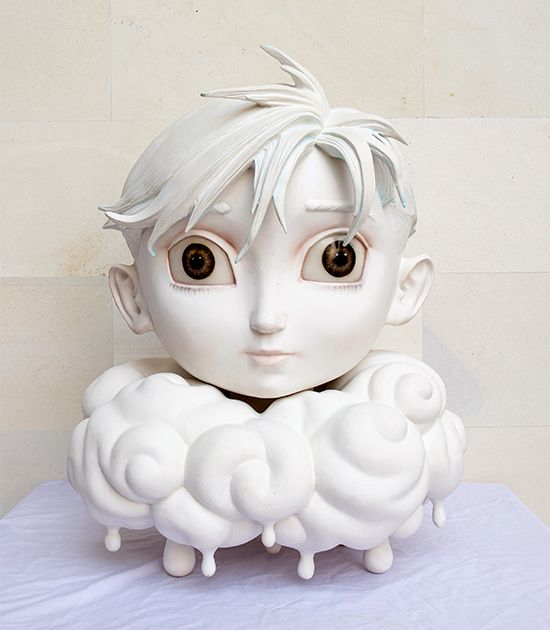
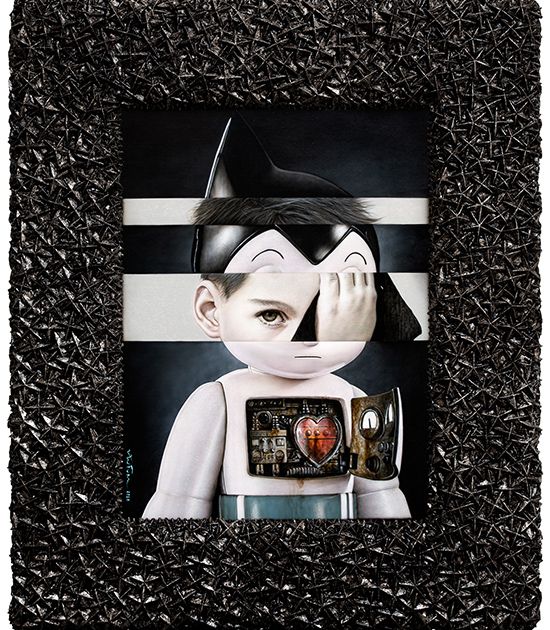
If “Comic Lives” bandied about astronauts and Donald Duck, the latest paintings and sculptures are more Japanese pop culture-centric: kawaii eyes, drill hair, Astro Boy, Naruto, anime, melted bears in pop colors, etc. Cuteness overload with a hint of something unnerving: the emojis are not merely “superimposed,” they are part of the reality being depicted, like flattened layers of what is objectively present.
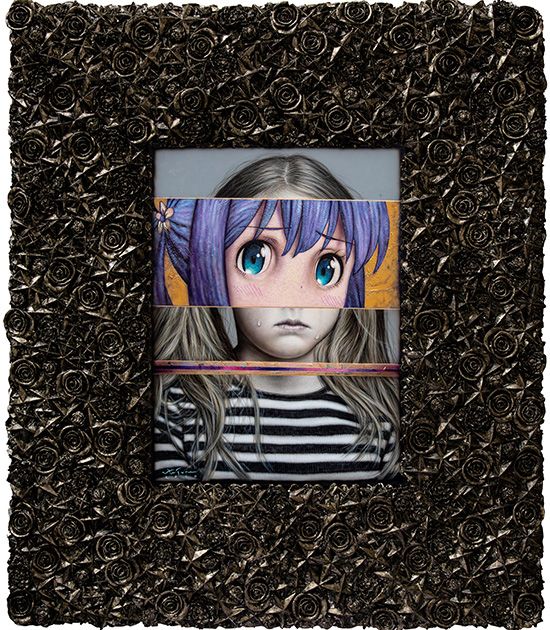
“Remember the movie Who Framed Roger Rabbit?” he asked, pointing out how cartoon and live-action characters interact on one plane of existence. “The world is turning into something similar: we can no longer distinguish between what’s real or not. They are totally mixed. We see everything simultaneously. The ‘glitch’ has been normalized.”
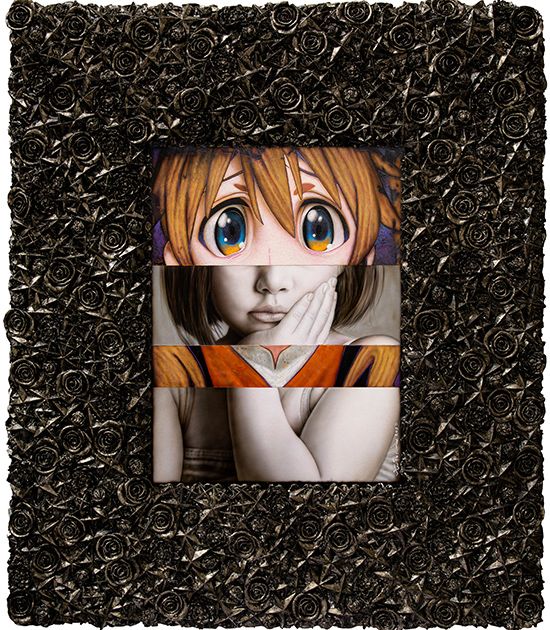
Have expressions become more animated yet less expressive? Have we sublimated our emotions into easily understood icons to mask our true feelings, often complex and irreducible? Do our kawaii eyes lie? Will the glitch run interlaced rings around us?
Both shows are co-curated by Ruel Caasi. Whitestone Ginza New Gallery is at 6-4-16 Ginza, Chuo-ku Tokyo, 104-0061, Japan. For information, visit www.whitestone-gallery.com. Karuizawa New Art Museum is at 1151-5 Karuizawa, Karuizawa-machi, Kitasaku-gun, Nagano Prefecture 389-0102, Japan.
A version of this story first appeared in The Philippine Star, 2021.


