In God’s country
Pilgrims once followed the Milky Way to Santiago. A hundred thousand a year still come, by foot, bike, bus and one donkey, now guided by GPS.
Part one: In which the author goes on a touristy quest of sorts, traveling to Spain upon the invitation of the National Tourist Office of Spain in partnership with Thai Airways, with Santiago de Compostela in Galicia, Spain as the final destination. The route to Santiago (which will be discussed extensively in part two) would involve taking lovely bus rides and even lovelier walks from Alcalá de Henares to La Rioja to Logroño to Santo Domingo to Burgos to Frómista to León to Astorga to O Cebreiro to the city of Santiago and back to Alcalá. With sustenance from a steady supply of morcilla (black pudding/blood sausage — an acquired taste) and rebojito (believe me, you’ll love this) and jamon serrano (more, more, more), and with the ever-patient Virginia González Quintana as guide, this questing writer from the Estrella Filipinas periódico would meet more guias (guides), residents, restaurateurs, shopkeepers and other blessed creatures in the course of the journey. No perils along the way. Only epiphanies over bottles of cerveza con limon and under Santiago’s field of invisible stars. Come. Just follow the cackle of scallop shells and the direction of the yellow arrow, wishing “Buen camino” to those we meet along the way. Reaching Santiago is the journey’s end, but as those minstrels from the New World called the Carpenters would look at it, we’ve only just begun.
Here’s the part where I talk to you directly. Just like one of those old, dying, memory-plagued characters straight out of the stories of the blind Argentine who wrote about dream-tigers, Jorge Luis Borges. Or like, well, Ferris Bueller.
For seven days, I — along with my trusty traveling companions (a fellow journalist, several travel agency executives, an airline GM and friends from Turespaña) — rode on a first-class bus that traveled the lengths of Northern Spain: from Alcalá de Henares, the birthplace of Miguel de Cervantes, all the way to Santiago de Compostela, the third most important Catholic site in the world next to the Holy Land itself and the Vatican. Journeying all day like modern-day pilgrims: sampling the cuisines, quaffing the many wines from the region, and, most importantly, digesting the stories and histories about the cities and small medieval towns we visited, as well as the lore about the cathedrals and chapels in the centers of the squares.
There we were: pilgrims with iPods, Kindles, cell phones and worries about the next catastrophes that would beset our world during these apocalyptic, not-so-apocryphal times. Like the faithful during medieval times — sans the ragged clothing and anti-marauder weaponry. Yes, almost like… if I could filch something from my atrophying, overpriced Literature education… Don Quixote. (Well, because of the crass jokes I would crack during the tour, I could very well be Sancho the jokester.) A new town, a new city, a different hotel each day. Places that were part of the medieval pilgrimage route: “El Camino de Santiago” or “The Way of Saint James.”
The touristy quest involved visiting the cathedral itself where the remains of Saint James the Apostle reportedly lie, with a virtual rosary of visitors, going round and round, down to the cold basement, to that casing of silver.
Saint James the Great is the Patron Saint of Spain, whose feast day the Roman Catholic world celebrates tomorrow, July 25. He is usually depicted on horseback with cockleshells, a sword and a pilgrim hat. After the death of Christ, lore has it that the apostles walked the earth to preach the gospels. James came to the Iberian Peninsula. Upon his return to Judea, he was beheaded by King Herod Agrippa I and, since it was customary to bury the apostles in the place where they preached, James’ remains were carried by sea to Iberia and buried secretly somewhere. According to legend, a monk named Pelayo discovered a marble ark in 813 AD, drawn to the site by a star — hence the word “Compostela” or “Field of Stars.” He reported this to Theodomiro, a bishop from the west of Galicia, who declared it as the sepulcher containing James’ remains. A chapel (which grew into a cathedral) and a shrine were established by King Alfonso II (who became the first pilgrim) on the fated spot, and pilgrims across the globe have flocked to it ever since. The travelers of yore traversed the old Roman roads, guided by the Milky Way. In our modern era, over 100,000 visitors come to Santiago each year — on foot, on bikes, on buses and even (we saw one, trudging uphill in Astorga) on a donkey — guided by maps and the electronic stars of GPS.
During our Camino de Santiago, it would be part of a magical-realistic trip festooned with legends about the saint grappling with evil wizards, zombie chickens, a bosomy statue of a woman that inspired the making of breast-shaped cheese (and prompted the profound question from one of the travel agents: “Is the cheese good?”), a knight who won his last battle while propped up dead upon his horse, and other tales that would beg for your suspension of disbelief. After all, talks about Finisterra or “The Ends of the Earth” blossomed from this region of Spanish castle magic. (Our tour bus reached the gateway of rolling hills toward Santiago with Bono singing in my iPod, “Our love shines like rain/In those Spanish eyes…” Right on cue.)
Staying in the Parador chain of hotels — ancient monasteries and pilgrims’ hospitals converted into five-star accommodations — in all the evenings (except one), visiting churches in mornings and afternoons, and partaking of delicious Estrella Galicia beer during mealtimes, we would be privy to astounding yet beautiful stories about
a) the Parador de Santiago beside a church that has a room specially built for the terminally ill so they could listen to Mass, and which they call “Observatory of the Dying”;
b) at the same hotel, the room where guitar master Andrés Segovia practiced his arpeggios because of the place’s fine acoustics;
c) and among other things:
1) a morgue converted into a restaurant with a bowling alley formerly beside it (both weird and wonderful);
2) a restaurant with a Michelin star in a village with a population of 30 residents (the food is heavenly);
3) a courtyard where the remains of 2,000 casualties in the Spanish Civil War are buried (ah, the scares of history);
4) the golden rooster weather vane (what a big cock!) in the place where the Kings of Leon (not the guys behind Use Somebody) were buried;
5) the tangled tales behind the splendor of the cathedrals that go from Gothic to Romanesque to even Neo-Classical and with Baroque flourishes — all semi-divine… and sometimes, these architectural styles can all be found in one cathedral.
To murder a line from Pablo Neruda, our days in Spain were short, but the forgetting would be so long. And as one guide would put it, “The Camino de Santiago is not just a pilgrimage; it is an experience of life.”
True, true. Jaime-Axel Ruiz, head of the Cultural Tourism Department in Madrid, and wife Elise kindly took us around and showed us a side of Spain that Filipino tourists would appreciate.
“Considering the Catholic tradition in the Philippines,” explains Jaime, “Santiago (to Filipinos) would be like an icon, a symbol of this cultural influence. To visit Santiago, and other historical cities in Spain, would be, for the Filipinos, an interesting reconnection with the past to better understand the present.”
The rhythm of the saint
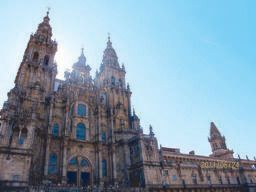
Our young guide, Paula Toimil Mato, met us at the Santiago square, the Plaza de Obradoiro. We stood at the mouth of the western part of the Santiago de Compostela Cathedral, a magnificent edifice with its bell tower and rattle tower (the rattling is heard on Holy Week when bells are kept from tolling). This is the spiritual beacon of the western world. Fronting it was Raxoi’s Palace (Pazo de Raxoi), the town hall; at its side was our hotel, a beautiful Parador that used to be a pilgrim’s hospital at the end of the 15th century, the Hospital Real.
The pilgrims, according to Paula, used to enter the north door of the cathedral and go out through the south. Upon the door is a sculpture of a blindfolded lady, a symbol of believing without having the need to see. The guide also explained the mystery of the scallop symbolism.
“The scallop shell, which had pre-Christian significance, stands for the beginning, the newborn. Pilgrims used the shell to put drinking water; they also used it as a spoon.” Very handy.
We went around to enter the cathedral to see the entranceway, the spectacular Pórtico de la Gloria containing 200 sculptures of Biblical history — from Adam and Eve to the four Evangelists to Saint John’s apocalypse of the end of time. Visitors — at least, they used to — knock their heads against the santo dos croques. Why? To absorb the genius of the figure, believed to be the architect of the doorway, Maestro Mateo. (Or to get one saintly headache.) Now cordoned off, there was a tall column that people touched to make their…not just one or three…but five wishes.
Paula reiterated the account of the founding of Santiago de Compostela as well as peripheral legends. “The story falls somewhere between legend and reality,” she said. “It’s a question of faith, though. To believe or not to believe.”
Take the case of this old Italian man in his sixties we met inside the cathedral. He cut quite a figure: bald, with a white Hemingway-esque beard, red jacket paired with camouflage pants, a walking stick in one hand and a bundle of newspaper clippings in the other. He had a spokesperson (or publicist if you will), a woman in violet velvet dress named Maria.
The man, Luigi Cianti, used to be a rich Italian businessman, living the high life and such in Rome. His wife died of cancer. Then one day, as he was driving his Ferrari, he got into a terrible accident. He survived, miraculously, and — like Saint Paul falling off his horse on the road to Damascus — he had an epiphany. He gave up all his worldly possessions (a fortune worth $7 million) and became a wanderer, walking for 17 years in four continents. And we bumped into him in Santiago as he arrived at the cathedral (not the first time, I presume; more like 34th or 35th). Maria the spokesperson said that his life story is well documented.
The man nodded and spoke in Italian, roughly translated into, “Google it.”
Here’s where the story turns into Luis Buñuel surreality. Apparently, this man has a “massage” from God. Something about a new paradise that doesn’t concern material wealth. Before parting ways, he asked us for, uh, a couple of euros as donation.
But we saw pilgrims not drawing any attention to themselves: they arrived on foot or on their mountain bikes, alone or in groups, sweaty, stinky, hungry, exhausted, shoulders sagged from the burden of their backpacks, with some nursing injuries, having traveled thousands of kilometers, sleeping in hostels (that go for as low as three euros for pilgrims with proper accreditations — not for Samsonite-lugging tourists), houses of strangers, and wherever night finds them. Footing roads upon roads lined with crosses and hórreos (granaries).
They quietly took their place inside the cathedral of their not-so-quixotic quest and waited for the pilgrims’ Mass, a sea of stories between each of them. They’re Italians, French, Spanish, Russians, Americans, Canadians, Japanese, Koreans, etc., coming from — pardon the pun — all walks of life. You could see it in their faces: that light inexpressible.
They made it.
“People that you find along the way — (they are the ones who) really build the Way,” remarked our tireless guide Virginia. “People who, with their personal experiences of spiritual search, make the Way become the symbol and metaphor of Christian (life) and the human condition.”
A quick stop at the market then we had to rush back to the cathedral toward the end of the noon Mass to catch the swinging of the botafumeiro (an incense-smoke-burning metal ball hanging from the dome itself), its upswing reaching a height of 21 meters and its velocity of up to 68 km/h. Like a holy pendulum of sorts, going from north to south to the comp of the cathedral organs, its cord pulled by eight men. The existing one was built in 1851, a silver-plated brass beauty. Why was Paula in a hurry for us to see it? Because the botafumeiro is only brought into action for special occasions. We were the fortunate ones — only some of us (hypnotized more by the swinging souvenir trade in the marketplace) didn’t know it.
We made our way to the side chamber of the main chapel with a colossal statue of the apostle in polychrome stone. Visitors lined up downstairs for a chance to put their arms around it, or simply touch the golden cape. A stairway led down to the crypt where the remains of James and his two disciples, Teodoro and Anastasio, lie.
Hearing the last strains of the Baroque-sounding keyboards as the botafumeiro swings from the ceiling (it’s a wonder that thing didn’t hit anything), with the pilgrims, tourists, holy men and a scattering of non-believers with the believers and their watchful eyes underneath the flying censer — to steal a phrase from a frequent Santiago visitor — was “creepily cool.”
The Mass had ended. Go in peace.
Not surprising to have felt that way inside the cathedral at the End of the World.
For particulars about the Camino, e-mail areaturismo@santiagoturismo.com or visit www.santiagoturismo.com.
Special thanks to Turespaña, NTOS Singapore, Paradores, World Heritage Cities, and the La Rioja, Castille & Leon tourism offices.
Our trip to Santiago de Compostela was hosted by The National Tourist Office of Spain and Thai Airways. All words and opinions are our own.
A version of this story first appeared in The Philippine Star, 2011. Print edition.


