Houses of the Holy
Floating on the Dead Sea, ten seconds inside the Holy Sepulchre, and a rabbi’s joke about the price of a phone call to God.
DEAD SEA, Israel — I am at the lowest spot on earth and I feel high.
No, it’s not because I have surreptitiously taken shots of liquefied qat leaves known (and chewed) far and wide in Yemen, the Arab Peninsula and the Horn of Africa as having components similar to amphetamines that cause excitement, loss of appetite, and the “E” word — not ecstasy but mild euphoria.
This we learned when we walked Anthony Bourdain-style inside Jerusalem’s Mahane Yehuda Market the day before, looking, poking around, thinking of literary or cinematic references to compare with the experience (top one on the list for my travel mates: Yentl), some of us sampling the racks upon racks of falafel, fruits, meats, nuts, pastries, and endless aisles of bread enough to feed 5,000 people I’d presume. There was a stall of qat leaves and a working blender. Lechaim! This is me drinking rocket juice. This is my brain on qat. This is me flying.
That was me lying. The journey to Israel the Land of Prophets is euphoria-inducing enough. It gives you a spiritual high. I can’t believe I am actually in Bible-land. My first recollection of the holiest of places was learning about it during Sunday classes at Dominican School and from a book of illustrated Bible stories. Also from watching movies on the old RPN-9 channel such as Jesus Christ Superstar (the riff, that overture, the Deep Purple singer in the OST, Yvonne Elliman gently singing “Could We Start Again Please?”), Jesus of Nazareth (Laurence Olivier, James Mason, Ian Holm and McShane, Christopher Plummer and Robert Powell), and The Bible (the “Sodom and Gomorrah” segment is eye-popping… also when Adam meets Eve).
As one gets older, one learns about the saga of the Jews in Europe, the Holocaust, the Nazis and the abominable Final Solution in history class; and then, in Current Events, the decades of unrest in Israel itself, the territorial disputes, the fragile peace, and the breaking news.
“Yes, we have conflict, but we do have a life,” explained Israeli Ambassador to the Philippines Menashe Bar-On during a meeting with us Israel-bound Filipino journalists, adding that there is more to the State of Israel than what is reported on CNN, BBC, Fox and by the wires… something beyond the headlines.
The embassy recently invited representatives from The STAR and another publication on a weeklong trip to show what Israel is all about: a multi-cultural and diverse nation, a country visited for pilgrimage, business and recreation. A land that is biblical (Jesus walked here for christsake), historical (Jerusalem was built, destroyed, and rose up again) and contemporary.
The contemporary part may come as surprise to those who think Israel is confined solely to the religious and what’s writ in crumbling books of yore. In the next few days, we pilgrims would see a Ron Arad contemporary art installation at the Israel Museum in Jerusalem; whatever’s on view at the Tel Aviv Museum of the Arts; everything exhibited at the depressing yet life-affirming Yad Vashem Holocaust Museum in Jerusalem…you walk into dark and emerge into light, the journey in between giving you a heaviness of heart; and all that’s left of Masada, where the Sicarii rebels made a doomed yet courageous stand against the heavily armed Romans in 73 AD, ending in the defiant Jews’ mass suicide. (More on these places in an upcoming article.)
We would learn about electric cars and get a spin in one in a place called, well, a Better Place Center.
We would watch a performance of a blind-and-deaf theater group called Please Touch.
We would tour Haifa, the sister city of Manila, and meet the vice mayor, Hedva Almog (a tough-as-nails lady who used to be a commandant in the army). Haifa, poised upon the slope of Mount Carmel, is called the “Pearl of the North.” Rightly so.
We would see Israel’s very own Silicon Valley, drop in at Haifa’s Hi-Center, a mega technological incubator (where some of the country’s brightest minds are working on new technological wonders and how to introduce them to the market… Einstein would be intrigued).
We would visit Agrostudies and learn how Israelis use advanced agricultural studies to cope with the shortage of land and lack of natural resources to create one paradigm of a farming industry (and, a bit ironically, teaching Filipino students the latest in agricultural methods — we would meet five of them, industrious lads). Israelis are survivors since they have no choice but to survive and, as a result, thrive, thrive and thrive some more; while we Filipinos, who are blessed with so much land and the best of nature’s bounty, have fallen behind our Asian neighbors — agriculturally and economically. (But we do have a lot of malls, though. Billboards as far as the eye can see.)
We would also visit Tel Aviv’s Rothschild Boulevard, its plush apartments and Bauhaus buildings, and the city of Jaffa, the ancient gateway of Israel with the Mediterranean lapping at its feet. And we would be toured by a guide named, I am not making this up, Or.
And we would be treated by Israel’s Department of Foreign Affairs to gustatory kosher delights (the best hummus-and-bread combos on the planet); some of us would watch shows (Mayumana), some of us would go portside in Tel Aviv and drink scandalous amounts of Goldstar and Maccabee beer; and I would find myself drunkenly singing a Rolling Stones tune onstage with a blues band in a bar right beside the US Embassy (“Gimme, gimme, gimme the honky tonk blues…”), moving like Jagger and meeting a girl with pink hair to the strains of Love in Vain.
All in a supposedly unsafe and ultra-conservative country, would you believe?
For now, here I float belly-up on the lake of salt called the Dead Sea with its thick, oily and salty consistency. It is Day two of our biblical mystery tour. I’m in shorts, flopping around like a crane stuck in spilled oil, or Blake Griffin after a non-existent foul. From Jerusalem, just after lunch at Ima at the same time as the crew from CNN, we took an hour-and-a-half van ride through the Judean desert (somewhere out there once stood the walls of Jericho), passed by Bedouins on camelback, past the mighty Masada fortress, and into a land 400 meters below sea level. We checked in at Dead Sea Crowne Plaza beside Lot’s Hotel. (See, Lot’s wife turned into a pillar of salt and what did he do afterwards? Open his own business; this guy was forward-thinking, didn’t want to look back unlike… nah, just kidding, couldn’t resist.)
Because of its salinity and high-mineral content, the Dead Sea allows no living thing to flourish and you cannot do anything but float — even if you’re the Bizarro counterpart of Michael Phelps and can’t swim to save your life during Shark Week. It’s disorienting: you float in an area where you’re supposed to be dogpaddling already. You will float, my friend, as you watch the sky turn vermillion during sunset, hear tales of how the Dead Sea Scrolls were discovered in Qumran, and watch a herd of tourists lounge on the beach, their legs marinating in saltwater and bodies slathered with black mineral mud. This body of water is, after all, famous for its healing properties. (Psoriasis, begone!) A rash I had with me forever would disappear the next day. A miracle.
Hey, King Herod the Great turned the Dead Sea into one of the world’s first health resorts. That guy pursued pleasure (building a proto-spa, a bathhouse in a desert fortress, even an artificial mountain for his mausoleum) and chased delights the same way bad mojo pursued him. The guy’s a tool. Josephus wrote that Herod died from an excruciating illness. “Herod’s Evil,” he diagnosed.
“Skin disease… when he was 69,” Zivit Sari (our golden light of a tour guide) would inform us on top of Masada the following day. “Pieces of Herod’s skin began falling off.”
Yes, we are in the land of stories as many as the grains of sand in the desert. And that morning, we began at the garden.
Morning in the Garden of Good and Evil
“There is a law in Jerusalem that all the houses and buildings must be built with a particular stone,” Zivit explained as we made our way to Gethsemane. An off-white limestone, the Jerusalem Stone gives the city a very unique atmosphere; makes touring seem like a journey through space and time.
We passed the Mount of Olives and into a church with an enclosed garden, its name derived from Aramaic meaning “oil press.”
You know the story: Jesus spent his last night as a free man agonizingly in the garden, just after having supper (his last) with the Apostles, and just before Judas Iscariot arrived with Roman soldiers and gave the most infamous kiss in biblical lore.
So, there we stood at the Garden of Gethsemane with our guide Zivit; in front of us, the Basilica of Agony or Church of All Nations with a section of the rock that Jesus prayed on the night of his arrest. Some of the olive trees in the garden are a thousand years old. The barks and branches attest to their ancientness. Gnarled and bent, as if twisting painfully into prayer. On the other side, headstones clamber up the Mount of Olives.
Off we went to another spot in the Old City. Zivit talked about its significance. “This is one of the most important places that we can show you in Israel because of the (possibility of the peaceful) co-existence of religions,” she explained. “We have the Tomb of David down here, which is a sacred place for Jews. Upstairs we have the Hall of the Last Supper, which is a sacred place for Christians. And for Muslims, King David is very important… and in different periods of time they made this building into mosques.” A synagogue, a church and a mosque in one structure — that, dear readers, is the heart of religious tolerance.
“You come into Israel with all these preconceived notions of people fighting, groups in conflict as reported by media,” Zivit insists. But when you actually go to Jerusalem, you’d see Ultra-Orthodox Jews, Christian and Muslims, holy men and ordinary folks walking the streets, talking to one another — just another day in a life of the Old City. “In spite of the clashes, I would say 95 percent of the people just want peace. And they have done so for generations upon generations. This building is a symbol of that.”
We snaked our way to the winding roads of the Old City, right at the heels of a Bar Mitzvah parade on a Monday, a boy’s coming-of-age party.
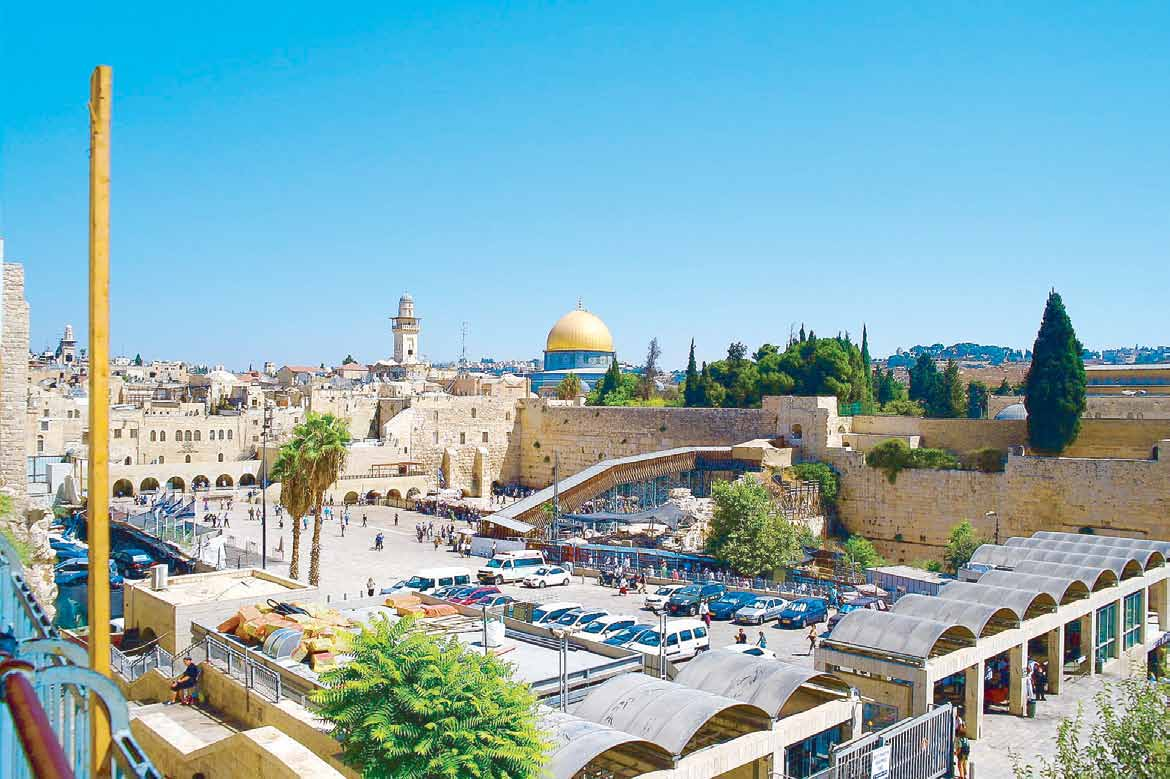
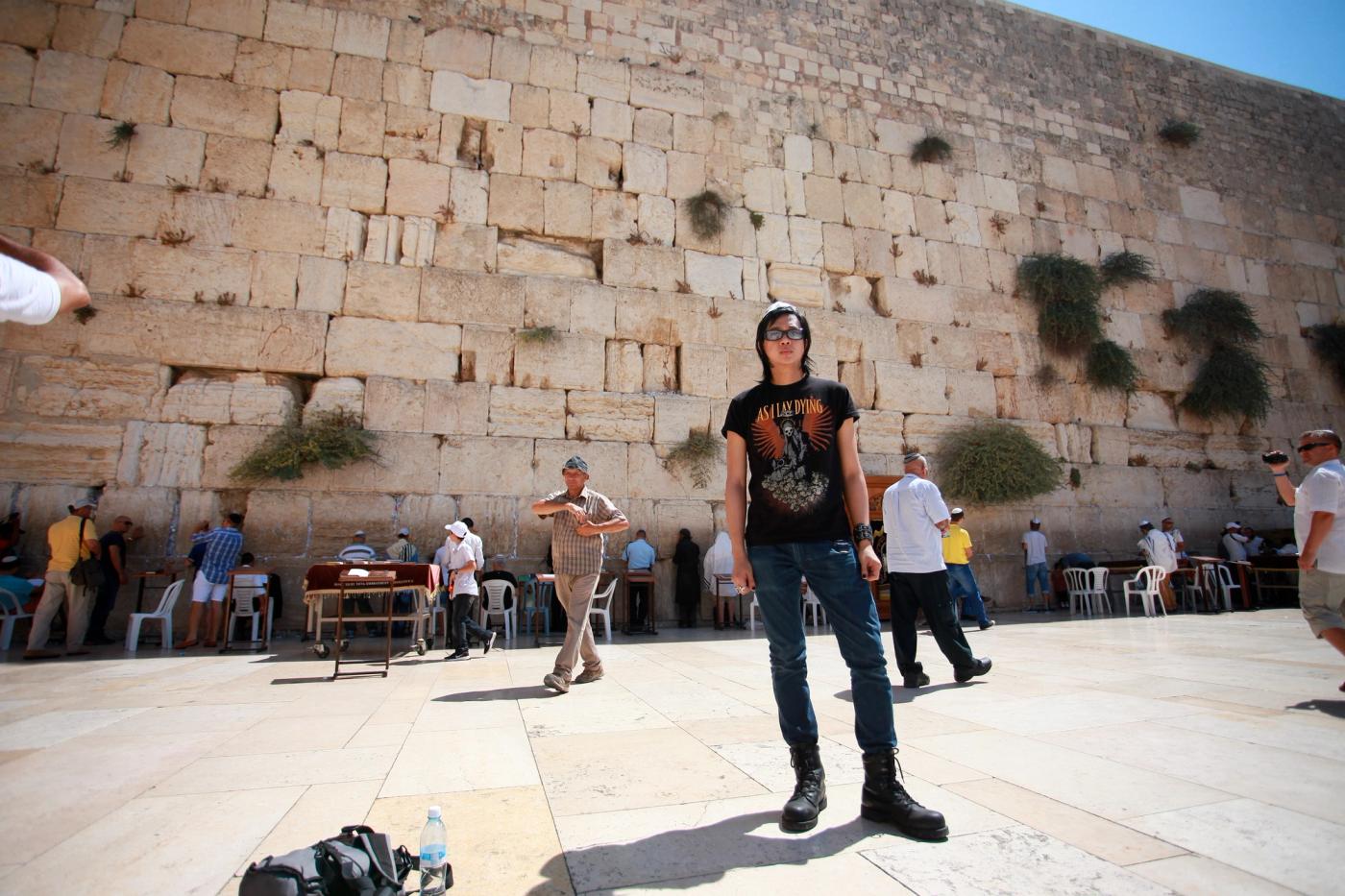
Then we found ourselves staring at the Western Wall (men on one side, women on another), the only fragment of the Great Temple to survive the Roman destruction, and the most sacred structure of the Jewish people who feel that the divine presence has never departed from those ancient stones.
What is the reason why devotees slip papers with written prayers into the crevices of the Wailing Wall, we were curious to know.
In a comical mood, Zivit told us the story of the Pope and the Rabbi. One day, the Rabbi visits the Pope in his office, and the Rabbi sees a golden telephone. “What’s that for?” The Pope answers, “Every time I want to call God, I pick up the telephone.” The Rabbi is amazed, orders the same telephone. The Pope visits the Rabbi in his office and sees a golden telephone as well. “Oh, so you use that to call God?” asks the Pope, “because from my office in the Vatican it’s very expensive — 10,000 euros per minute.” The Rabbi nods. “Here it is just 10 shekels per minute.” The Pope is shocked. “How come from my office it’s expensive, and from here it is so cheap?” “Ah,” the Rabbi answers. “Here in Israel, it is a local call.”
After hearing that from Zivit, we made our way into the Western Wall to put our own little Post-its upon God’s gate.
“Today, you can even Facebook or e-mail the Wailing Wall,” Zivit remarked. “God is very updated.”
Station to Station
As we rode the van headed for Via Dolorosa or the Stations of the Cross, I thought we were going to a little church with paintings or bas reliefs of the Stations of the Cross mounted on the walls. I thought wrong: we were headed for the actual Stations of the Cross.
From the station where Simon of Cyrene helps Jesus in carrying the cross, we walked uphill past the spot where Veronica wipes the face of Christ, past the other stations and stalls upon stalls of food and dried goods and souvenirs, and toward Golgotha or the Hill of Calvary. We spotted pilgrims carrying crosses of their own toward the hilltop. A common sight, said Zivit.
Our last stop was the Church of the Holy Sepulchre, which is said to contain the tomb where Jesus Christ was buried. For some this is where the story ends for Jesus; while for others, death was only the beginning for Christ, who was said to have been crucified over the place where Adam’s skull was buried.
So, it is believed that the Redeemer was crucified on top of the spot where they buried the first Sinner. Dig the parallelism.
“This is a Greek Orthodox chapel,” explained Zivit. “You see people getting in line to touch the Rock of Calvary. Tradition has it that when the crucified Christ finally stopped breathing, a drop of blood touched the stone, and an earthquake occurred.” The cracked rock can be seen under glass on both sides of an altar.
There is also the Stone of Anointing, which tradition claims to be the spot where Jesus’ body was prepared for burial by Joseph of Arimathea. Here, tourists have their rosaries, other sacred items, and personal belongings (such as handkerchiefs) blessed by placing them upon the stone.
We lined up around the Aedicule itself, which has two rooms: one containing the Angel’s Stone, a fragment of the stone believed to have sealed the tomb after Jesus’ burial, and the second one is the sepulcher itself.
We had just 10 seconds inside the chamber with Jesus’ tomb, announced the surly priest in charge. The room was small, barely enough space for four people. It would give claustrophobics fatal panic attacks. But it gave me flashes of everything: the descent into hell, the judgment of the living and the dead, the resurrection of the body and life everlasting (everything we learned in Sunday school) and, oddly enough, a grunge song from the ’90s sung by a guy who mentions Jesus a lot.
All in a span of 10 seconds.
Yes, the room was small. But it was thousands of years wide.
Gallery photos by Raymund Isaac
A version of this story first appeared in The Philippine Star, 2012. Print edition.


