Frankfurter Buchmesse 2023: Why books matter in a time of war & the ongoing assault on truth
Books are being banned, censored and even burned in parts of America. In Germany, they hold the world’s largest trade fair for books.
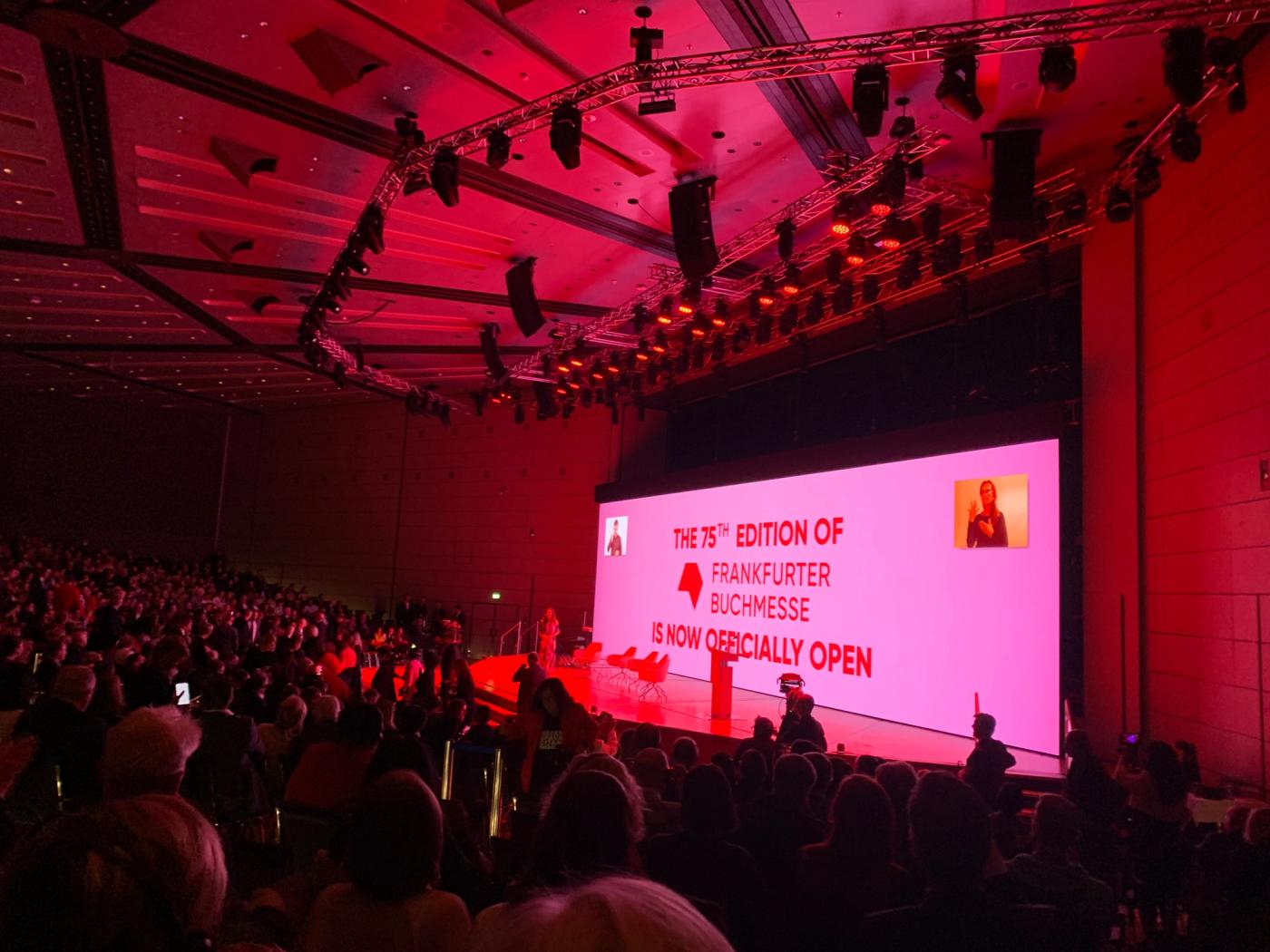
In one of the strangest plot twists in the most bonkers of timelines we could ever imagine, books are being banned or censored (burned, even) in parts of America, while in Germany, they have just wrapped up the world’s largest trade fair for books: the 75th Frankfurter Buchmesse (FBM). A fair that recognizes the mystifying appeal of a stack of papers glued or sewn together bustling with words exploring histories, creating multiverses, sharing a sea of stories. Oh, how many of us have found comfort in a book — getting lost in Macondo or Yoknapatawpha County, stressing over that rascal Raskolnikov, knowing why Gregor Samsa could not report to work that morning or who exactly “wept at the romance of the streets with their pushcarts full of onions and bad music.” Books were our amulets against school bullies, abusive relatives, and teachers who did not have the capacity to understand us. Books — just like songs by The Animals — offered a way out. We chilled to books before Netflix or Disney shoved Riverdale and The Marvels down our throats. Now, people are glued to their iPhones watching other people lip-sync, do stupid pranks, or stuff food into their gaping maws. Histories are being erased wholesale. Journalists are getting tagged as enemies of the people. George Orwell and Margaret Atwood books get bandied about on Twitter without actually being read. (Don Jr. rails at stuff being “Orwellian” many times, trumped out of his gourd.) It’s like we are in the fifth and final act and still there are more clowns coming out of the clown car. (By the way there was a proposal to ban Anne Frank’s Diary of a Young Girl because — according to a parent — it is “a real downer.”)
At the Frankfurt book fair, on the other hand, German kids and teens lined up to have their favorite authors sign their books. Some dressed up as anime or comic book characters and cavorted on the fairgrounds. (What Filipinos usually do in toy conventions.) After the publishers, booksellers, literary agents, and other players from the global publishing industry had their exclusive digs for the first three days at the bookstalls (to negotiate international publishing rights and license fees, to shop for that potential bestseller, etc.), the public swooped in during the weekend. It was glorious to behold. Nothing nerdish or esoteric about reading books in this part of the world. It is rather essential, integral.
But the recent Frankfurter Buchmesse itself was not immune from any controversy. “There is a black cloud above all of us in the world, a dark shadow cast by war,” said the host during opening night of the book fair. “What is the power of books in these difficult times?”
A number of Arab publishing associations pulled out of the fair in protest over its decision to postpone the 2023 LiBeraturpreis award ceremony honoring Berlin-based Palestinian author Adania Shibli. There was an uproar during the speech of Slovenian philosopher Slavoj Žižek as he condemned the decision as scandalous. Zizek also made remarks about the Israeli and Palestinian conflict that irked a number of people in the audience. He was repeatedly interrupted by Uwe Becker, the Anti-Semitism commissioner of the German state of Hesse, who stormed out of the hall, stormed back in, and shouted at Žižek in mid-speech. That, dear readers, escalated quickly.
Thankfully, civility prevailed. It is important to make sure that everyone can be heard, according to Juergen Boos, president and CEO of the Frankfurter Buchmesse GmbH. “I’m glad that somebody interrupted the speech. It (should be allowed). I’m also glad that we listened to the speech to the very end — even though we didn’t like it, or maybe even condemn it.” The way Boos eased the tension down a notch was masterful.
During a crescendo of shelling, the march of fascism, and onslaught of unsettling events, do books still matter? Well, more so than ever.
Claudia Roth, Federal Government Commissioner for Culture and the Media, explained, “I’m convinced that, especially in times like these, reading opens our eyes. It creates understanding across all borders and it teaches us empathy. It is right now that we need the freedom to think of the diversity of books and perspectives — and this is what the Frankfurt Book Fair represents. Reading allows you to experience things you never experienced yourself. It enables you to have new insights and perspectives. With every chapter, with every new page, we can overcome opposites, which sometimes seem irreconcilable in our everyday life. Reading proves every day that despite our differences we can understand each other. That our society is by no means doomed to drift apart.”
She stressed the importance of holding an event such as the Frankfurter Buchmesse. “(Fostering a) diverse publishing landscape in our country is invaluable to our democracy. And this is why the thousands of books presented here every year are good news. Good news for our country, for our society.”
FBM, by tradition, stands for the joy of reading and the fun of stories, but it’s always been very political as well. Boos, who has been the Frankfurter Buchmesse president since 2005, shared how the book fair is completely unique in the world. “And I’m so lucky to be in the middle of it and be involved with it and, to some extent, also to shape it. And it’s a great challenge, sometimes — also it’s shocking, but it’s also very rewarding.”
What the world needs now is a festival of thinkers and readers rather than a congregation of trolls and truthers.
Roth described the book fair as “a marketplace of words.” She asked, “What would be at stake when you no longer trust the word?”
Karin Schmidt-Friderichs, chairwoman of the German Publishers & Booksellers Association, said, “Reading forces us to stop and think.” And with a bang of the hammer, she declared the 75th Frankfurt Book Fair open. It is important to note that the German Book Trade awarded this year’s Peace Prize to Salman Rushdie, joining a list that includes Atwood, Susan Sontag, Amos Oz and Václav Havel, among others.
“This is a strong and clear signal against fanaticism,” said Roth, “and for the power of the book, for the power of the free word — and this is exactly what stands for the Frankfurt Book Fair.”
Rushdie mused over the power of books: “When a reader falls in love with a book, it leaves its essence inside him like radioactive fallout in an arable field. And after that there are certain crops that will no longer grow in him, while other stranger, more fantastic growths may occasionally be produced.”
The book fair then is a field of phenomenal fruits.
A version of this story first appeared in The Philippine Star, 2023. Print edition.


