City of blinding light
To run or not to run, I ask myself, rushing past the Winged Victory of Samothrace and Eva Mendes, also touring the Louvre, herself a work of art.
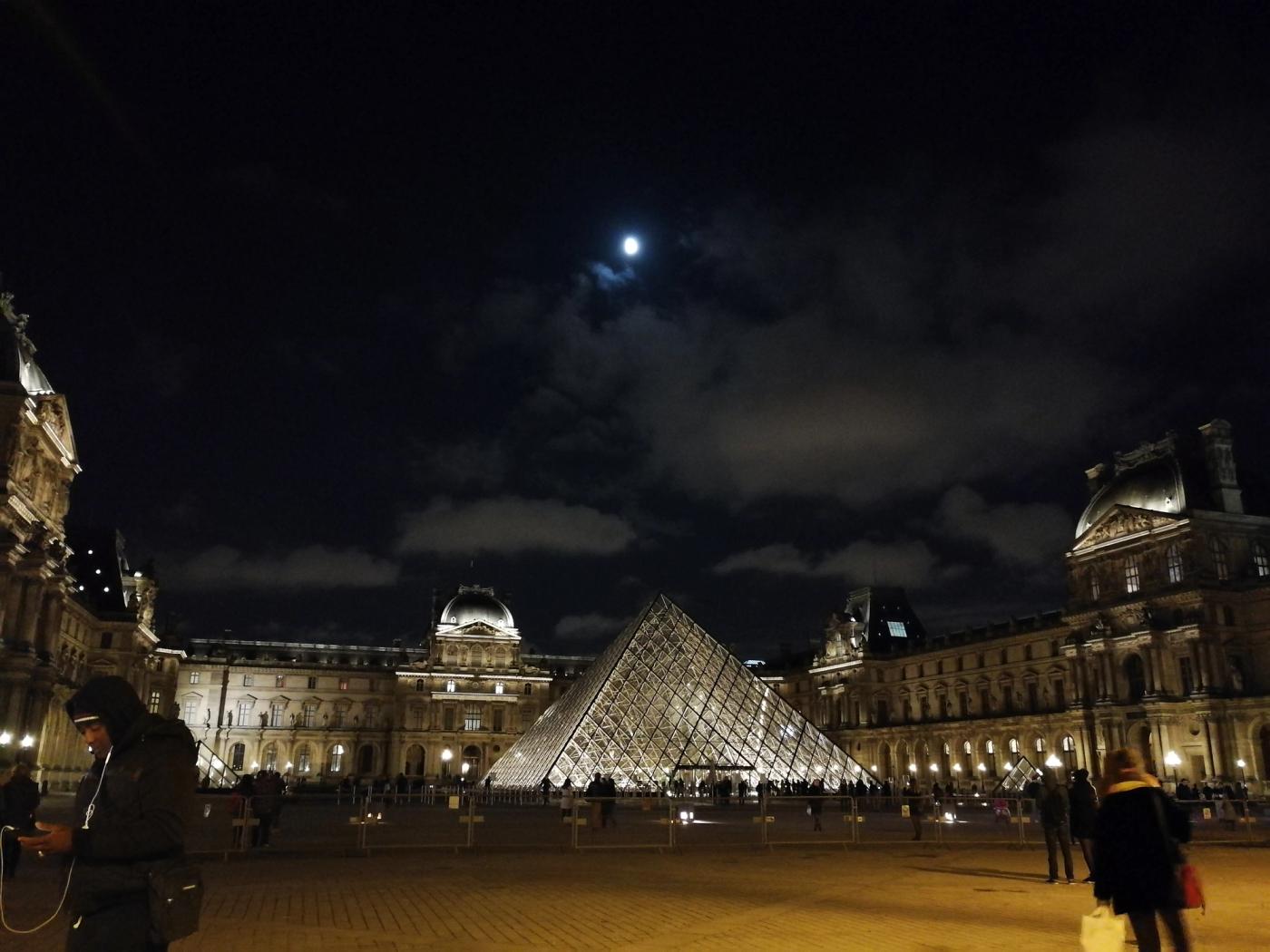
I am thinking of going on a mad dash across the halls of the Louvre in Paris. In slow motion just like in a Wes Anderson movie, soundtracked by 12-string guitars and harpsichords or a samba version of David Bowie’s Ziggy Stardust and the Spiders from Mars.
You see, I have roughly 30 minutes to look around before I meet up with a fellow journalist inside the glass pyramid designed by I.M. Pei, and I haven’t even seen the “Mona Lisa” yet. That morning in my hotel in Saint Honoré I read in The Guardian about artist Martin Creed’s show at The Tate in neighboring Britain. Creed is infamous for his Turner Prize-winning installation called “The Lights Going On and Off,” wherein — as you guessed it — the lights in the gallery are turned on and off. The artist’s current opus titled “Work No. 850” involves a single athlete running at top speed through the Duveen galleries at Tate Britain, as if chasing something or obsessively sprinting to relieve himself in the restroom. It is not unlike a relay race with 15-second pauses just like a rest in a piece of music, Creed told The Guardian. “Running fast is the opposite of death: it’s an example of aliveness.”
The seed of Creed’s inspiration can be traced to his visit to the catacombs of the Capuchin monks in Palermo. The artist and his friends had only five minutes to see the museum, so they trotted madly across the panels of dead bodies. He says, “It made me think, why do we have to look at paintings for a long time? Why not just look for a second?” Why should art be always static or wall-bound? Why can’t art be about motion and dislocation? The organization called Artangel mounted something called “Margate Exodus,” which recreated the events of the Book of Exodus in the seaside town involving 5,000 participants. And that’s just one example.
To run or not to run, I ask myself as I rush past the Winged Victory of Samothrace and the actress Eva Mendes also touring the Louvre, herself a work of art. If you’re staying for, let’s say, three to four days in Paris, everything is abbreviated. The day before, I spent only two hours at Musée d’Orsay, a converted railway station that houses awe-inspiring works by Van Gogh, Degas, Rodin and Cézanne. I can say I have stood before the very gates of Hell. Well, meaning Rodin’s sculpture based on Dante’s The Inferno. Having watched Sam Neill’s In the Mouth of Madness far too many times, I wondered what if those doors opened. Would I see devils and hell-spawns? Or would I merely see illegal recruiters, child molesters and gambling lords standing on the other side, if I were to believe Sartre’s premise that hell is other people.
Speaking of the French Existentialist who famously turned down the Nobel Prize, Sartre and his flame Simone de Beauvoir hung out for hours in Parisian cafes trying to solve the problems of the world. I learned this aboard an “Illuminations” tour bus.
Paris is the navel of the world. As the bus went past the tree-lined boulevards, make-out bridges, animated cafés and buildings so beautiful in their stony silences, all I could think of was the motley cast of characters who at one point in their lives considered the City of Lights the center of the universe. James Joyce with his epiphanies about river-runs and the ineluctable modality of the visible. Henry Miller with his freeloading and free associations. Pablo Picasso and his Protean, Promethean legend.
Story has it that the Nazis once visited Picasso in his Parisian apartment at the height of the German occupation. The Gestapo chief saw scattered inside the artist’s apartment postcards of “Guernica,” Picasso’s masterpiece depicting the bombing of the Spanish city Guernica by German bombers.
“Did you do this?” asked the German, holding up the postcard.
“No,” retorted Picasso, “you did.”
In France they kiss on Main Streets
That’s what Joni Mitchell said. From the bus window I saw young French students exchanging gums and saliva on the make-out bridge as the Seine flowed darkly below — shades of Remembrance of Things Past. Marcel Proust must have passed here inside a cab. I learned inside the tour bus that Proust would flag a cab to the Ritz and then when he got there he would tell the cabbie to lend him 10 francs and keep them as tip. What a wise guy.
The “Illuminations” package offers tourists a trip around Paris at night — scattered with monuments, hotels, churches, fountains, bridges and canals. From the Paris Visions office, the bus would traverse the Place Vendôme, the Paris Opéra, the Louvre, Latin Quarter, the Bastille, Rue de Rivoli, Place de la Concorde, the Madeleine, Rue Royale, Champs-Élysées, Arc de Triomphe, Trocadéro, Eiffel Tower, the Invalides and Notre Dame de Paris. The recording purveyed more interesting information.
Molière staged his plays at the Paris Opéra…
Gargoyles and stone dragons sit atop Notre Dame, an asylum for anyone on the run. Its great doors embossed with virgins, the chosen and the damned. No hunchbacks, though…
The Franco-Prussian War resulted in famine within the walls of Paris. People had nothing to eat. There were about 20 million rats in the city. What food source do you think the elders recommended at that time? Consider a ratatouille dish consisting of Ratatouille himself…
A fountain near the center of the city is decorated with tritons and mermaids, one of which was reputedly modeled after Victor Hugo’s mistress…
Leonardo, not the one from the Teenage Mutant Ninja Turtles
All around the streets of Paris are posters of La Mouche. I think nothing of it at first only to find out later on as I walk the hallways of the Louvre that La Mouche is an opera version of David Cronenberg’s The Fly, featuring an orchestra conducted by tenor Plácido Domingo. An opera about body horror? I can just imagine the scientist (played by Jeff Goldblum in the movie) singing, “Be afraid, be very afraid,” in a deep bass-baritone voice. Nose falling off on cue.
But my deepening horror is going to the Louvre and not being able to see the “Mona Lisa.” I decide to make a hasty exit from the Richelieu Hall, have a quick lunch and then go back to the galleries. I have managed to go inside the Louvre for free that morning because of my press ID. I have done the same in institutions such as the New York Museum of Modern Art, Tate Modern, d’Orsay, and other museums in Scotland and Spain. One of the few perks of being a journalist abroad.
After coffee and bagels, I go back to the Richelieu Hall. The guards won’t let me in. They call the manager who tells me my press ID is not honored in the Louvre, and that I should have paid the nine-euro entrance in the first place. It seems I have been stealing stares all morning.
For a moment there, I — like Martin Creed — want to make a mad dash for the “Mona Lisa.”
A version of this story first appeared in The Philippine Star, 2009.


