Baroque and roll in Heidelberg
‘Put your foot here and you will return to Heidelberg and live happily ever after,’ our guide says. I stepped into the impression. (Narrator: It would.)
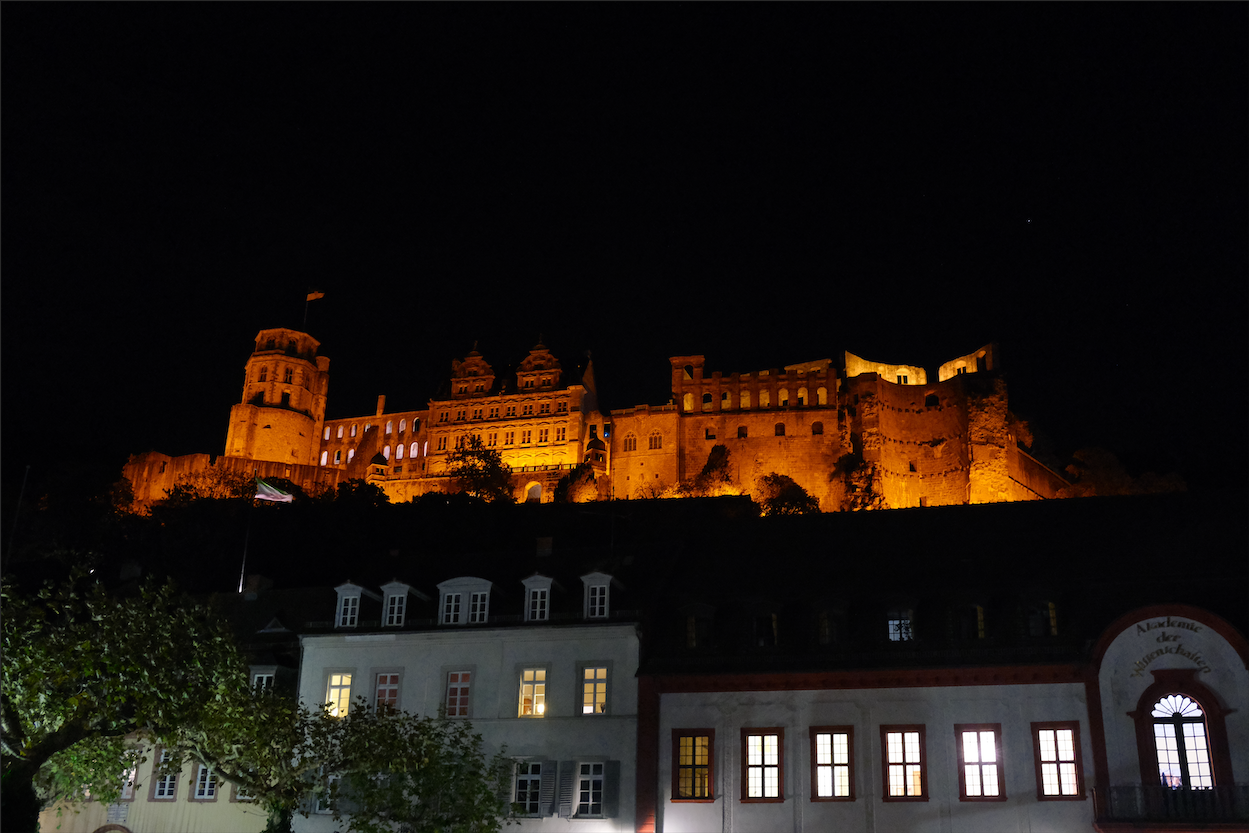
As if the Snow Queen and the Winter King threw a pajama party.
It snowed heavily yesterday in Frankfurt and its fringes, making me half-expect John Carpenter’s Thing to pop out of the snowblinding landscape. But today it is sunny — almost tropical, almost like Cape Town in summer. Fine time for a tour of Heidelberg.
Our tour guide, an American named Charlotte Frey, tells us how some tourists flew in from Florida aboard their private jet yesterday (shades of Lifestyles of the Rich & Famous). The tour had to push through. Money can’t buy good weather or a guest appearance by the sun, though. “The (rich tourists) didn’t even attempt to hide how miserable they were,” Frey recalls with a laugh, adding that they walked out in the middle of her dissertation on Heidelberg Castle because it was freaking cold. Would’ve frozen Robin Leach to death.
“It’s all right because they have the world,” Frey tells our group composed of journalists from Southeast Asia. “It’s great that you guys have sunshine instead.”
German Castle Magic
We are in Germany for the “Light + Building” fair — the biggest exhibition in the world to feature future trends on lighting as well as home and building automation and fixtures. I arrived in Frankfurt on a Sunday morning, took a cab out of the airport, and witnessed my cabbie get into a shouting and shoving match with a bus driver. The verbal tussle was so salacious (it seemed that the two held deep, festering grudges) to the point I started wishing for subtitles. Shops were closed and streets were deserted. Feeling like Allan Jones of Uncut, I head over to the hotel pub to imprudently spend my precious few euros on pitchers of German lager with a tall glass of bar nuts courtesy of the bartender. First day of the assignment and I was blowing everything on bitter brew. As if on cue, Teutonic rock ’n’ roll slithered from the speakers; it was Oktoberfest in April. I braced myself for the Scorpions. Two lovers at the corner table fed each other peanuts, while I watched an emptying mug all afternoon. Two lovers entwined… Time flies when you’re not having fun.
That was days ago. A daze ago. Here I am now listening to Frey talk about how the River Neckar flows quietly through Heidelberg, a city in Germany’s Baden-Württemberg area, two hours away from Frankfurt Main. She was quite delighted to meet a Filipino because a famous Pinoy made Heidelberg home for several months. José Rizal loved this German city, apparently, and this German city loved him back. There is even a bronze sculpture of Rizal in Wilhelmsfeld near Heidelberg. It portrays our hero in a wistful mood.
Rizal was the guest in the home of Wilhelmsfeld pastor Karl Ullmer. Frey surmises that Rizal finally completed Noli Me Tangere in Ullmer’s home. “This was the most serene period in his life. He became good friends with Ullmer and his family. He even drew pictures for Ullmer’s kids. In the end they pleaded with Rizal not to go back to the Philippines because of the fate awaiting him there. The rest is history. During Rizal’s birthday the Knights of Rizal put a wreath of flowers in front of his statue in Wilhelmsfeld.” (If I get to see historian Ambeth Ocampo, the first thing I’d ask him is how Rizal really spent his time in Heidelberg.)
Frey takes us around the city, showing us visual aids from time to time — images of a Heidelberg woodcut by Sebastian Münster, doomed lovers Princess Elizabeth Stuart and Prince Elector Friedrich V, Mark Twain who wrote A Tramp Abroad in the Schloss Hotel overlooking the castle, a young Rizal wearing a sash, etc.
We take a short trip aboard a train that clambers upward — I think they call it a funicular railway. More walking. More pointing to landmarks from a great height. The gateway to the castle here, the Old Bridge and the Philosopher’s Walk (Philosophenweg) there. “Zigzagging up the mountains, through the trees is Philosopher’s Way,” she says. “You can get a breathtaking view of Heidelberg from there.”
At the center of the Corn Market (Kornmarkt) is a statue of the Madonna. “This was the place where corn and grain were sold,” Frey informs us. “And this is considered the most beautiful baroque statue in Heidelberg.” More beautiful baroque buildings. More delicious histories. More information about this Frederick dude who brought on the Thirty Years War.
We pass by tall trees and the guide points to white buttons with numbers on the trunks used in cataloguing the trees. “One tourist thought that those buttons were audio tags, so he pressed one and waited. What did he expect to hear? ‘Hello, I’m an elm’?” Frey says with a giggle.
We find ourselves on top of the world’s biggest barrel and learn about a midget who had an insatiable thirst for wine. He was invited by Prince Elector Karl Philip to be the court jester and guard of the vat. “Every time the people in the king’s court asked the midget to have more wine, he’d say ‘Perché no?’ meaning ‘Why not?’” Thus, his name became Perkeo. “Today, there is even the Perkeo Society in Heidelberg composed of people who love good wine and good food, and who are always in a merry humor.”
Frey is puzzled that no one wants his or her photo taken beside the Great Vat. The reason: it’s dark as hell in there. But the guide manages to cajole the Thai journalist to strike a pose. And the resulting photo? Mostly black save for a blurred white face not unlike Sadako’s.
Hail Heidelberg
In one of the churches Frey takes us to the Lazarus Tower with burning candles and names of the dearly departed. Near University Square we spot the plaque marking the apartment where Rizal lived for a few months. In front of the Witches Tower that very few Heidelberg citizens know the exact location of, we hear about reported apparitions and wailings in the area, as well as a “strange electric feeling on moonless nights.” Frey glosses over the dark bits and instead points to benches around the tower where lots of couples first met and eventually got married.
The guide takes us to a part of the castle overlooking the river and shows us a foot imprint on the stone floor. “If you put your foot here, you will return to Heidelberg and live happily ever after,” she says.
Legend has it that a princess tried to commit suicide by leaping from a tower since her father did not approve of her relationship with a knight. She jumped. She landed on the stone floor and — get this — bounced. After leaving the footprint (that girl had a big foot; she’s probably nicknamed Shaquilla), she ended up in the Neckar Valley unharmed. Well, save for an ankle sprain, perhaps. As a result, the father finally relented. The lovers got married, lived happily ever after and all that jazz.
I stepped into the impression. Might work, might not.
The following morning, when my host tries to book me an earlier flight back to the Philippines, we can’t access my e-ticket because the Internet server in the hotel is down. Strange, this being a German city and all. And when we finally get Web access, her laptop starts acting up. Keeps hanging. She smiles. “I think you’ll be staying in Heidelberg a bit longer.”
A version of this story first appeared in The Philippine Star, 2008.


