The solitary saga of Manong Frankie
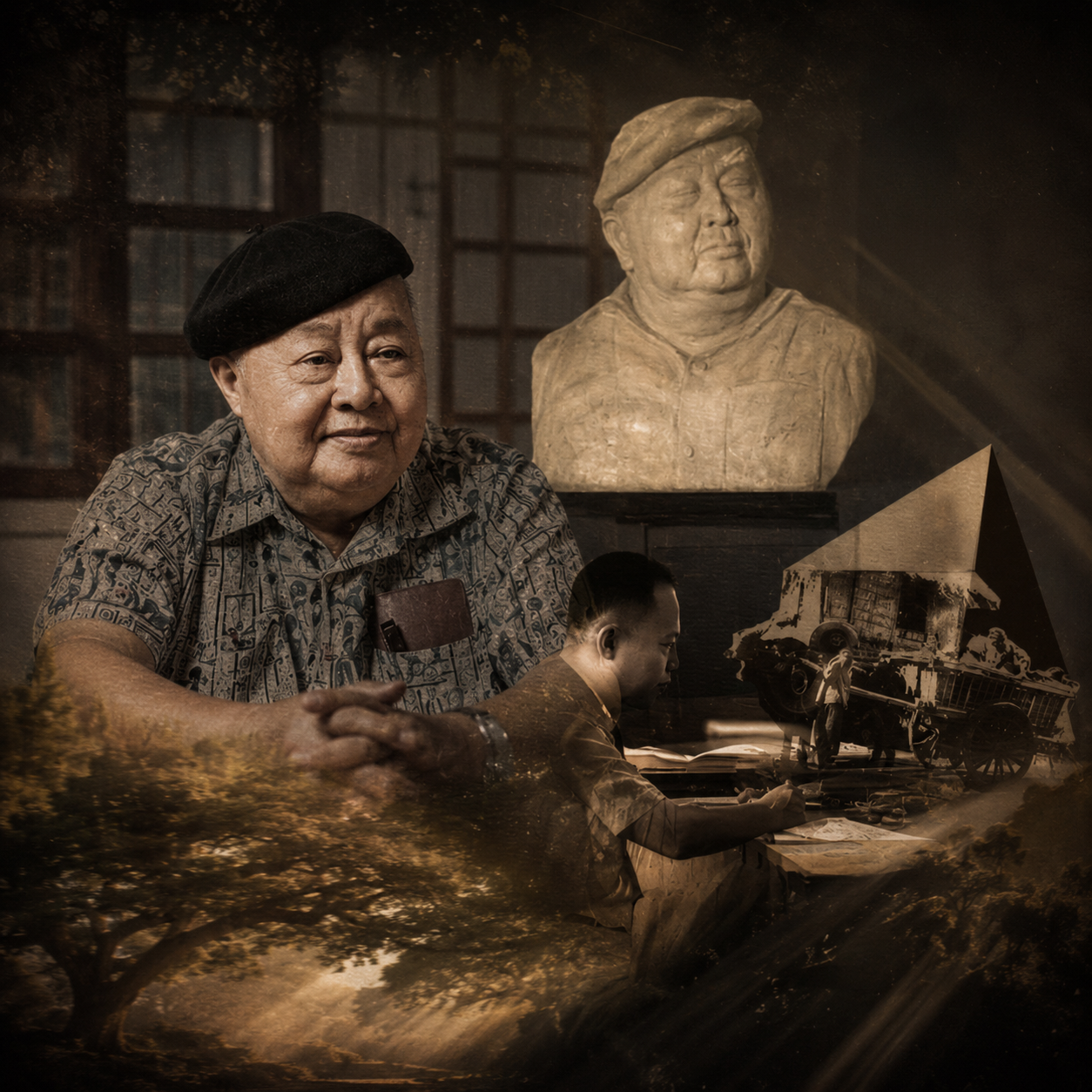
‘When you write,’ Manong Frankie said in a voice that could fell ancient trees, ‘it’s not just with words.’ There is a trail of a life in every word.
It is one thing to read books in mellifluous contemplation — with the sun shining, birds singing, all is well. It is a different experience altogether when reading books as the apocalypse unfurls outside your window — with a pandemic raging on, politics polarizing “us” against “them,” doom-scrolling becoming a nightly thing.
But the greatest pieces of prose or poetry obliterate what is outside the pages: all that is left is just the reader, book in hand, long lock-downed afternoons ahead to disappear into the pathways and alleyways of the printed word. A universe of code, ciphers and characters.
We get to join the Samsons and the Asperris and the thorn-strewn roads of society in an epic saga set in the Rosales town of Pangasinan; Istak, a farmer able to speak Spanish and Latin and who gravitates more to writing than farming; Don Carlos on his deathbed, spinning a web of lies and trail of tears; and a host of others. War, rebellion, colonial baggage, class struggle, patriotism in all variants, oligarchy in all stripes, turmoil, redemption, pretenders, truth-tellers, slum-dwellers, god-stealers, a past that mutates, refuses to die or is brought back in all its writhing, putrid un-glory — this becomes your reality as a reader when clutching an F. Sionil José book. Not the real, humdrum one outside, full of sound and fury signifying adulting. But something more revelatory.
F. Sionil José, National Artist for Literature and STAR columnist, passed away on Jan. 6, Thursday, at the age of 97. The man was supposed to undergo angioplasty on Friday, according to his wife Tessie. Manong Frankie apparently died in his sleep.
“Thank you, brave heart,” posted Manong Frankie on his Facebook account on the afternoon before his passing, seemingly prescient and prepared for whatever is about to come:
“There are times when as an agnostic I doubt the presence of an almighty and loving God. But, dear brave heart, you are here to disprove this illusion, to do away with the conclusion that if you doubt Him, you kill Him. I cannot kill you, dear heart; you have to do that yourself. For 97 years you have been constantly working patiently pumping much more efficiently and longer than most machines. Of course, I know that a book lasts long, too, as the libraries have shown, books that have lived more than 300 years. Now that I am here waiting for an angioplasty, I hope that you will survive it and I with it, so that I will be able to continue what I have been doing with so much energy that only you have been able to give. Thank you, dear brave heart, and, dear Lord, for this most precious gift.”
Oh how strong that heart was, so was the head that was moved by its every beat. A mind that put up all those literary constructs and events; stubborn, opinionated, as well as unrelenting to the point of antagonizing a lot of fellow writers. Manong Frankie did not hold back. In his Hindsight columns, he was always this old-timer raging against something, anything. (For more of that, just read his more controversial columns and the ensuing backlash.) But the man I got to meet was different: he was always warm, encouraging and supportive.
A few years before the world went to shit, I visited Manong Frankie in his Solidaridad bookshop. That place holds a lot of memories. Let me backtrack: as AB Literature students in the University of Santo Tomas, my classmates and I would go there once we got our allowance and hope we could procure for ourselves a Faulkner by Modern Library or a Foucault by Vintage or a vintage Quijano de Manila or — not a favorite of Manong’s — José Garcia Villa, we being unabashed bookworms.
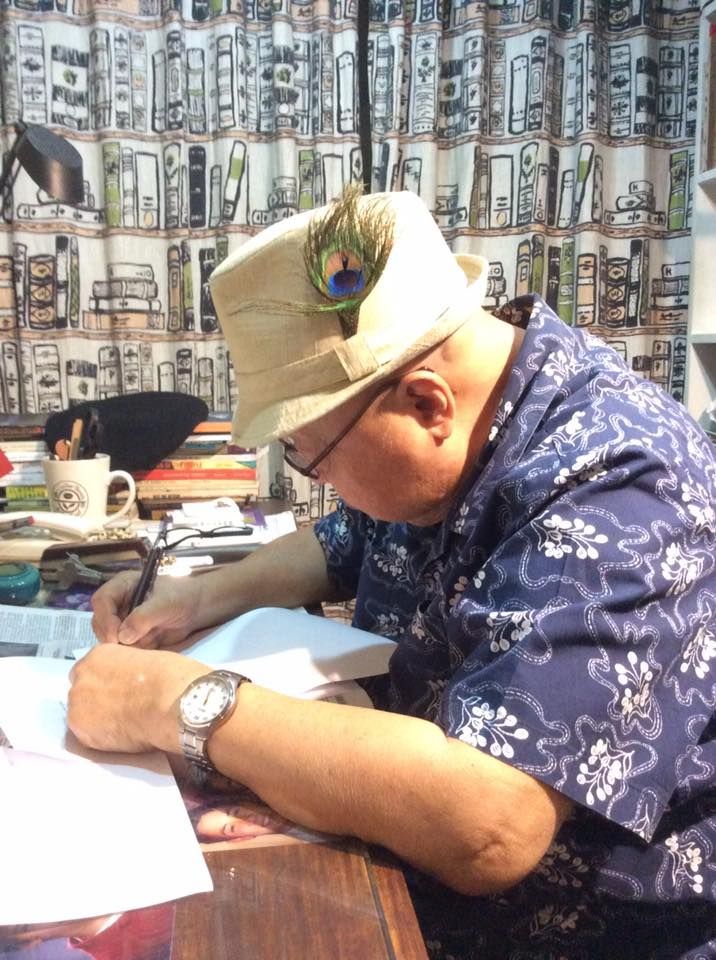
On the second floor is an office. From downstairs we could hear the thundering voice of the owner. We knew who it was: a writer with mountains upon mountains of stories, and rivers upon rivers of inspiration and passion in impaling words down by longhand in his journal or neatly typewritten on shroud-white paper. There is a meeting room on the topmost floor, up a flight of narrow stairs. Decades later, I would find myself in that very room: a long, nondescript afternoon would turn into an unforgettable chat with the man himself.
In there is a small study that the writer called his “den of iniquity” with its imposing wooden table, an electric typewriter, a snooze nook, artworks, and racks of his own novels and collected short fiction translated into 28 languages. If you could see an infinite, time-lapsed snapshot of all the men of letters who have visited the area, you could see Günter Grass on a corner bench by the dining area with Norman Mailer and Mario Vargas Llosa nearby. Countless other authors of worldwide renown all came to see the man and talk shop.
Imagine one of the Philippines’ literary giants wasting his precious time on me, spilling the secrets, giving out a tutorial, what video-gamers call a walkthrough, like a musician-uncle impressed when his nephew started fingering rudimentary D-A-G chords. F. Sionil José — one of the Philippines’ most critically acclaimed authors abroad, one of the country’s most prolific, one of its most widely read — told me this, as if I should’ve known it all along (and not a sort of terrifying secret of the universe as Jorge Luis Borges put it so worryingly and blindingly brilliant in Ficciones):
“When you write,” he said with a voice that could fell ancient trees in forgotten forests, “it’s not just with words.” There is a trail of a life in every word, he added.
He once declared, “The writer’s own life is now his richest material; he must study himself, shed all sense of pride and be naked to his own creative eye. He knows if he is his own critic that art is the most tyrannical and demanding mistress he has to serve with unblemished constancy.”
Yes, a life shadowed by ideas, social empathies and, most importantly, a soul.
Manong Frankie said being called “the old man of Philippine letters” was a dubious distinction. “I am 86; most of my contemporaries — the first post-war generation of writers — have gone and I am the last to bear witness to what transpired historically and culturally in the last century and on to this new and uncertain age.”
Newness. Uncertainty. These are the monarchs of our time. But writers such as F. Sionil José provide us with a history, with roots, with a racial memory, and with a foreshadowing of what terrors and delights our future might hold.
He advised aspiring writers, “Nurture memory because it will be your most important asset, because without individual and collective memory, there is no nation.”
Those words are crucial for each one of us disappearing behind the looking-glass of our smartphones and laptops, flexing and ratioing with abandon. We have forgotten to remember, though. We have TikTok-ed and Reeled our way into oblivion, dancing maniacally. And that would spell the doom of our nation.
Nation is an essential element in F. Sionil José’s prose, almost achieving character-like status in his oeuvre. His epiphanies deal with a nation in search of itself, as well as the need to address social iniquities and transform the lives of average Filipino families. His novels — essential readings such as Viajero, Sin, Dusk (Po-on), and the tomes in the Rosales Saga (“this saga is my homage, my humble tribute to my unhappy country…”) — can be enjoyed by the richness of their narratives, as well as the ideational slap of their social commentaries.
Oh, the stories spun by an unguarded F. Sionil José during our talks:
How he once spent three days writing feverishly, not eating, not sleeping, chronicling the grand sagas spinning in his head.
How he once told a young artist, “You could become rich, you could become famous, but if you don’t make social commentaries with your work, you would never be considered great.” “What about Van Gogh?” somebody wise-cracked. Manong Frankie retorted, “Have you seen ‘Potato Eaters’?” F. Sionil José, one; heckler, zero.
How in a Klaus Zeller book launch he berated some socialites who were chirpily chatting during a speech: “Peasants behave better than you!” The Rhinoplastied matrons could only stare.
How he enjoyed writing in places like Tokyo and Paris (“no telephone calls, no friends, no Manila newspapers”).
How he still enjoyed writing even in his twilight years — calling a character “Esperanza” after watching Stanley Kubrick’s adaptation of Lolita featuring James Mason as Humbert Humbert, and after rereading Nabokov’s classic.
How he conceptualized a sci-fi novel with nods to The Picture of Dorian Gray.
How he reiterated that a person could discover much about the country by reading its literature.
How he laboriously spent days, working his butt off in his study on Padre Faura, or in his home in Quezon City. That was his solitary saga.
Love’s labors are un-lost: the great man has left us all these myths created, histories revisited, fiction to help us become who we are. They are all there in libraries and bookshops waiting to be unraveled and pored over. A heady road trip into a Rosales town without checkpoints, rapid tests or quarantines.
“Not a day goes by,” said the old man of Philippine letters, “that I don’t write.”
Up to the very last moment, in a love letter to his old broken heart, that was what he precisely did.
A version of this story first appeared in The Philippine Star, 2022.


