The Art of Drowning in Visions
Glenn Bautista drew Rizal’s monument from a line by line transcription of his 39 poems, then vanished for 15 years. On the artist we forgot.
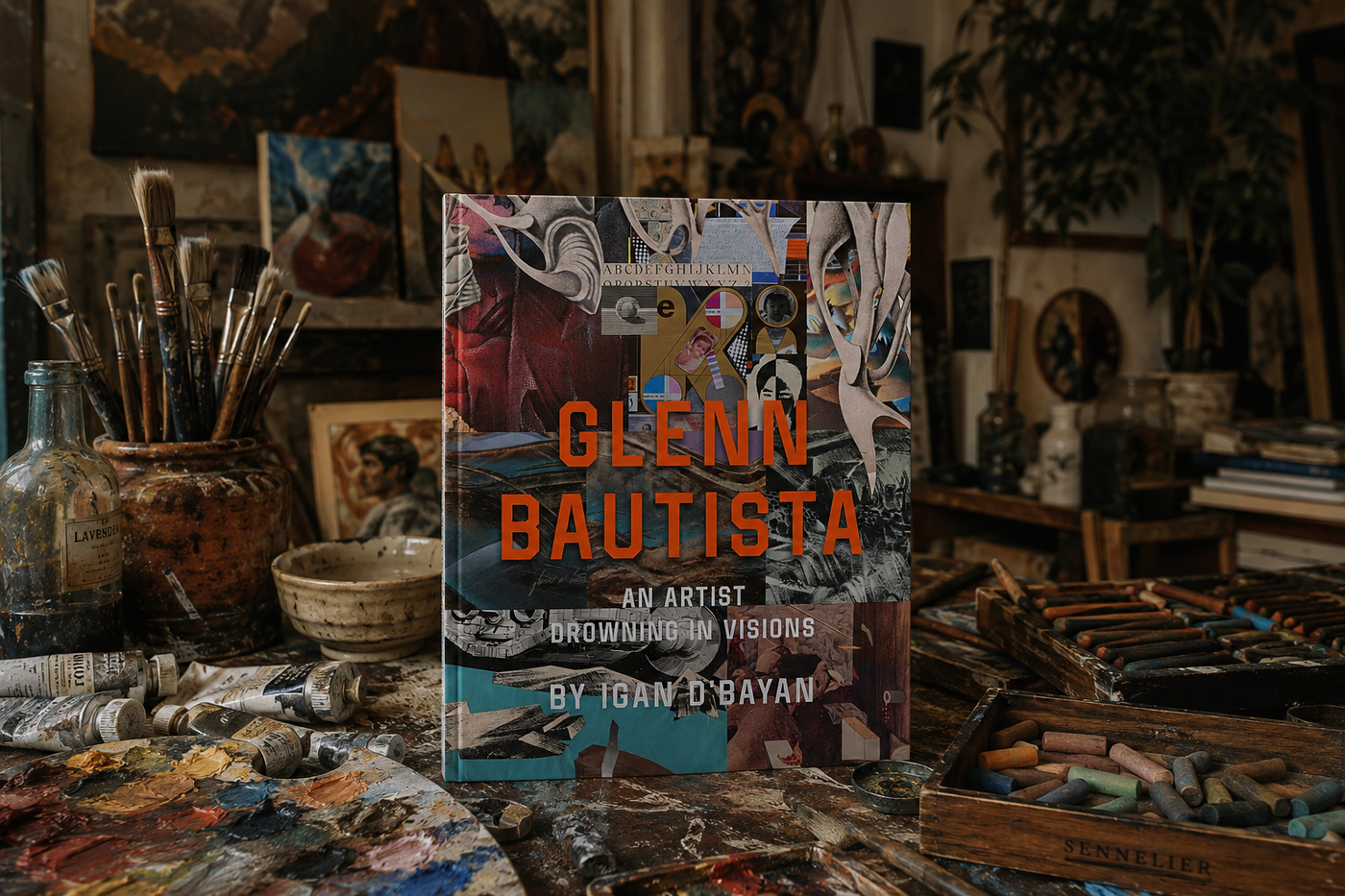
Ah, Glenn Bautista, the aesthetician of “Orgamiscapes” and “Sonicas” with his masterful strokes and restlessly probing mind… why isn’t he as celebrated as other artists who don’t even have a quarter of his mad skills?
Bautista once created a massive pen-and-ink rendering (measuring six feet by three feet) of José Rizal’s monument at Luneta Park using a line-by-line transcription of Rizal’s 39 poems including Mi Último Adiós (Last Farewell) and a song titled A orillas del Pasig using different stylus sizes of Erograph technical pens. It took him two years from 1965 to ’67. The precision and patience were astounding. So too was his ink-on-paper drawing (also measuring six feet by three feet) of Guillermo Tolentino’s Oblation at the University of the Philippines (UP), with tones and shadows achieved by drawing differently spaced parallel horizontal lines. The artist said it was reminiscent of the lines on the screens of old television sets. Imagine the hours spent grappling with lines: nothing but ink, lines, and seeming infinity. Just as his contemporaries were painting barrio lasses and society matrons. So, why hasn’t Glenn Bautista received more accolades?
Gallery Genesis owner and art patron Ernie Salas may have the answer.
He tells us how Bautista became a hermit for 15 years. The artist kept away from the art scene for personal reasons and then followed his wife Lorna to the U.S. where the two of them stayed for many years until Glenn’s death in 2014.
Salas explains how the art community tends to have a very short memory. Collectors, institutions, and colleagues are aware of a particular artist when he or she is still active, but a prolonged absence tends to turn everything blurry, hazy, and sadly unmemorable. Bautista is a perfect example of a forgotten but highly talented, well-respected, and widely recognized artist during his active period in the Eighties up to the late Nineties. After he left the country, almost collective amnesia set in, that cycle of aimless forgetting.
Bautista had two retrospectives: one at the Cultural Center of the Philippines (CCP) Little Gallery in 1987 titled “Halo-halo,” covering over 20 years of prolific art-making, and another at the National Museum of Fine Arts in September 2016, two years after the artist’s death, a retrospective of 300 works. He even mounted a one-man show simultaneously in nine galleries at the Art Walk of SM Megamall. When Bautista went to Germany in the Eighties, he specialized in lithographs and became friends with controversial German artist Joseph Beuys. The Joseph Beuys. The guy with his head coated in honey and gold leaf explaining art to a dead hare in the iconic 1965 performance piece immortalized in old black-and-white photographs. Glenn’s 1985 series of artworks titled “Cut-Outs in Paper & Wood” became part of the permanent exhibition of Galerie Art 204 at Rethelstraße, Düsseldorf, in the company of Beuys as well as European masters Max Ernst, Marc Chagall, Salvador Dalí and Joan Miró.
Salas points out Bautista’s undoing: the artist painted only for his own satisfaction, just like those iconic American and European expressionists. He did not care if there was enough money for food on the table. The muse was his priority. Not the gods of career or legacy.
“I don’t paint to sell or paint because it sells. How can I do that? I’d be violating myself,” the artist once said in an interview.
Art critics in Europe loved his work. In the Philippines, there was not enough buzz — although critics such as Rod Paras-Perez, Eric Torres, and Leo Benesa were early champions. Benesa once told the Gallery Genesis owner that he could mount a group show featuring Glenn all by himself and his multitude of artistic styles. Salas said the local art scene was not ready for the art of Glenn Bautista during those times. Too advanced, too experimental, too restless.
It was not ready for him then, and maybe it is still not ready for him now.
These pages tell the story of the uncommon art of one of the most skillful and gifted artists the country has ever produced and that many of us hardly even know… but should.
Alice Guillermo’s coffee-table book on the art of Glenn Bautista, which was published on limited distribution, was a valuable source of information for this book, augmented by the artist’s old blog entries (from February 2007 to November 2013), a 1976 interview published in Patmos, and conversations with our publisher Ernie Salas.
Bautista was a prolific blogger. He talked about his upbringing as the son of a Methodist minister, the circuitous paths of his wandering mind, his being an artist “drowning in visions,” as well as interesting tidbits: conversations with a nameless Brahmin guru, playing music with his son David’s red Hamer guitar, getting roused from sleep by firemen’s hoses in a train station in Barcelona along with a friend from National Geographic, and getting arrested in Athens, Greece for doing rubbings on tracing paper of one of the Parthenon stones.
Glenn may be gone, but an artist never really leaves this earthly plane. The artworks are out there — disrupting the sadness of empty rooms, asking grand questions, poking the cosmos.
These are the rubbings, the inescapable traces: Glenn Bautista was here and he made his mark.
This is the introduction to Glenn Bautista: An Artist Drowning in Visions, a coffee-table book written by Igan D’Bayan and published by Gallery Genesis. Special thanks to the Salas Family.
For purchase inquiries, you may contact Gallery Genesis directly at info@gallerygenesis.com or visit their website at www.gallerygenesis.ph.
A version of this story first appeared in Glenn Bautista: An Artist Drowning in Visions, 2024.


