Daddy Groovy
The colonel who sketched a dream house that was never built, and the son who has started to see him in the mirror every morning.
“You’re the reason why the opera is in me.” — Bono sings about his dad in “Sometimes You Can’t Make It On Your Own”
I never really got to know my father. My dad, Isagani Villa D’Bayan Sr., died when I was still a kid, at an age when a boy is supposed to be immersed in Marvel and DC Comics — or Star Wars and a galaxy far, far away — I was dealing with death and absence, not unreal things. Not about Uncle Ben dying and thrusting Peter Parker into that tangled web of a life, fighting against goblins and kingpins; nor about the search for the long-lost father in Voltes V sub-plotting the epic battle against the Boazanians. But super villains and aliens (always dressed in ridiculous costumes, always mouthing the silliest of one-liners) could never be as menacing as the sadness that hung like a black cloak inside our house the day my dad died. That dread was real.
I was in the hospital room when Buerger’s disease finally claimed him as it did many others. He was a heavy smoker, Camel his favorite burn. My dad quietly turned his head to the right — and that was it. No more raging against the dying of the light. After suffering from a stroke a couple of years before, he was plunged into a state of catatonia, could barely walk or talk. After school I would find Papa slumped in his wicker chair, not saying a word. I’d drop my schoolbag, open the TV, and watch cartoons with him. My dad — who as a teen joined the resistance movement against the Japanese (what a brave, brave soul) — must’ve found that coyote really, really stupid, considering he had ACME rockets and such. Sometimes there was a smile, sometimes only a blank stare. Most of the time nothingness bloomed behind brown eyes. That was the twilight of the strongman of our household, the autumn of our patriarch. The half-paralyzed warrior in a wicker chair, not the things a person wants to remember his father by.
While my sisters wept and my brothers sat in silence, a big brown butterfly was seen winging inside the living room for a minute and was gone.
The symbolism wasn’t lost on any of us.
Papa had eight kids with his first wife (four sons and four daughters) and another four with my mom (three boys and one girl). We all lived under one roof in those cheerfully chaotic houses in Baguio, Blumentritt, Sta. Cruz, and later on in Pilar Village. It was a nomadic life: we went where Dad’s job was. At night he sketched furiously for hours, coming up with designs for a dream house where we would all live and which would remain un-built. Papa encouraged acceptance, peaceful coexistence and equal treatment of all the offspring. But the world is not governed by the rules of Marvel Comics where good triumphs over evil, thus I grew up in a soap-operatic environment with lots of histrionics and hysterics from my other siblings, lots of dialogue that I thought belonged solely to Sharon Cuneta movies. (They threatened to throw me out of the Pilar house several times when I was a teenager. I left eventually. Never looked back. When you see pigs flying or devils wearing mink coats, that’s the time I’ll go back to the old house.)
Still, Papa, a retired army colonel, was my hero when I was growing up. After all he gave me his name, Isagani. I hated it at first. I got teased and bullied by classmates who sported fancy foreign combo-names (such as Clifford Jefferson or Ralph Siegfried). I learned to live with it eventually. Today, despite my associations with booze and bad writing, I really do try my damn best to deserve that name, to do it justice. Maybe in the future I will.
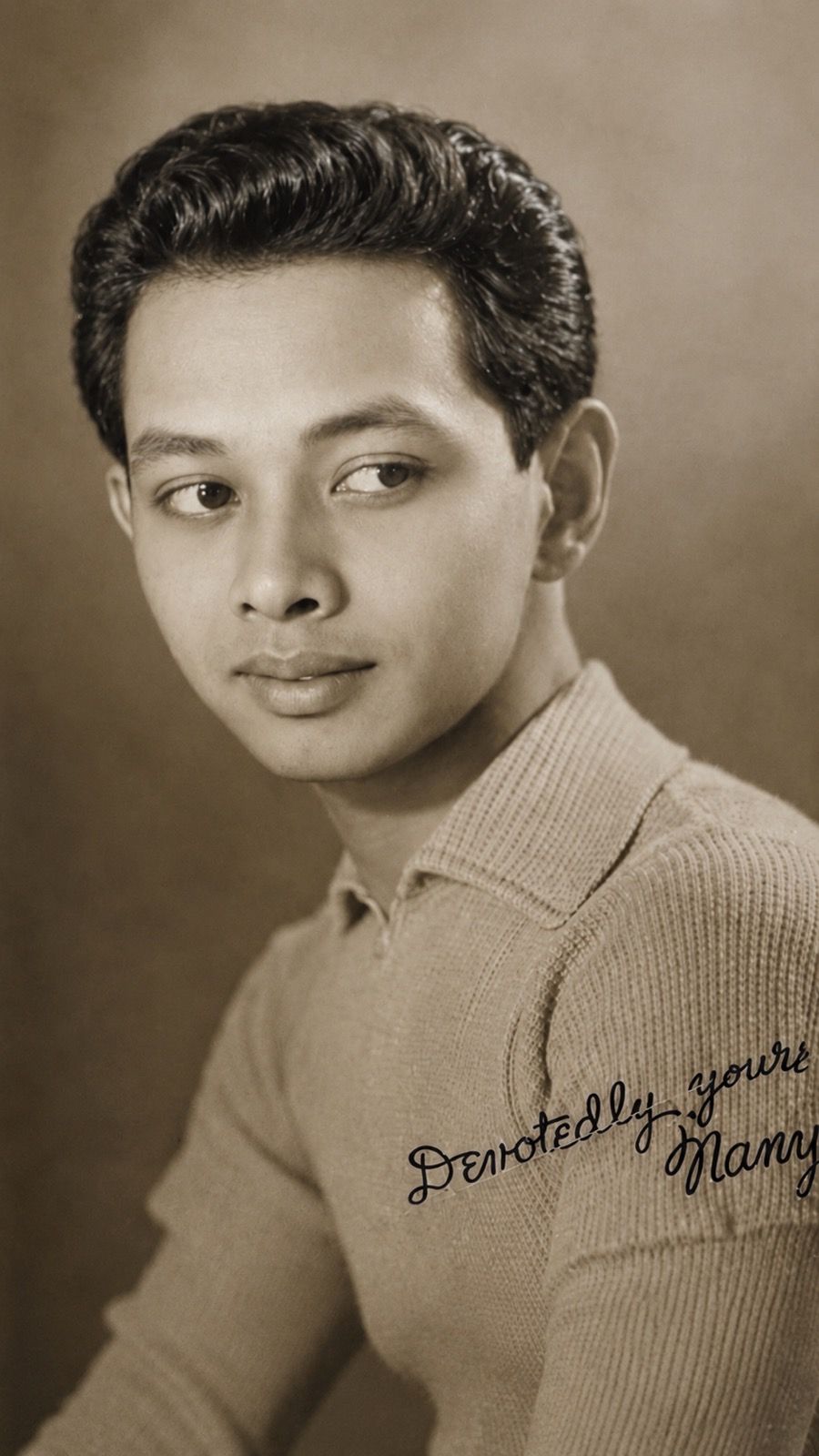
I never really got to know my father, but I learned a lot about him — from stories told by my siblings, from his journals, from old sepia photos where he’s dressed like a Beat poet (Allen Ginsberg eyeglasses, Jack Kerouac polo shirt, and such), from the books that he wrote (self-published volumes of plays, poems and biographies of local movie stars), as well as the ones he read and reread (from William Shakespeare to Edgar Allan Poe to Walt Whitman).
Papa was a graduate of the Philippine Military Academy and took up psychology in the University of the Philippines. “He would look at a person he just met straight in the eye and know right away if he or she has good intentions or wicked designs,” says my sister Jelly. She tells me my dad’s parents were rich, had Spanish blood, and were the first ones in their town to afford a car. I could just imagine it: the townsfolk putting a halt to their daily chores as they watched my father take the car for a spin.
The affluence was gone when he got married and had kids, too little money to spread around. “He was humble and advocated a simple life,” says Jelly, who ended up putting the rest of us through school along with my other sister Josie. A quiet man who led a quiet life. But my dad got into a lot of trouble in the places he worked in because he tended to point out the errors of his superiors, locking horns with his bosses lots of times, ending up on the road to another job. “If he felt he was right, he wouldn’t bow down to everyone,” she recalls.
Papa taught English (and I think either literature or philosophy) at National Teachers College in Manila and St. Louis University in Baguio. He collected books and published his own writings. He punched away at the keys of his old typewriter (maintained by a guy called Mang Along) up to the small hours, a pack of Camels for company. He did write-ups for Manila Times, Liwayway magazine and Bagong Buhay tabloid. My mother Elena remembers him as a good dancer and singer. “Only You” by The Platters was his favorite, recalls my brother Ramon. Josie remembers it as “Danny Boy.” Ramon says, “And whenever Papa watched TV and heard someone — a TV host or a politician — commit a grammatical error, he would point it out. ‘Parang pulis na walang batuta,’ is his favorite catchphrase.”
Josie reminisces, “I loved watching movies when I was a kid. Even if Papa was broke, he’d still come up with money just so I could go to the cinema, to stop me from crying. He would sing for me and we’d dance together during his free time. Whenever he drank a bottle of Coke, he always left some for me.” Alternating with my mom, Josie took care of Papa when he was confined.
Jelly remembers the same thing about Papa. “He made it a point to bring home pasalubong every day. His pockets were always full of toys and sweets for us — candies, raisins. Simple inexpensive things that for us would be unforgettable.”
Papa was a disciplinarian. He hated it when his kids cut classes to go to the movie-houses in Recto or Sta. Cruz, or hang out in canteens or eateries just to listen to the jukebox. My sister Jean says, “He would watch the ferris wheel from the window of our house to check if I was there (in one of the coaches). I remember one of his friends visited so he asked me to turn on the electric fan. I pressed the no. 3 button. Natangay nung malakas na hangin ’yung wig nung friend niya. Hinabol nila pareho ’yung lumilipad na wig (laughs). Papa scolded me after that.”
I am sure Dennis, Topet, Erlene, Jugy (when he was still alive) and my other siblings have fond memories as well. Papa loved Vic Morrow in Combat — must’ve reminded him of his exploits during the war. When he was a member of the Resistance movement, he got caught by the Japanese and imprisoned along with others in Fort Santiago. Jelly recalls, “They escaped by jumping into the river, but not before getting stabbed with a bayonet in the leg.” This left a big ugly scar.
Jelly adds, “When I was about to marry Aki, a Japanese, I was a bit nervous to ask for Papa’s blessing, considering what he and his family went through during the Japanese Occupation. But you know what? Papa accepted Aki with open arms, that’s how kind and broadminded he was.”
Before Papa died, he was reduced to this shell of a man. He couldn’t even reach for his cigarettes. He just sat all afternoon, staring out the window, probably thinking of stories he’d never get to write. The typewriter sat there gathering dust and years. The books, newspaper clippings and journals filled with his take on life and love were eroded away by flood and forgetfulness.
But the universe has its way of nudging us into remembering. Every day when I look in the mirror I am starting to resemble Papa’s old sepia photograph: the dark eyes, the furrowed brows, the nicotine-stained lips. And then off to work I go: traveling the lengths of Manila and its many confusions, earning my daily bread as a writer for this broadsheet, punching away at the keys of a Mac computer up to the small hours with the muse and a pack of Marlboros for company, doing sketches of dream houses and dream lives.
I never really got to know my father. But I get to learn about him by living every day.
A version of this story first appeared in The Philippine Star, 2008.


