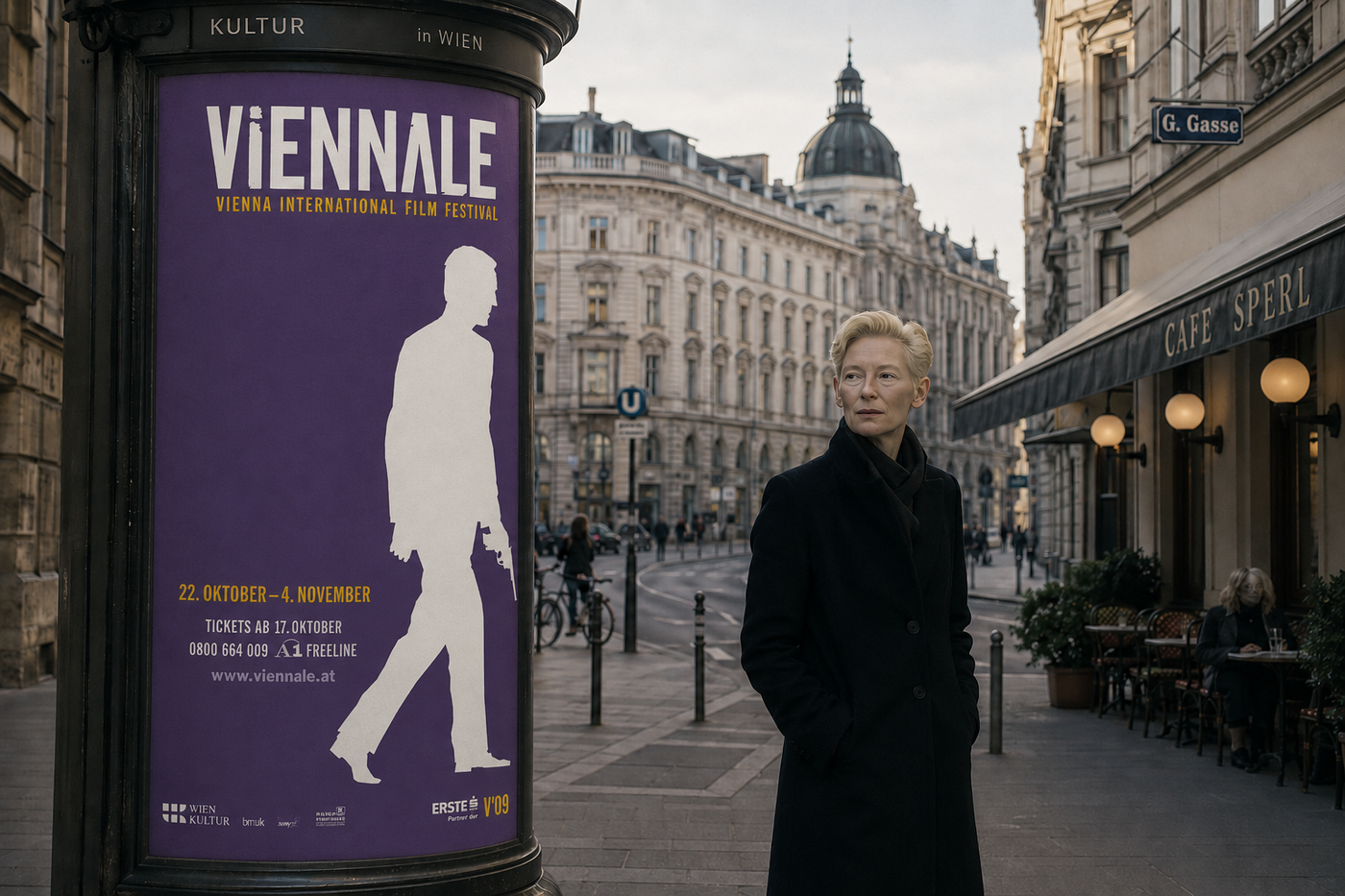
Vienna International Film Festival pays tribute to Brocka: V for Viennale
Autumn in Vienna for the Viennale: Lars von Trier’s Antichrist, Tilda Swinton retrospectives, and Nora Aunor on screen in Lino Brocka’s Bona.
Walking out of the Künstlerhaus theater after watching a particularly glum movie and into the gripping gloom of Vienna in autumn, a girl of Turkish descent tells me sagely: “Strange how most of the movies I’ve watched in the Viennale are set in autumn… in a forest. So every time I step out of the theater, it’s as if the movie hasn’t really ended.”
She’s right. A piece of really great cinema never really ends or goes away. It is lodged there in the hypothalamic theater.
In her “State of Cinema” address at the San Francisco Film Festival in 2006, actress Tilda Swinton answers her son’s question about what people’s dreams were like before films were invented. She tells the boy — a fan of movies and David Bowie — that the state of cinema is a dream state, that film is the art-form through which time becomes material, and that cinema is where the boy met and will meet Jean Cocteau, Buster Keaton, Jean-Luc Godard, Federico Fellini, and David Lynch for the first time, where the Pixar people live and the universe under the sea, where the boy saw China first.
“Our dreams are the place where we can remember that which we never realized we knew,” the actress writes. “And the prism through which we can reflect these visions — the trick of light, that alchemy of smoke of mirrors so much more than the sum of its parts — is what cinema is.”
Tilda then counsels the kid: “Never stop asking. Never stop moon-age daydreaming. Dream us the future, baby. Awaken our memories. Vote for Pedro. Dream on.”
The dreaming is endless, and the spool spinning in one’s head is infinite. In there, Alex the droog continues to wax beatifically about Beethoven; someone is singing a Roy Orbison song with lips unmoving; some guests are still trying desperately to get out of a party thrown by Buñuel; and Brando is about to do something erotic with butter.
In Vienna, I watched Lars von Trier’s Antichrist at the Gartenbaukino before heading for the Künstlerhaus and its images followed me like the hydrophobic hound of hell: a cabin in Eden, doomed lovers, mutilated genitals and all. All the while trailing a Handel aria. Just when you think cinema has lost some of its shock value because of the everyday upset of real life (zoomed into our living rooms by CNN, BBC, ABS-CBN), you watch Willem Dafoe’s penis spurting blood, Charlotte Gainsbourg putting a pair of scissors against her crotch, and… and… and you take part in the collective squirm in the darkened theater. Writhe on. Twist away. We are and will always be addicted to that rush.
Every year, at the twilight of October (from Oct. 22 to Nov. 4), filmmakers, film critics, cultural attachés, and an army of cineastes gather at the Austrian capital to indulge in great cinema at the Vienna International Film Festival, more commonly known as the Viennale.
Festival director Hans Hurch and his team have invited The STAR to cover this year’s Viennale. Here’s how the gig goes: From the Vienna Hilton where the journalists are billeted, we take a three-minute walk to Stubentor Parkring 2 ticket office, reserve seats in any of the five festival theaters (Künstlerhaus, Gartenbaukino, Metro, Urania and Stadtkino), and basically go from one moviehouse and into another around the Ring roads of Vienna to watch films to the heart’s delight. All kinds by all sorts: masters such as Francis Ford Coppola, Woody Allen, Werner Herzog, and Von Trier; promising new directors such as Julio Hernández Cordón from Guatemala and Alejo Moguillansky from Argentina; and outstanding Filipino filmmakers such as Khavn dela Cruz, Raya Martin, Brillante Mendoza and the great Lino Brocka (who is being feted with a tribute by the festival). Features. Documentaries. Short Films. An entire buffet of celluloid dishes. (My only quibble is whenever I go to the counter to reserve a seat for screenings all the must-see flicks are showing at the same time. This year’s roster is that good.)
The Viennale is not competitive with or complementary to other film festivals (such as Cannes, Venice, Berlin, Toronto, London, Rotterdam, etc.), but is an independent and — in a way — “ideal” film festival. Hurch explains, “Ideal in the sense of it being committed to one cause only: cinema, the history and presence of a form, the richness, surprises and originality of film.” He adds, “And I don’t like competitions between filmmakers. There is enough competition going on in the world right now.” The Viennale gives special prizes to films, but the festival doesn’t operate like the ones in Cannes and Venice.
Over coffee Hurch talks to me about his love for cinema.
“For me, each film is the festival,” he says. “I don’t make up an ideology or great idea for the festival. For us, the history of cinema is very important. So we don’t just show new films, but always in connection with old films.”
The majority of the films in the Viennale are new (world premieres, international first screenings), but there are also retrospectives (“The Unquiet American: Transgressive Comedies” from the US at the Filmmuseum), thematic showcases (early Austrian cinema organized by Filmarchiv Austria), and tributes.
The Viennale pays tribute to Tilda Swinton (who in her films slithers into roles from femme fatales to androgynous angels with ease), one shape-shifting, very versatile actress. There are screenings of some of her key films such as Caravaggio (a film by Derek Jarman), Orlando (Sally Potter), Man to Man (John Maybury), and Michael Clayton (the Tony Gilroy film for which Tilda won an Oscar for Best Supporting Actress in 2008).
Timothy Carey is also honored with screenings of Stanley Kubrick’s Paths of Glory, Bob Rafelson’s Head, and The World’s Greatest Sinner, the 1962 film in which director/writer/actor Timothy Carey stars as insurance salesman Clarence Hilliard who one day decides that every person is a superhuman being, so he renames himself “God” and establishes his own religion, political party and garage rock band. Musical score by a then-unknown Frank Zappa. One admirer says that Carey’s acting walks the tightrope between bursts of madness and total personal clarity. Much like Zappa’s music, I tell you.
There is, of course, the Lino Brocka tribute.
“Over the years, we’ve built up a very good public. There’s a big trust between the people and us,” he says. Thus, the Viennale offers more experimental fare, as well as showcases challenging documentaries. (The statistics would show that in the entire run of Viennale, 94,800 people attended the screenings. The number of sold-out screenings totaled 124 out of 345.)
“I like very much what Lino Brocka once said. He said, ‘I’m not interested in making the Great Filipino Cinema; I am interested in making the Great Filipino Audience.’ That’s what our fulfillment is with the Viennale — we have built a very good public, a lot of young people go and see the films. If somebody interferes with my work, I would really fight. I wouldn’t protect myself as much as I would protect the work of the filmmakers and the work of our staff.”
Epilogue
I am inside the Künstlerhaus theater about to watch a Lino Brocka movie in Vienna. The film is called Bona. It was released in 1980. I have seen it in chop-chopped versions on TV, and in appallingly grainy, scratched print in a moviehouse in Manila. This Viennese venue looks more ideal for ballet and chamber music. There are masks mounted on the walls, as well as sprawling Baroque paintings. Something breaks its high-artiness: in the darkened theater, someone goes, “Bakla, nasaan ka?” I feel at home already.
Almost everything about the movie is pure genius. You’d think at first that this is just some melodrama in the squatters’ area, some heavy-handed treatment about urban squalor. Hell no. The story draws you in, orbiting the viewers slowly into the bitter and burning ending. Philip Salvador as the narcissistic, feckless gigolo of an action movie extra named Gardo is brilliant. If you lived in Bona’s neighborhood, you’d surely have beaten him up — just for wearing those glam-rock white boots. This is Nora Aunor’s greatest performance. Ever. Her stares alone drive the film forward. Subtlety is a skill. And she was so beautiful in Bona, in all her gravely glory. A New York Times critic said the audience would realize that Gardo is a douche-bag five minutes into the film (well, he demands warm-water baths from Bona), while it would take Bona about 90 minutes. Well, this New Yorker obviously hasn’t met too many martyrs from Manila in his life.
I like the peripherals of the film: the Black Nazarene procession, Bona eating Chippy, Claire dela Fuente’s Sayang wafting from the radio, the stun of leopard-skin-print underwear and Sto. Niño statue in the abortionist’s house, and Gardo singing, “MacArthur’s Park is melting in the dark, all the sweet green ice cream flowing down.”
I walk out of the theater, into the gathering cold of the Viennese autumn, and tread the shortcut through Stadtpark (which is melting in the dark) back to my hotel. Weirdly this: I am sweating. Almost feeling the fatal boiling-water dousing that Bona gave Gardo by film’s end.
A piece of really great cinema never really ends.
A version of this story first appeared in The Philippine Star, 2009.


