Tradition takes a selfie with disruption
Olan Ventura & Ronson Culibrina take us to the visual edge and back in Olan’s ‘Prismatic Petals’ and Ronson’s ‘Marahuyo’ exhibitions at Goldenberg Mansion.
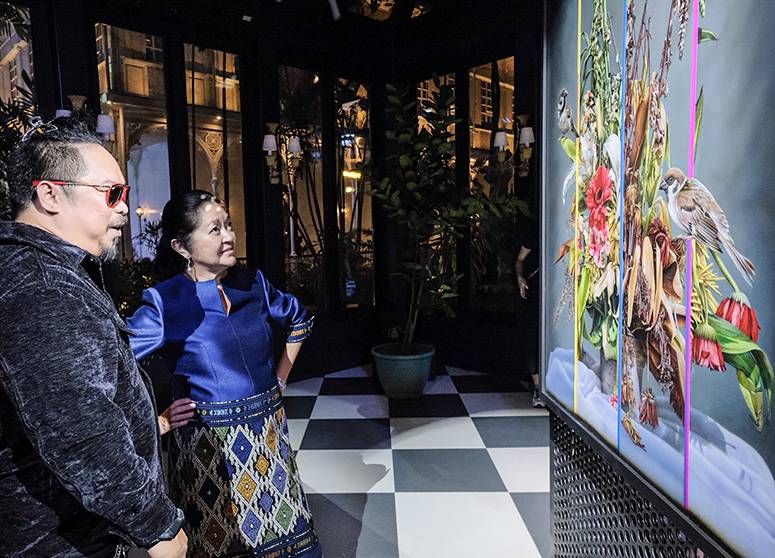
Filipino contemporary artists Olan Ventura and Ronson Culibrina recently mounted back-to-back exhibitions at the Goldenberg Mansion in Malacañang.
The pairing of these two artists—both redefining in their own way how we view Filipino heritage, identity, and aesthetics—feels like an apt conversation between past and present, chaos and beauty. As someone once mused, “It would be interesting if Tradition took a selfie with Disruption, and still looked stunning.”
At first glance, Olan Ventura’s still lifes appear familiar, even classical. But a closer look reveals a different story: Ventura’s floral compositions are anything but still. In Prismatic Petals, his flowers are dissected and interrupted, sliced into pieces by bands of vibrant color that evoke the glitch of a faulty screen or printer error. His work is a meditation on the fragmented nature of contemporary existence, where beauty and order are continually interrupted by the chaos of technology and modern life.
“Minsan kailangan mong sirain ang beauty para makagawa ng ibang uri ng beauty,” Ventura says of his process. His bold, deconstructed blooms force viewers to engage with the tension between nature and artificiality, between the calm of tradition and the frenzied pace of today’s world.
One of the standout pieces in the exhibition is a large-scale diptych, where delicate petals and stems are bisected by vertical bars of color. The composition feels digitally manipulated, as though a printer has malfunctioned mid-task. The effect is unsettling, but oddly mesmerizing.
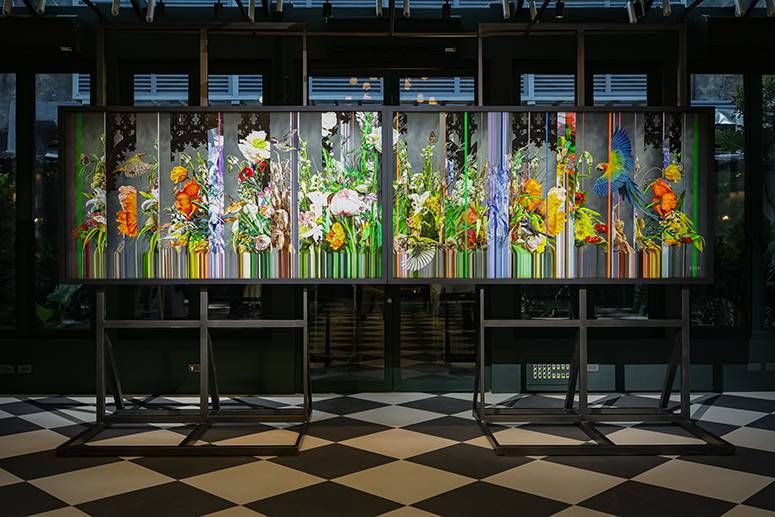
The Prismatic Petals collection can be seen as a commentary on the instability of beauty in the digital age, where every image we consume is subject to disruption, interference, and reinterpretation. Ventura’s use of fragmentation mirrors our contemporary experience: We live in a world of fractured realities, where the natural and the synthetic overlap, and where even the most timeless forms—like a simple flower—are filtered through the lens of technology.
Another way to interpret the pieces is how Olan presents—in a single frame—all the stages of the existence of flowers: from blossoming to decaying, akin to a deck of the ephemeral captured in a sequence of still shots.
Ventura’s fractured blooms invite us to see beyond the veneer of perfection, challenging us to embrace the imperfections—because in the end, sometimes the most captivating petals are those caught between the glitches.
Ronson Culibrina offers a radically different yet equally provocative take on Filipino identity. His latest series, Marahuyo, reinterprets the iconic works of Fernando Amorsolo, the Filipino master known for his idyllic rural scenes and portraits of the feminine form. But where Amorsolo romanticized these visions of a simpler, pre-colonial Philippines, Culibrina distorts and disrupts them, layering contemporary pop culture symbols onto the pastoral landscapes.
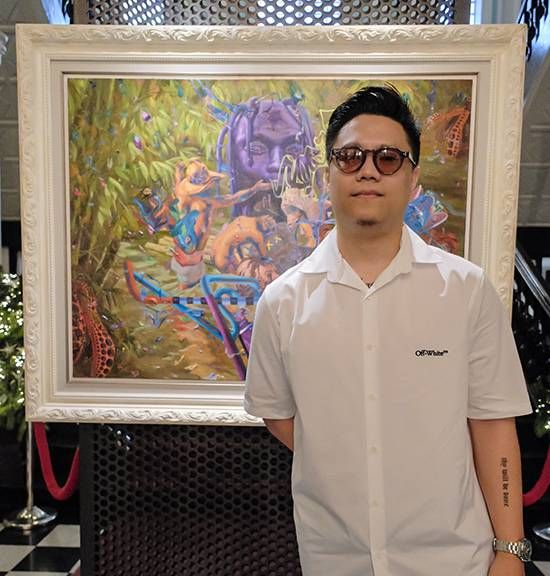
Culibrina’s Siesta, for instance, is a kaleidoscope of dots and splashes of Coca-Cola red. Mariposa becomes a deliberately, skillfully vandalized muse—complete with flowers and Louis Vuitton logo patterns. The traditional rural Philippines meets modern consumerism, and the resulting clash is both jarring and illuminating. Elsewhere, in Piging sa Ilog, a once serene riverbank scene is now splattered with a riot of images (from art, pop, and what-have-you), challenging the viewer’s perception of Amorsolo’s pristine portrayal of Filipino life.
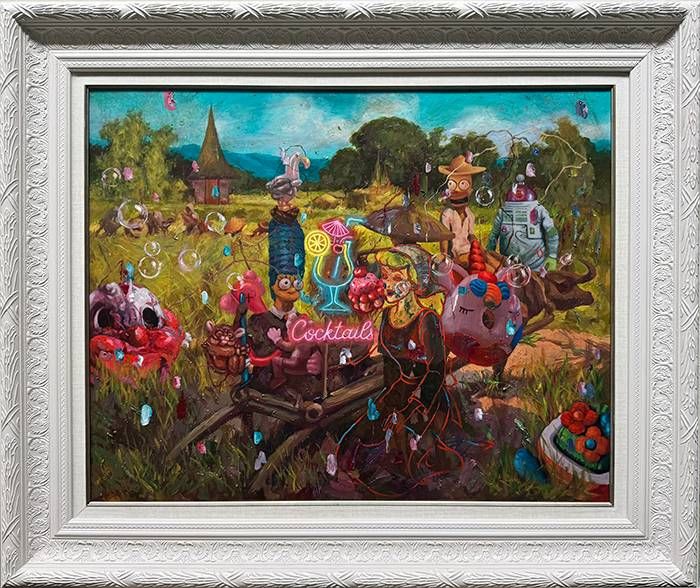
Marahuyo means “to be enchanted,” and in Culibrina’s hands, it is clear that enchantment is not a passive experience. By embedding pop cultural symbols within these quintessentially Filipino scenes, Culibrina invites viewers to consider how external influences shape, and sometimes distort, national identity in a globalized world.
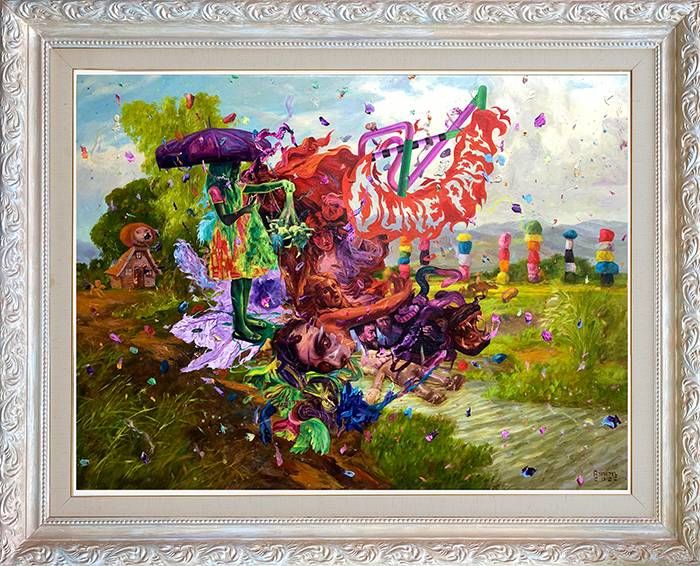
“I grew up with the everyday images of rural life,” Culibrina explains, referencing Talim Island in Laguna de Bay (a dagger-shaped piece of land inhabited by fisherfolk). “But later on, I realized that the Filipino experience is more complex. It’s not just about nostalgia; it’s about how we adapt, how we blend traditions with modernity, and how we navigate an increasingly interconnected world.”
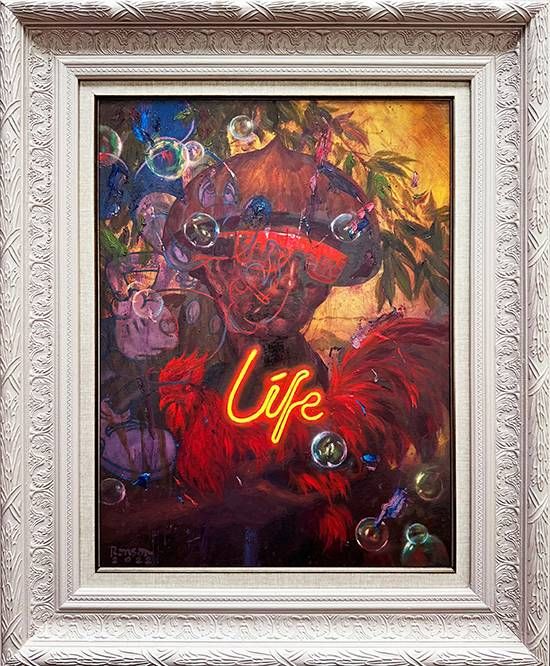
What links these two exhibitions—Ventura’s fragmented florals and Culibrina’s pop culture-laden Amorsolo interventions—is a shared fascination with disruption. Both artists grapple with the tension between the old and the new, the natural and the digital, the local and the global. And yet, within that tension, both find moments of clarity, maybe even unintended epiphanies.
Disruption, indeed, is the bane of serenity—and identity is the mother of intervention.
As Olan Ventura’s exquisite bouquets wilt by degrees or transform into grids, Ronson Culibrina’s idyllic rice fields are overtaken by the gradients of chaos and pop archetypes. It dawns upon us: how there is undeniable beauty in disruption, and chaos, lovely chaos, is arguably another form of order.
The show, part of the Goldenberg Mansion Art Series, was curated by Ruel Caasi and produced by Cloudgrey Gallery. Resonating with the artists’ aesthetic is the Goldenberg Mansion, a space that itself embodies a dialogue between history and modernity. Situated in the heart of Manila, the mansion is a testament to the city’s colonial past, now reimagined as a vibrant cultural hub. The proceeds of the back-to-back shows will go to the Girl Scouts of the Philippines.
A version of this story first appeared in The Philippine Star, 2024. Print edition.


